In the muddy plains of eastern Ukraine, the nature of warfare is undergoing a transformation unseen since the advent of gunpowder. It is no longer just about the courage of soldiers or the might of artillery. Today, the front line is increasingly inhabited by "iron soldiers" – unmanned ground vehicles (UGVs) and autonomous drones that make split-second decisions. What began as a necessity for survival against a numerically superior foe has evolved into a global Revolution in Military Affairs (RMA).
The Rise of Unmanned Ground Vehicles (UGVs)
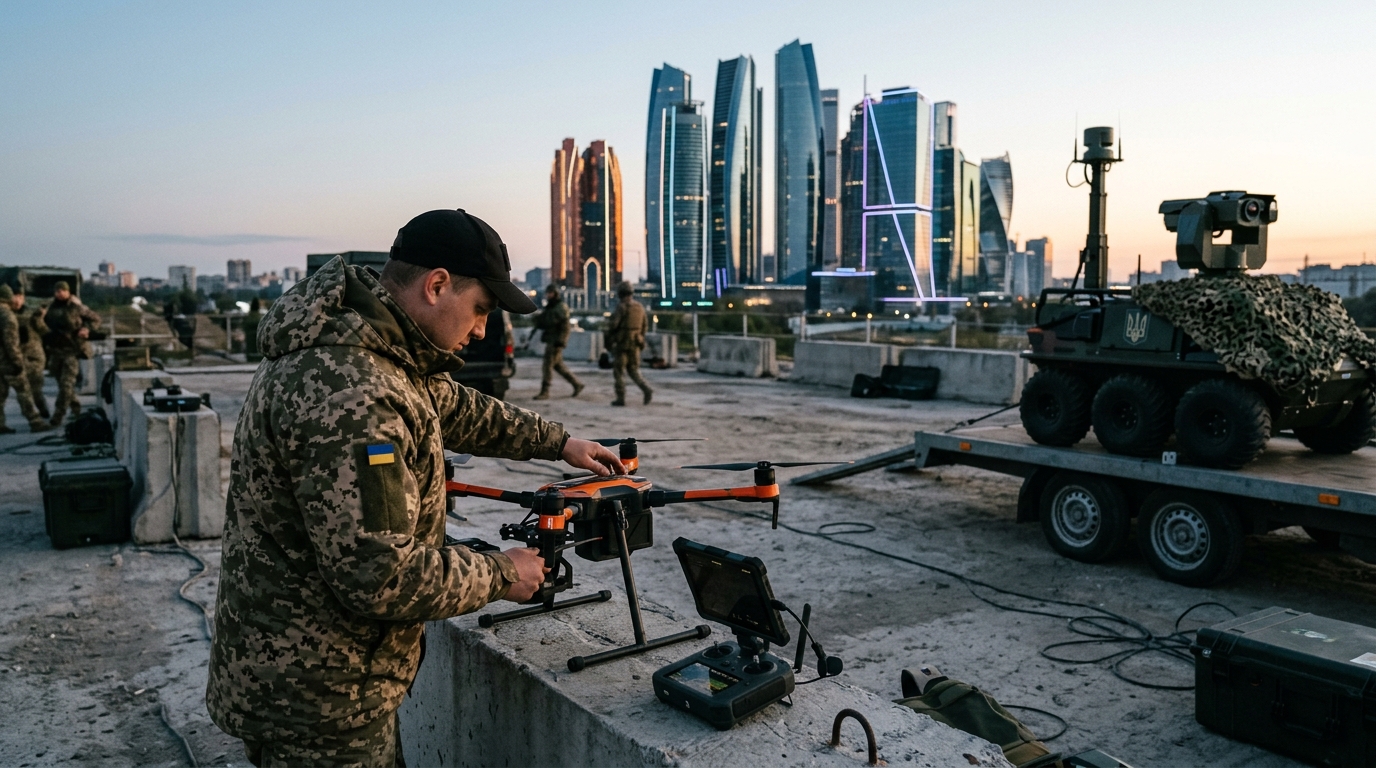
While aerial drones (UAVs) have dominated headlines for two years, the real innovation observed in 2026 is the maturation of ground-based robotic systems. Ukraine, through its Brave1 platform, has developed a suite of robots performing missions previously deemed impossible for machines. These robots are no longer simple remote-controlled toys. They possess advanced navigation algorithms allowing them to traverse minefields, evacuate the wounded, and set up machine-gun ambushes, all while their operators remain kilometers away in secure bunkers.
The use of UGVs solves one of the modern battlefield's greatest problems: the "last mile" of resupply. In areas where human movement is suicidal due to ubiquitous FPV drones, robots deliver ammunition and food with a minimal thermal and visual signature. However, the transition from logistics to direct combat is what sends shivers through the international community. Robotic turrets, equipped with thermal sensors and AI target recognition, can identify and neutralize threats with precision that exceeds human capability, while simultaneously reducing friendly fire incidents.
Artificial Intelligence vs. Electronic Warfare
The primary driver behind the push for full autonomy is Electronic Warfare (EW). Russian forces have deployed powerful jamming systems that "blind" remote-controlled drones, severing the link between operator and machine. Ukraine’s response has been the development of "autonomous terminal guidance." When a drone or UGV loses its signal, the onboard AI takes full control. Using computer vision, the robot recognizes the terrain and its pre-assigned target, completing the mission without any human intervention.
This technological leap creates a new dynamic: the war of algorithms. Victory no longer belongs to the side with the most tanks, but to the one with the superior code to bypass jamming. Data from the battlefield is fed daily into machine learning models, making the robots smarter by the hour. It is a real-time learning loop, turning Ukraine into a vast laboratory for Western defense industries. Software updates are now as critical as shell deliveries.
Ethical Dilemmas and the Future of Humanity
The emergence of Lethal Autonomous Weapons Systems (LAWS) brings humanity to a terrifying crossroads. If a machine can decide on life and death without human confirmation, who bears responsibility for a war crime? International organizations warn that we are drifting toward a world where war is conducted at speeds beyond human perception, making diplomacy and de-escalation nearly impossible.
Despite the outcry, the reality on the ground suggests that returning to the past is impossible. Robots offer an advantage no government can ignore: the preservation of political capital by reducing soldier casualties. In the future, armies may consist of small teams of specialists overseeing swarms of machines. Ukraine is not just a local conflict; it is the prelude to an era where human presence on the battlefield will be considered optional, if not a liability.
"We are not just building machines; we are building the future of our national survival. If the enemy uses mass, we must use intelligence," says a high-ranking official from the Ukrainian Ministry of Digital Transformation.
In conclusion, Ukraine’s robot soldiers represent the tip of the spear for a new global order. The technology being forged today under the pressure of existential threat will define the security of the coming decades. The question is no longer whether robots will fight, but whether we, as their creators, can still control the consequences of our creations.