For decades, the health of coral reefs was assessed using what could be described as a "dermatological" approach: scientists observed the surface. If the color was vibrant, the coral was deemed healthy. If it turned white, it was in peril. However, a groundbreaking new study, utilizing advanced 3D imaging and Artificial Intelligence algorithms, reveals a far more somber reality. Stony corals, the primary architects of reef ecosystems, may appear intact on the outside while their internal skeletal systems are collapsing from an invisible erosion.
The research, conducted by an international team of scientists using high-resolution micro-CT scans, demonstrates that climate change and ocean acidification are not merely causing the well-known phenomenon of coral bleaching. Instead, they are attacking the structural integrity of the organism from the inside out. Without the aid of AI, analyzing these thousands of three-dimensional data layers would have taken years of manual labor. Today, technology allows us to see the invisible in near real-time.
The Technology Behind the Discovery
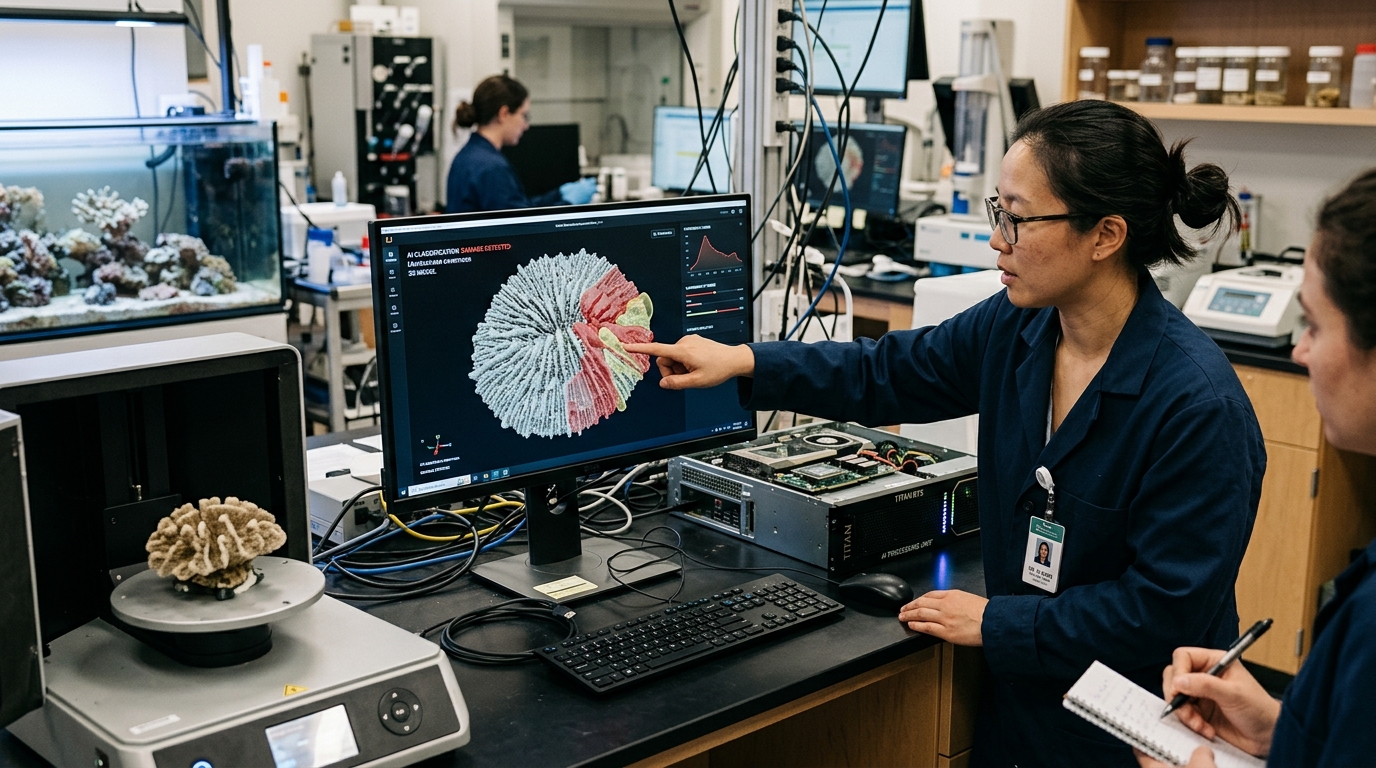
The use of Computed Tomography (CT) is not new to biology, but its application at an ecosystem scale was always prohibitive due to the sheer volume of data. This is where Artificial Intelligence steps in. Researchers trained neural networks to distinguish between healthy calcium carbonate and the voids created by bioeroding agents, such as boring sponges and microscopic boring organisms that thrive in warmer, more acidic waters.
The AI model can digitally "dissect" the coral and calculate the volume of internal loss with millimeter precision. The results were startling: in many instances, corals that appeared healthy in underwater photographs had lost up to 40% of their internal mass. This phenomenon, which scientists liken to "oceanic osteoporosis," leaves reefs extremely vulnerable to physical destruction. Even moderate tropical storms can now level entire structures that have been hollowed out from within.
Why Internal Erosion is a Critical Metric
Coral reefs are not just beautiful underwater landscapes; they are vital natural breakwaters that protect coastlines from erosion and flooding. When a reef's internal structure weakens, its ability to absorb wave energy diminishes dramatically. The study emphasizes that AI provides a "window into the future," allowing us to predict which reefs are at risk of total collapse long before the damage becomes visible to a diver's eye.
- Data Precision: AI reduces the margin of error in biomass estimation by 85% compared to traditional visual methods.
- Analytical Speed: Processes that once took months in a laboratory setting are now completed in a matter of hours.
- Predictive Modeling: Digital twins of corals allow for stress-testing against future climate scenarios and storm surges.
The significance of this research extends beyond pure science. It has immediate implications for environmental policy and coastal zone management. If current monitoring methods are underestimating the damage, then funding for reef restoration may be misdirected or woefully inadequate for the scale of the impending crisis.
The Ethical and Political Dimensions of Tech-Driven Monitoring
As Artificial Intelligence becomes our primary tool for understanding the ecological crisis, questions of responsibility arise. The knowledge of internal reef collapse removes any excuse for political inertia. We can no longer claim ignorance because the surface appeared serene. Technology is forcing us to confront the raw truth of human impact on the marine environment.
"AI doesn't save the reefs; it simply shows us how quickly we are losing them. Salvation requires political will that technology cannot substitute," noted one of the lead researchers of the study.
Looking ahead, the team plans to integrate this AI into autonomous underwater vehicles (AUVs) capable of performing these scans in situ, without the need to remove samples from the reef. This "non-invasive" biopsy of the oceans could radically change the game of global marine conservation, offering a live map of planetary health that will be impossible for governments to ignore. The transition from visual observation to deep structural analysis marks a new era in our desperate attempt to preserve what remains of the world's underwater rainforests.