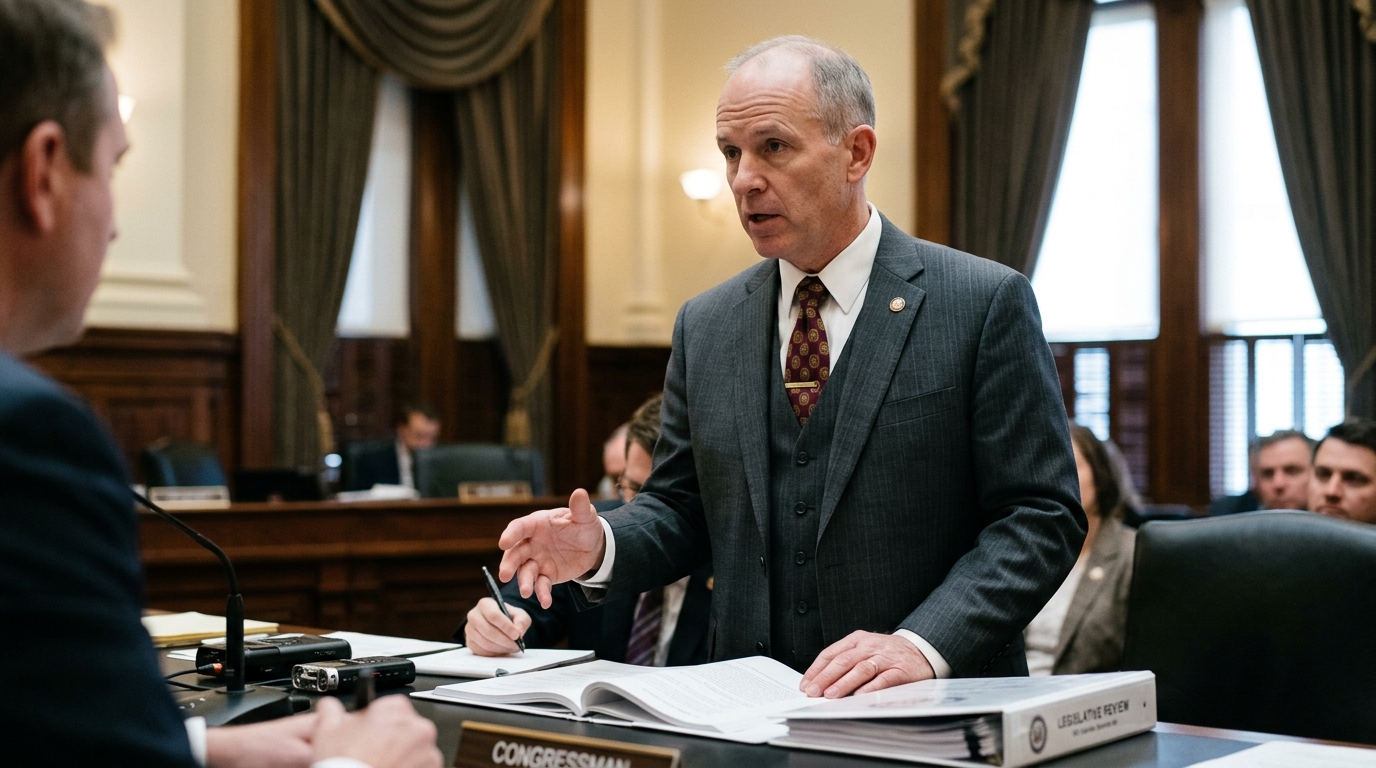
In an era where Artificial Intelligence (AI) is permeating every facet of our daily lives, from corporate boardrooms to operating theaters, a new frontline is being drawn in what many considered the final bastion of innocence: the nursery. Congressman John Curtis of Utah is leading a legislative charge to restrict or outright ban the use of advanced AI systems in toys designed for children, bringing to light the profound risks of perpetual surveillance and psychological manipulation.
The Legislative Core: Transparency and the 'Right to Obscurity'
Congressman Curtis’s proposal is not merely a Luddite reaction to emerging technology; it is a profound political statement on the boundaries of privacy. The proposed "AI in Toys Disclosure Act" aims to mandate that companies clearly label products utilizing generative AI to interact with children. However, Curtis goes further, suggesting that the very nature of AI—its capacity to learn, store, and process data—is fundamentally at odds with the developmental needs of childhood.
According to the congressman, parents are often unaware that a "smart" doll or a robotic companion is not just a plaything, but a data-harvesting node. These toys can record conversations, analyze emotional responses, and construct a granular profile of a child long before they even have their first email address. Utah, a state that has pioneered rigorous laws regarding social media and minor protection, serves as the ideal crucible for such federal legislation.
Privacy Concerns: The Bedroom as a Data Mine
The primary argument against AI-integrated toys centers on data security. Unlike adult devices, where consent—however perfunctory—is a legal requirement, children lack the capacity to understand that the secrets they whisper to a favorite toy are being converted into code and stored on remote servers. History has already provided warnings, such as the "My Friend Cayla" doll, which was banned in Germany as a "spy device" due to security vulnerabilities that allowed third parties to listen in on children.
p>With the advent of Large Language Models (LLMs), the risk has magnified exponentially. A toy capable of free-form dialogue could, inadvertently or through malicious exploitation, extract sensitive information about family life, daily routines, or home locations. Curtis argues that the toy industry has not demonstrated the requisite responsibility to handle such data, particularly when the underlying incentive is to further "train" proprietary algorithms using the most intimate human interactions.Psychological Impact: The Erosion of Imaginative Play
Beyond the legal and technical frameworks lies a deeper concern regarding developmental psychology. Experts warn that when a toy "thinks" and "responds" for the child, the process of free, imaginative play is fundamentally altered. Traditionally, a child projects a voice and personality onto their doll. With AI, the doll imposes its own pre-programmed personality onto the child.
- Technological Dependency: Forming deep emotional bonds with algorithms can lead to social withdrawal and a preference for simulated interaction over human connection.
- Subtle Manipulation: The ability of AI to mirror a child's temperament makes it a powerful tool for persuasion, which could be exploited for commercial or ideological purposes.
- Normalization of Surveillance: Introducing constant monitoring in early childhood conditions a generation to accept the absence of privacy as a natural state of being.
Curtis emphasizes that childhood should remain a "sacred space" where technology does not interfere with authentic human growth. His move reflects a growing skepticism toward "smart" technology that promises convenience but often extracts a heavy price in terms of individual autonomy and cognitive development.
Industry Pushback and the Road Ahead
Toy manufacturers, conversely, argue that AI can provide unique educational experiences tailored to each child's specific learning pace, assisting with language acquisition and problem-solving skills. They contend that draconian restrictions will stifle innovation and deprive children of the very tools they will need to navigate a future dominated by AI.
However, the legislative momentum from Utah is gaining traction. If Curtis succeeds in elevating these regulations to the federal level, it would represent a historic shift in consumer protection. The debate is no longer just about whether AI is "good" or "bad," but about where we must draw a red line to protect the most vulnerable members of society. Play, it seems, has become a very serious business indeed.