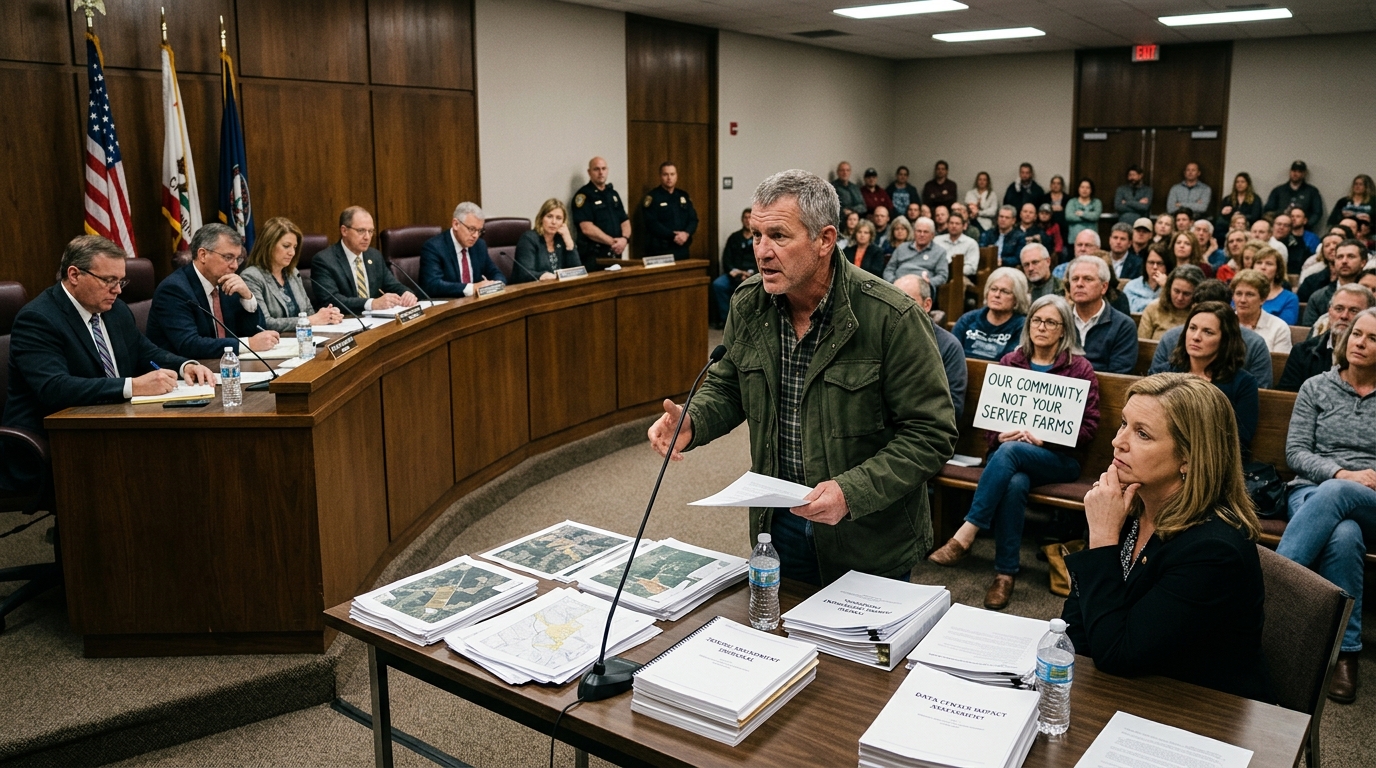
The global race for Artificial Intelligence (AI) supremacy is often depicted as a high-stakes battle of algorithms and sophisticated microchips. However, in the heart of the United States, this struggle is taking a much more physical and cacophonous form. The massive data centers—the physical cathedrals of the AI era—are facing an unprecedented wave of local opposition that threatens to derail the ambitions of Big Tech.
The Battle for 'Data Center Alley'
For decades, Northern Virginia, specifically Loudoun County, was a data center utopia. With 70% of global internet traffic passing through the region, the local economy thrived on tax revenue. But the dawn of Generative AI has fundamentally shifted the landscape. The demand for raw computing power has skyrocketed, leading to the construction of gargantuan facilities that now sit uncomfortably close to residential neighborhoods and schools.
Residents are no longer just complaining about eyesores. The incessant hum of cooling systems, the staggering water consumption during droughts, and the immense strain on the electrical grid have turned passive acceptance into active hostility. In Prince William County, local council meetings now stretch into the early hours of the morning as hundreds of citizens demand a moratorium on new developments.
Energy Hunger and Environmental Costs
AI is energy-intensive in a way that traditional computing never was. A single query to ChatGPT consumes roughly ten times more electricity than a standard Google search. This 'thirst' is forcing utility companies to rewrite their playbooks, sometimes delaying the decommissioning of coal-fired power plants to meet the surging demand.
- Water Usage: Cooling systems require millions of gallons of water daily, raising alarms about local aquifer levels.
- Grid Stability: In states like Georgia and Arizona, energy demand forecasts for the next decade have doubled, primarily due to proposed data center campuses.
- Noise Pollution: The massive cooling fans produce a constant, low-frequency drone that residents describe as a form of psychological torture.
"We aren't anti-technology, but we cannot sacrifice our quality of life and our natural resources just so a company in Silicon Valley can train its models," says a local activist in Virginia.
Political Implications and the AI Bottleneck
This resistance is no longer confined to local town halls; it is climbing the political ladder. State legislators across the country are introducing bills to tighten zoning laws, demanding that tech companies invest in their own renewable energy sources and prove that their presence won't drive up utility bills for everyday consumers.
For giants like Microsoft, Google, and Amazon, this represents an existential threat. If they cannot build the infrastructure, they cannot scale AI. The industry's response has been to scout more remote locations or invest in radical cooling technologies and Small Modular Reactors (SMRs). However, the clock is ticking, and the social license to operate is wearing thin.
Conclusion
The collision between digital progress and local sustainability highlights a fundamental truth: AI does not live in 'the cloud'; it lives on the ground. The success of the next phase of the technological revolution will not be decided solely in research labs, but in the ability of tech giants to convince local communities that they are good neighbors, rather than merely energy-hungry tenants.