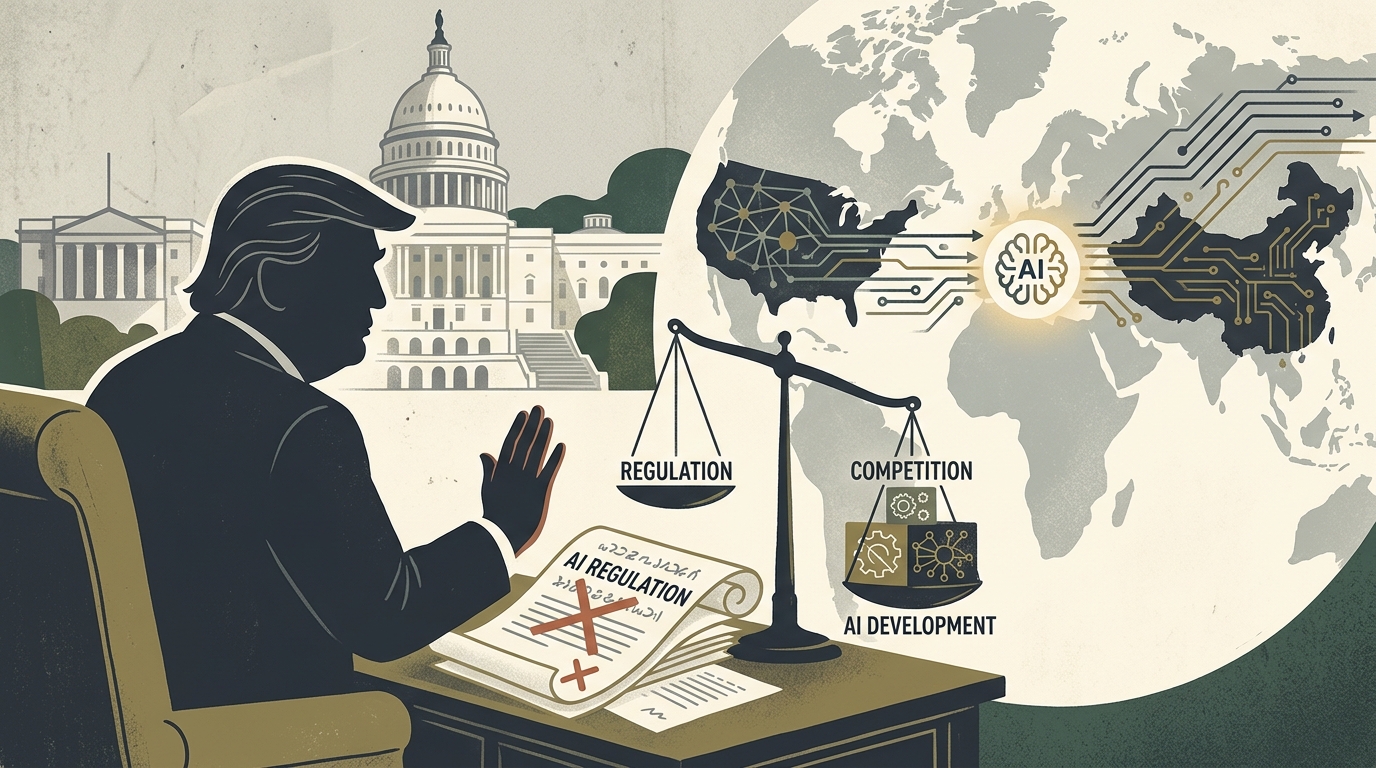
In a move set to redefine the global technological landscape, President Donald Trump has decided to postpone the signing of a long-anticipated executive order on Artificial Intelligence. The official reasoning, as reported by Reuters, centers on the imperative for the United States to maintain its dominance over China, avoiding regulatory hurdles that could stifle domestic innovation.
The Geopolitics of Compute
This decision is not merely a bureaucratic delay; it is a clear statement of intent. In the 2026 'America First' doctrine, AI is not viewed as a tool in need of a leash, but as the ultimate weapon in the economic and military cold war with Beijing. White House advisors argue that any attempt to impose strict safety standards or ethical boundaries would be 'suicidal,' offering the Chinese Academy of Sciences and giants like Baidu and Huawei the chance to close the gap.
China has already invested billions in AI infrastructure, aiming to become the global leader by 2030. For the Trump administration, regulating AI at this stage is akin to restricting nuclear research during the Manhattan Project. The strategy is clear: dominance first, safety discussions later.
Deregulation and the Silicon Valley Reaction
The postponement has been welcomed by a significant portion of Silicon Valley, particularly those championing the 'effective accelerationism' (e/acc) movement. Companies previously pressured by guidelines regarding algorithmic transparency and training data audits now see a clear path forward.
- Freedom to Develop: The lack of federal oversight allows companies to experiment with larger models without fear of fines or shutdowns.
- Capital Attraction: Investors view deregulation as a green light for massive deployments into AI startups.
- National Security: Closer collaboration between the Pentagon and tech titans is now the priority, with AI being integrated into every level of defense strategy.
"We cannot afford the luxury of excessive caution when our adversaries are playing by no rules at all," a senior administration official stated.
The Risks of 'Blind' Speed
However, this decision is not without its detractors. Scientists and ethics experts warn that unleashing AI without safeguards poses existential risks. The potential for autonomous weapon systems, mass-produced disinformation, and the erosion of privacy are issues that critics argue are being sidelined in the name of competition.
The European Union, which has already implemented its AI Act, now finds itself in a difficult position. The US decision to follow a path of deregulation creates a technological rift across the Atlantic, forcing European companies to choose between compliance with strict EU rules and the competitiveness offered by the American model. May 21, 2026, will be remembered as the day Washington chose power over precaution, laying the groundwork for a new era of technological confrontation.