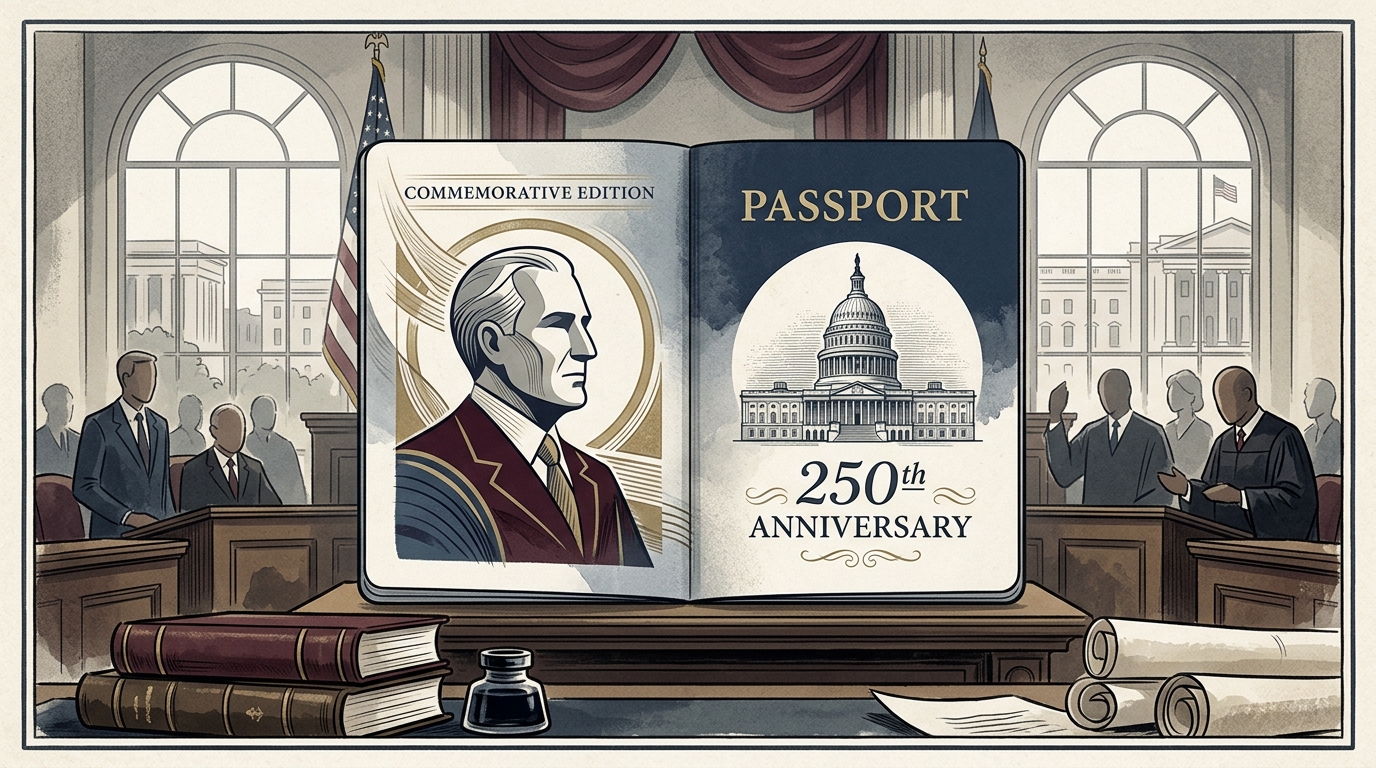
As the United States approaches the historic milestone of July 4, 2026, the administration has moved forward with a decision destined to be remembered not only for its celebratory nature but for the intense political firestorm it has ignited. The new "Semiquincentennial Passport" is more than just a travel document; it is a political manifesto printed on polycarbonate. For the first time in modern history, the image of a sitting or recent President, Donald Trump, is being integrated into the design of a document that has traditionally remained neutral, focusing on national symbols like the bald eagle and the Statue of Liberty.
The Grand Anniversary and the Aesthetics of Power
The 250th anniversary of the signing of the Declaration of Independence is a milestone that any administration would want to brand with its own legacy. However, the choice to include Donald Trump’s face in a special edition of the passport breaks long-standing norms. According to the official announcement, this move is intended to honor the "rebirth of the American spirit" and a return to "America First" values. The passport features a central spread where the President’s portrait appears using Optically Variable Inks (OVI), which shift colors based on the angle of light, framed by excerpts from his speeches on national sovereignty.
The document's aesthetics are designed to project strength. Beyond Trump’s visage, the visa pages feature illustrations of major infrastructure projects, the American wilderness, and scenes from the 1776 Revolution. Criticism from Democrats was immediate and sharp, citing the "weaponization of the state" and a "slide toward a cult of personality" reminiscent of authoritarian regimes. Conversely, supporters argue that Trump is the architect of the modern American resurgence, and his presence on the document symbolizes the nation's newfound resilience in a multipolar world.
Breaking Centuries of Tradition
Historically, U.S. passports have avoided depicting living persons. Tradition dictated that the document belonged to the people and the state, not the transient leadership. Even during the Bicentennial in 1976, the design focused on the historical heritage of the Founding Fathers. This current shift marks a profound change in how the U.S. perceives its global image. A passport is the nation's "face" abroad; placing Trump on it sends a clear message to international allies and adversaries about who holds the reins of the superpower.
- The new passport will be issued as an optional choice for citizens, alongside the classic version.
- It features 50 distinct security elements, making it the most counterfeit-resistant document in the world.
- The application fee includes a $50 surcharge, with proceeds funding the national Semiquincentennial celebrations.
High-Tech Security Engineering
Beyond the political dimension, the new passport is a technological marvel. It incorporates a new biometric chip with quantum-resistant encryption, designed to protect citizen data from future cyber threats. The data page is constructed from seven layers of polycarbonate, where the holder’s photo and the President’s portrait are laser-engraved, creating a tactile, 3D effect that is impossible to replicate with conventional printing methods.
"This is not just a document. It is a symbol of American excellence in the 21st century," stated a high-ranking State Department official during the unveiling ceremony in Washington.
The use of Artificial Intelligence in verifying watermarks allows border agents worldwide to authenticate the document within milliseconds. However, analysts warn that the high degree of politicization of such a document may cause friction in certain countries where the American President’s image remains controversial, potentially leading to more rigorous secondary screenings for holders of this specific edition.
Global Soft Power and the America First Legacy
As the first batches of the new passports are set to be delivered to citizens in May 2026, the debate over American identity reaches a fever pitch. In an era of intense polarization, even a travel document becomes a battlefield. For many Americans, the new passport is an object of pride, a memento of a historic era. For others, it is a stark reminder of the division permeating the country. What is certain is that the 250th anniversary of the United States will be celebrated in a way that won't be easily forgotten, leaving an indelible mark—literally and figuratively—on the pages of history.