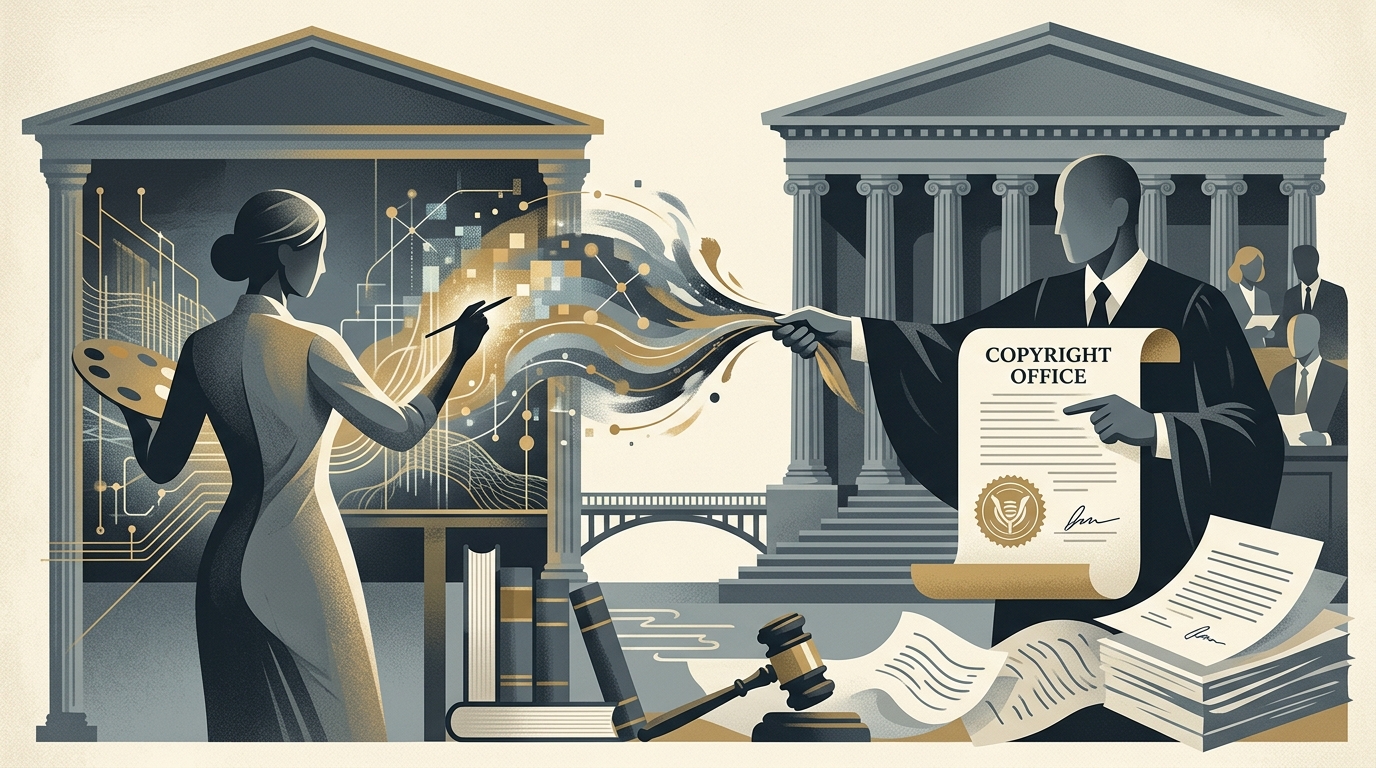
The history of art is punctuated by moments where technology forced legislators and critics to redefine the very essence of "creation." From the advent of photography in the 19th century to the use of synthesizers in music, resistance to the new is a historical constant. However, the case of Jason M. Allen and his work "Théâtre D'opéra Spatial" represents something far deeper: a head-on collision between the traditional concept of human authorship and the emerging reality of generative artificial intelligence (AI).
Allen, who famously won first place in an art competition at the Colorado State Fair in 2022 using the Midjourney tool, recently filed a lawsuit against the U.S. Copyright Office (USCO). This move follows the Office's repeated refusal to register his work, arguing that it lacks the requisite "human authorship." This case is not just about a single painting; it is about the future of the entire creative industry.
The Nature of Creativity in the Age of Prompts
Allen's central argument focuses on the complexity of the creative process. According to him, "Théâtre D'opéra Spatial" was not the result of a simple button press. It required hundreds of prompt iterations, weeks of refinement, and the use of Adobe Photoshop to correct details and upscale the image. Allen contends that the AI was merely a "tool," much like a camera or a brush, and that the creative direction belonged exclusively to him.
On the other hand, the USCO remains tethered to the principle that copyright requires "human intellectual effort" to the extent that the machine is not the primary creator. In its decision, the Office stated that because Midjourney generates images based on algorithmic probabilities rather than specific instructions for every pixel, the final output cannot be protected. This distinction between "instruction" and "execution" is at the heart of the legal dispute.
Legal Precedents and the Shadow of Thaler
Allen's lawsuit does not exist in a vacuum. It follows the case of Stephen Thaler, who unsuccessfully tried to register his AI as an "inventor" and "author." However, Allen's case is different: he does not claim the AI is the creator, but that he is the creator *through* the AI. The ruling in *Thaler v. Perlmutter* (2023) confirmed that works created solely by machines are not eligible for protection, but it left a window open for works with "significant human involvement."
The question the court must now answer is: Where is the line drawn? If an artist spends 100 hours perfecting a prompt, is that any less "creative" than someone taking a candid photograph on the street? Photography was once dismissed as "soulless mechanical reproduction" until the U.S. Supreme Court ruled in 1884 (Burrow-Giles Lithographic Co. v. Sarony) that the photographer controls composition, lighting, and pose, thus making them an author.
Economic and Social Implications
If Allen wins, it will pave the way for the mass registration of AI works, potentially flooding the market with copyrighted content produced at minimal cost. This prospect terrifies traditional illustrators and artists, who see the value of their labor threatened. Conversely, if he loses, companies investing billions in AI will find themselves in a gray zone, where their generated outputs belong to the public domain, making commercial exploitation difficult.
In Europe and Greece, the debate is equally intense, with the AI Act setting strict transparency rules. The decision in the Allen case will undoubtedly influence international jurisprudence, as art knows no borders in the digital age. "Théâtre D'opéra Spatial" may have started as an experimental image, but it is now the banner of a revolution seeking recognition.
"I will not stop until my creative input is recognized for what it is: art," Allen stated outside the courtroom.
In a world where the boundaries between human and machine are becoming increasingly blurred, the judiciary is called upon to define the essence of human expression. Is art the result of physical labor and the movement of the hand, or the conception of an idea realized through sophisticated tools?