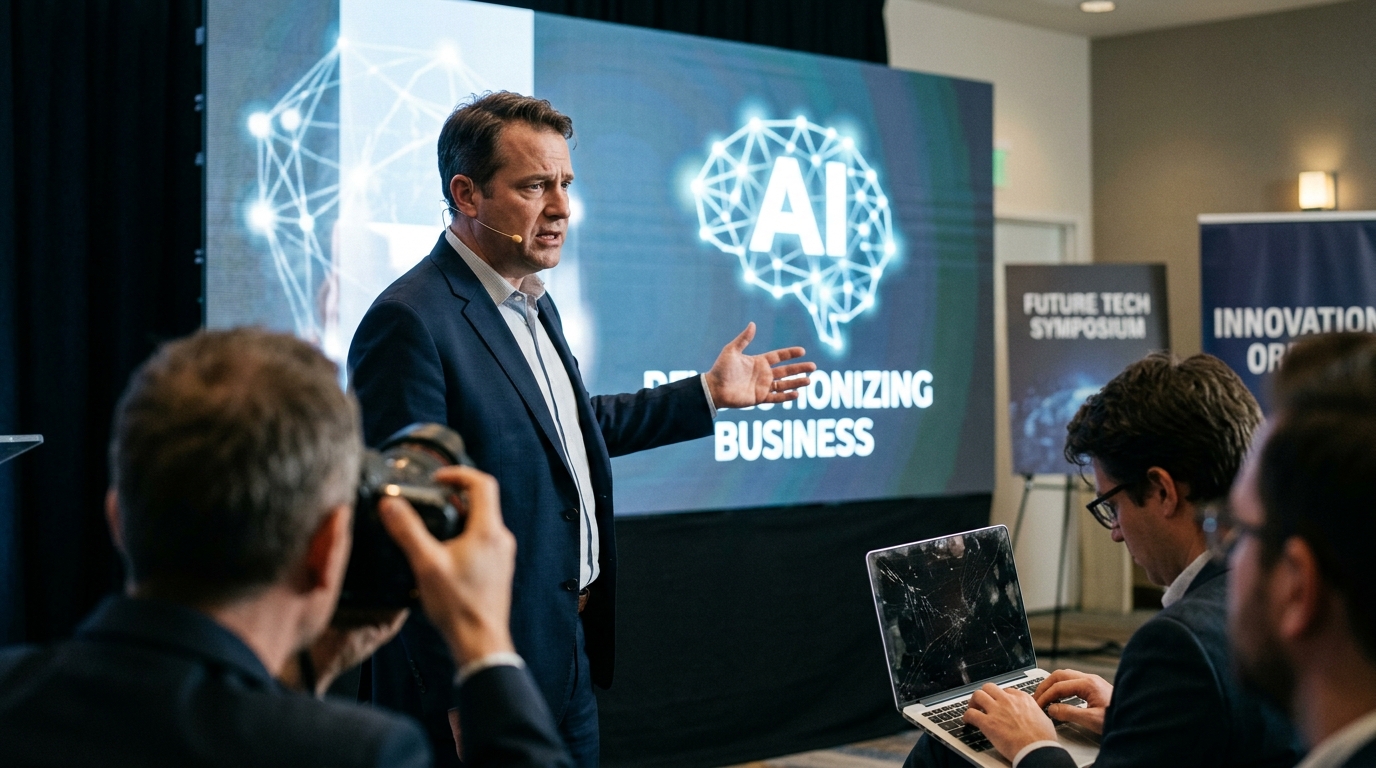
History often repeats itself, frequently with the same momentum but under a different guise. Just as the addition of ".com" to a company's name in the 1990s was enough to send its stock price soaring, and just as "greenwashing" later became the tool for a disingenuous ecological conscience, today we are witnessing the rise of "AI washing." This is the practice of firms exaggerating or lying about their use of artificial intelligence in their products and services, seeking to reap the benefits of the current investment fever.
The Anatomy of an Illusion
AI washing is not merely innocent marketing. It is a strategic choice aimed at capitalizing on investor FOMO (Fear Of Missing Out). According to recent analyses, an alarming number of businesses—from startups to retail giants—claim to use "advanced machine learning algorithms" or "autonomous decision-making" when, in reality, their processes rely on simple Excel spreadsheets or traditional automation that has existed for decades.
The distinction between genuine innovation and promotional noise is becoming increasingly blurred. For the average consumer or non-specialist investor, terms like "Generative AI" and "Neural Networks" sound like magic. Companies are well aware of this and exploit the ambiguity of these terms. As market experts point out, if a company claims its AI "solves all problems," it likely does none of them.
"AI washing is a threat to market integrity. When promises do not meet reality, trust in technology collapses, dragging down those who are producing genuine work with it."
Regulatory Crackdown
The situation has reached a point where regulators worldwide have begun to take action. The U.S. Securities and Exchange Commission (SEC) has already imposed fines on investment advisory firms that falsely claimed to use AI for client data analysis. Gary Gensler, Chairman of the SEC, was blunt: "Don't do AI washing. If you're using an AI model, say so. If not, don't say it."
In Europe, the EU AI Act sets strict transparency frameworks. Companies will not only be required to prove their technology is safe but also that it is what they claim it to be. Misleading consumers about the capabilities of an AI system could soon result in fines reaching up to 7% of a company's global turnover. This strictness is necessary to avoid a systemic crisis of confidence.
- Exaggerated Claims: Promises of "human-like intelligence" in simple chatbots.
- Opaque Processes: Refusal to explain how an algorithm actually functions.
- Rebranding Old Tools: Labeling 1990s-era statistical models as "cutting-edge AI."
- Investment Deception: Using the term AI in shareholder presentations without any impact on actual production.
The Risk of a New Bubble
The question looming over Silicon Valley and global stock markets is whether AI washing is a precursor to a major correction. When company valuations are based on keywords rather than revenue or actual efficiency, the market becomes fragile. The Theranos saga remains a fresh reminder of what happens when technological "magic" turns out to be fraud.
Furthermore, this phenomenon stifles real innovation. Startups developing meaningful solutions in healthcare, climate change, or materials science are forced to compete in a noisy space filled with "digital charlatans." Purging the market of AI washing is not just a legal mandate but a moral necessity for the survival of technological progress itself.
Conclusion: A Return to Substance
As we move into the latter half of the 2020s, market maturity will be judged by its ability to separate the wheat from the chaff. Investors are becoming more cautious, demanding proof of concept and detailed technical audits before committing capital. The era when the word "AI" opened every door is ending. In its place comes an era of accountability, where technology must prove its value in practice, not just in press releases.