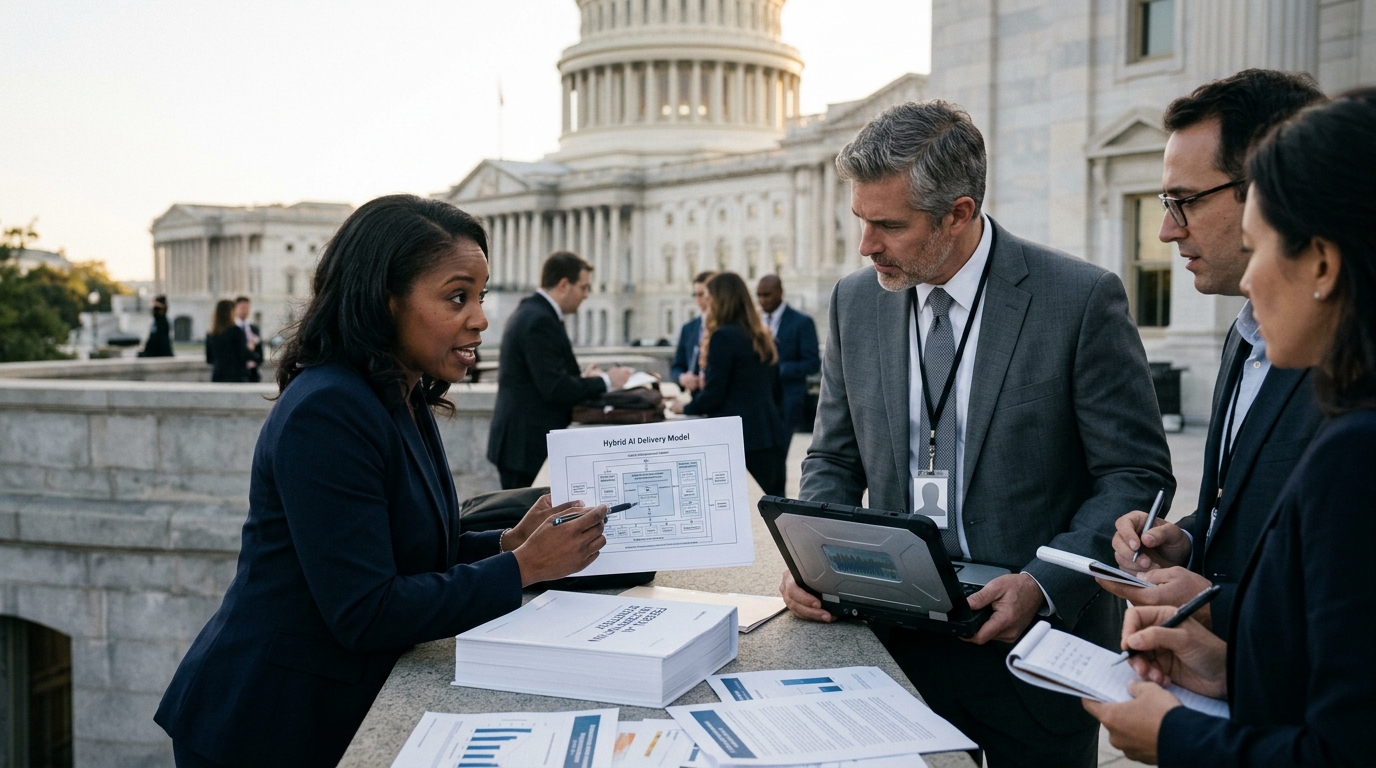
The era of experimentation with Artificial Intelligence (AI) in the public sector is drawing to a close, making way for a more mature, strategic approach. As we navigate through 2026, the conversation in global capitals has shifted from whether to adopt AI to how to integrate it in a way that guarantees operational continuity and national security. The "Hybrid by Design" model is emerging as the answer to the challenges of scale, privacy, and the avoidance of vendor lock-in.
The Architecture of Digital Sovereignty
For decades, federal IT relied on a binary choice: either on-premise for maximum security or public cloud for speed and flexibility. AI, however, demands a third path. The hybrid model now proposed by leading technocrats combines the computational power of major cloud providers with the rigorous data protection of government-owned data centers.
According to recent analyses, this approach allows government agencies to train specialized Small Language Models (SLMs) on sensitive data within their own perimeters, while utilizing large language models (LLMs) for general text processing and citizen services. This separation is not merely technical but deeply political, ensuring that the state's "memory" remains under sovereign control.
- Interoperability across multiple cloud providers.
- Utilization of local infrastructure for classified information.
- Integration of open-source models to drive down costs.
- Strict data governance through automated compliance checks.
From Cloud First to AI-Native
Transitioning to a hybrid model requires a radical overhaul of procurement strategies. Traditional IT contracts, often spanning decades, are ill-suited for the pace of AI evolution. The new delivery model promotes the use of modular architectures. This means an agency can swap one AI model for a newer, more efficient one without having to rebuild its entire infrastructure.
"Artificial Intelligence is not a product you buy and put on a shelf. It is a living organism that requires constant data feeding and regular tuning," notes a senior analyst at the Federal News Network.
Furthermore, the emphasis is now on Edge AI—running AI models directly on devices or local servers, away from centralized data centers. This is critical for applications in national defense, emergency response, and healthcare, where data latency can have fatal consequences.
The Talent and Ethics Challenge
Despite technological progress, the greatest hurdle remains the human factor. Building a hybrid system requires skills that are scarce in the labor market: data engineers, AI cybersecurity specialists, and legal experts who understand the implications of algorithmic decisions. Governments must compete with the private sector to attract this talent, offering not just salaries but the incentive of serving the public good.
Finally, the ethical dimension remains front and center. The hybrid model provides a safety valve: by allowing control over training data, authorities can mitigate bias and ensure that AI-driven decisions are transparent and explainable. In an age where trust in institutions is being tested, the technical integrity of AI is a prerequisite for the democratic legitimacy of its use.