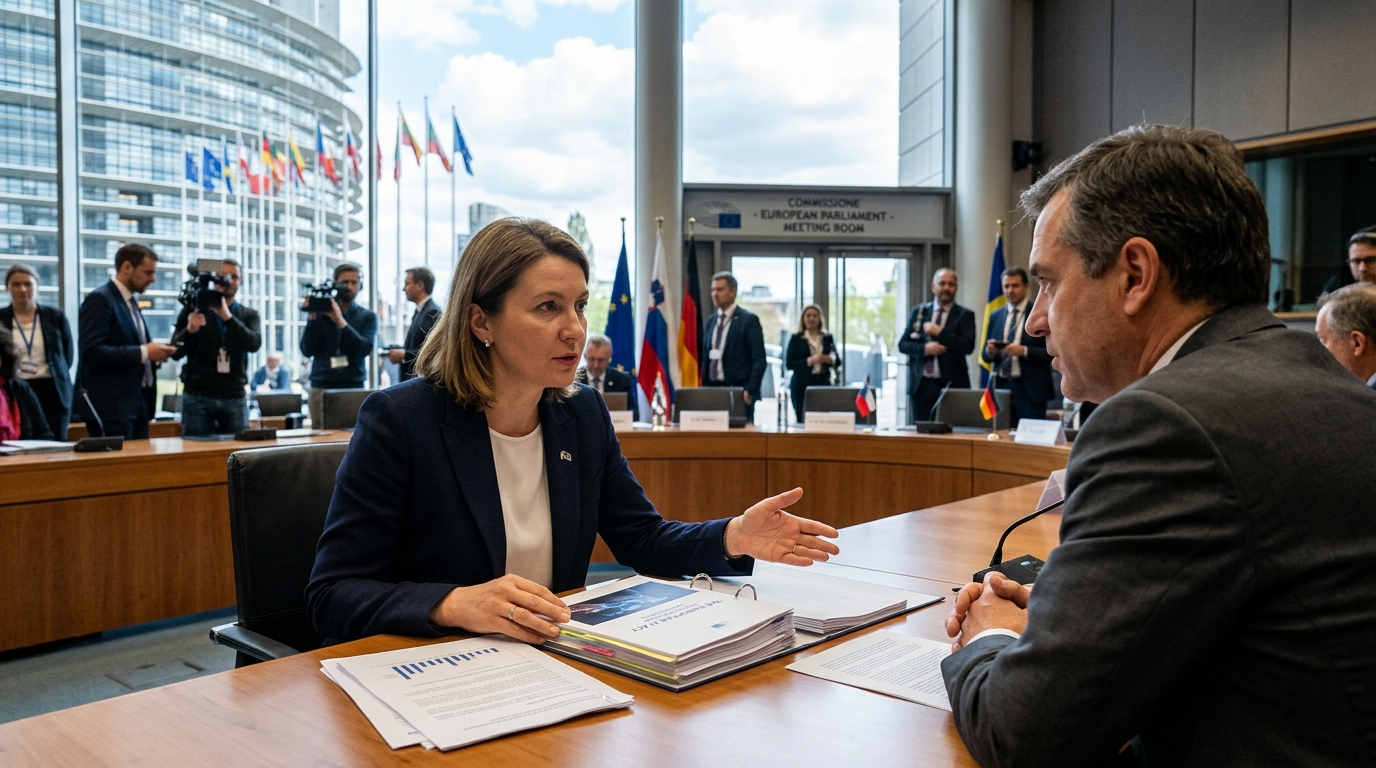
As we navigate the first half of 2026, the global geopolitical chessboard of technology is no longer defined solely by raw computing power or data volume, but by a fundamental philosophical conflict. On one side, the Silicon Valley model—historically driven by the 'move fast and break things' mantra—aims for the achievement of Artificial General Intelligence (AGI) at any cost. On the other, the European Union is solidifying its own 'Human-Centric Model,' an approach that treats AI not as an autonomous deity, but as a tool in the service of social cohesion and individual liberties.
The Regulatory Fortress and the 'Brussels Effect'
The full implementation of the EU AI Act has radically altered the landscape. While critics initially feared that over-regulation would stifle innovation, the reality of 2026 suggests otherwise. Europe has successfully wielded the 'Brussels Effect': global corporations are forced to adopt European standards of transparency and ethics to maintain access to the single market. Requirements for algorithmic explainability and the ban on social scoring systems have become the new global norms.
The European vision is not just about constraints; it is about creating an ecosystem of trust. According to recent studies, European consumers show an increased preference for AI applications carrying the 'Ethical AI' certification, viewing it as a guarantee of privacy protection. This 'human side' of technology is transforming from a burden into a competitive advantage, attracting talent who wish to work on projects with genuine social impact.
The Battle for Digital Sovereignty and the Rise of National Champions
Europe is no longer content with being just a regulator. The rise of companies like Mistral in France and Aleph Alpha in Germany proves there is room for European Large Language Models (LLMs) that respect linguistic diversity and local culture. The 'Digital Sovereignty' strategy aims to reduce dependence on American cloud infrastructure and establish an independent European network of supercomputers.
- Investment in Open Source: Europe leads the movement for Open Source AI, ensuring that knowledge is not monopolized by a few elite players.
- Labor Protection: New directives ensure that AI is used to augment the worker rather than arbitrarily replace them.
- Cultural Integrity: European models are trained on data reflecting European history and values, avoiding the biases often embedded in Silicon Valley models.
Ethics and Social Impact: Putting Humans at the Center
The central question Europe poses is: 'What kind of society do we want to build?' In Silicon Valley, the answer is often the maximization of efficiency. In Paris, Berlin, and Athens, the answer includes dignity, justice, and democratic accountability. The use of AI in healthcare, for instance, follows the 'human-in-the-loop' model in Europe, where algorithms assist doctors but do not make final life-or-death decisions without oversight.
"Technology without values is merely an accelerator of inequality. In Europe, we choose for AI to be the accelerator of human progress," stated the Digital Policy Commissioner recently.
In conclusion, the European challenge to Silicon Valley is not merely economic. It is an invitation for a global redefinition of progress. As 2026 unfolds, the success of this vision will be judged by the EU's ability to translate its principles into viable business models that can stand tall against the giants of the Pacific.