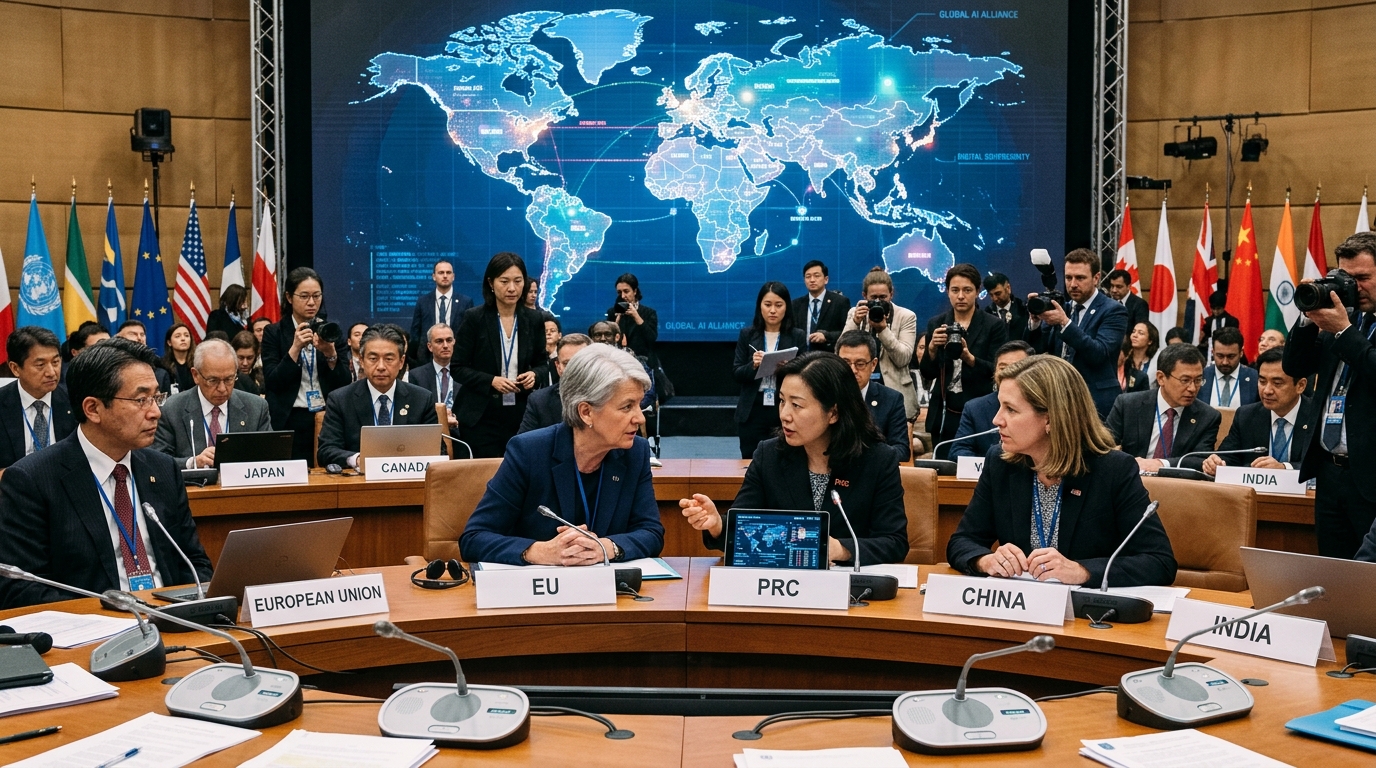
In the geopolitical chessboard of the 21st century, Artificial Intelligence (AI) is no longer just a tool for economic growth, but the ultimate instrument of power. As we approach mid-2026, tensions between the two sides of the Atlantic are reaching a boiling point. The European Union, having fully implemented its landmark AI Act, now finds itself facing an unexpected wall: the United States' refusal to grant full access to models classified as "high-risk" or "dual-use."
American Protectionism Under the Guise of Security
The U.S. government, following a strict line that began with the 2023 executive orders and intensified in subsequent years, argues that top-tier AI models—those exceeding computational thresholds of 10^26 FLOPs—are strategic assets. The fear is twofold: first, the potential for these models to be used in creating biological weapons or launching sophisticated cyberattacks, and second, the leakage of intellectual property to China through European channels.
"This is not a trade war; it is about safeguarding global stability," U.S. Department of Commerce officials state.
However, Brussels sees the situation differently. For Europe, restricting access to model weights and source code is not a security measure but a way for American giants—OpenAI, Google, Anthropic—to maintain a monopoly on knowledge. Without access to these models, European companies and research institutions risk becoming mere "customers" of Silicon Valley, lacking the ability to deeply customize or audit the systems they deploy.
The European Response: Digital Sovereignty and Open Source
Europe's reaction centers on the concept of "Digital Sovereignty." France and Germany are leading the pressure on Washington, demanding transparent procedures and guaranteed access for research purposes. The rise of Mistral AI and other European open-source initiatives represents the "counter-weight" to American closed-door control. European leaders argue that security is achieved through transparency, not obscurity.
- The need for "Sovereign AI" trained on European data and aligned with European values.
- The creation of European supercomputing hubs (EuroHPC) to reduce reliance on American cloud infrastructure.
- The imposition of fines and restrictions on U.S. models that fail to meet the transparency requirements of the AI Act.
The stakes are enormous. If Europe fails to secure access to cutting-edge technology, its economy could be disadvantaged for decades. Conversely, if the U.S. yields, it fears losing the unique advantage that allows it to lead the Western world against the Chinese threat.
The Future of Transatlantic Cooperation
The situation is further complicated by internal U.S. politics. With elections looming and a polarized climate, no administration wants to appear "soft" on protecting American technology. Europe, for its part, threatens to use the "Brussels Effect"—the power to impose regulations that the rest of the world eventually adopts due to the size of the single market.
In this environment, the establishment of the U.S.-EU Trade and Technology Council (TTC) seems insufficient. A new "AI Treaty" is required, similar to nuclear non-proliferation treaties, which would distinguish between commercial applications and truly dangerous military uses. Until then, the digital world will remain divided by an invisible but powerful wall of code.