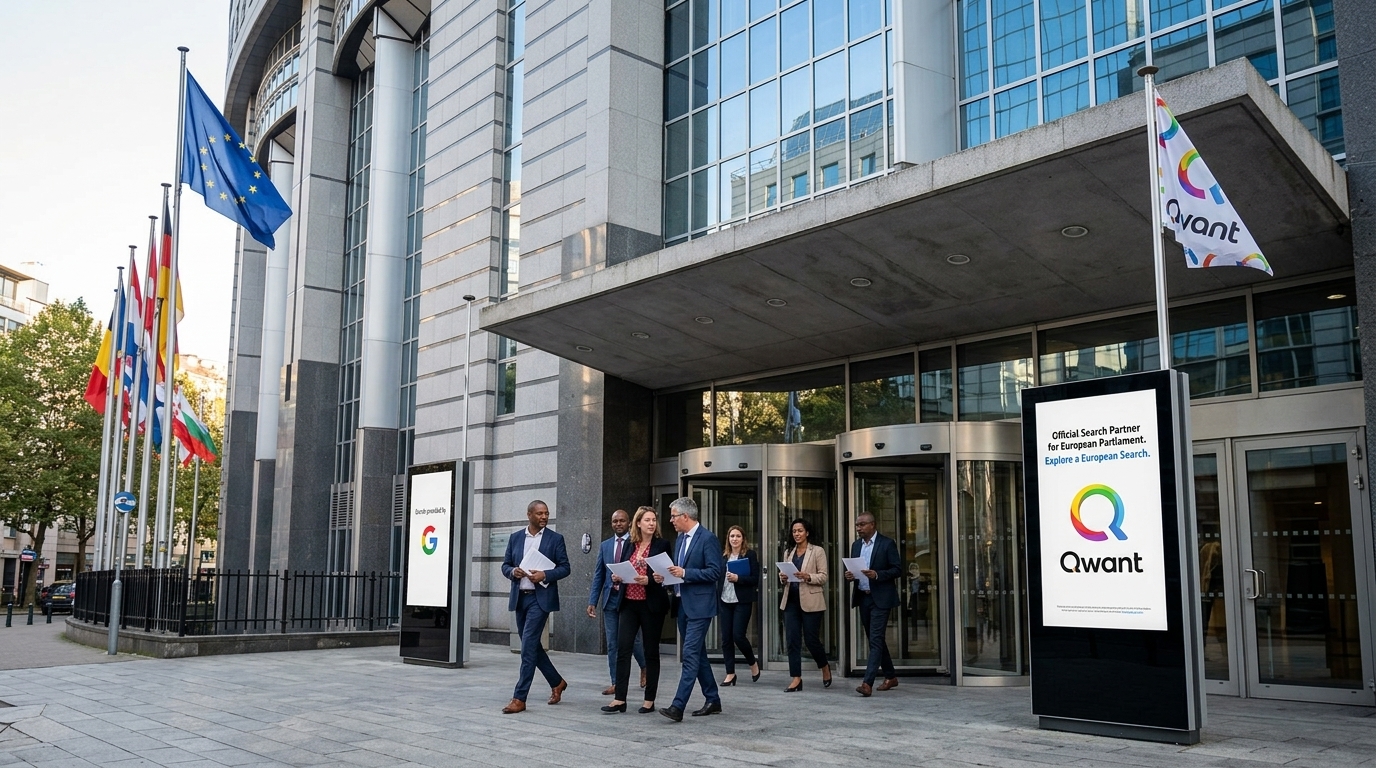
In a move that transcends the boundaries of a simple technical upgrade and touches the core of European geopolitical strategy, the European Parliament has announced the replacement of Google with the French search engine Qwant as the default on the computers of MEPs and staff. This decision is not a bolt from the blue, but the culmination of a long-standing debate on Europe's need to decouple from the technological monopoly of Silicon Valley, while protecting the privacy of its institutional communications.
Qwant, founded in 2013, has built its reputation on the promise that it does not track its users or sell their personal data to advertisers. Unlike Google's model, which relies on creating detailed user profiles for ad targeting, Qwant claims to offer a "neutral" search experience where results are not influenced by the user's history or location. For a body like the European Parliament, where handling sensitive political information is a daily occurrence, choosing a search engine that respects privacy is a matter of national and supranational security.
Digital Sovereignty as a Political Imperative
The concept of "digital sovereignty" has become the holy grail of the European Commission in recent years. After decades of Europe acting primarily as a consumer of American technologies, the shift towards domestic solutions is now considered mandatory. The choice of Qwant sends a clear message: Europe is willing to support its own "ecosystems," even if it means a slight sacrifice in the speed or precision of the results offered by Google's algorithm.
Proponents of the move argue that dependence on American companies makes Europe vulnerable to pressure and surveillance by foreign intelligence services, especially following past revelations of programs like PRISM. Furthermore, the implementation of the General Data Protection Regulation (GDPR) has created a legal framework that Google often struggles to fully comply with, leading to continuous fines and legal battles with European data protection authorities.
Challenges and User Experience
However, the transition is not without its challenges. Google holds over 90% of the search market in Europe for a very simple reason: its product is exceptional. Google's ability to understand the context of a search and provide accurate results in fractions of a second is the result of billions of dollars in investment and massive amounts of data. Qwant, although significantly improved, often relies on Microsoft's infrastructure (Bing) for part of its results, raising questions about how "independent" it actually is.
Furthermore, there is the risk of resistance from the users themselves. MEPs and their staff, accustomed to the convenience of the Google ecosystem, may find Qwant less intuitive. The success of this venture will depend on whether Qwant can provide an experience that doesn't make users look for ways to bypass default settings to return to the familiar embrace of the American giant.
The Message to Silicon Valley
The European Parliament's decision also represents a symbolic victory in the war against monopolies. With the Digital Markets Act (DMA) and the Digital Services Act (DSA), the EU is trying to open the market for smaller players. When the very legislative body that enacts these rules chooses a smaller, European player, it reinforces the credibility of its policy.
In conclusion, replacing Google with Qwant is an act of political will. It is a statement that the values of privacy and autonomy outweigh technical dominance. If Qwant manages to rise to the occasion, we might see other European institutions—and perhaps national governments—follow suit, shaping a new, more "European" internet.