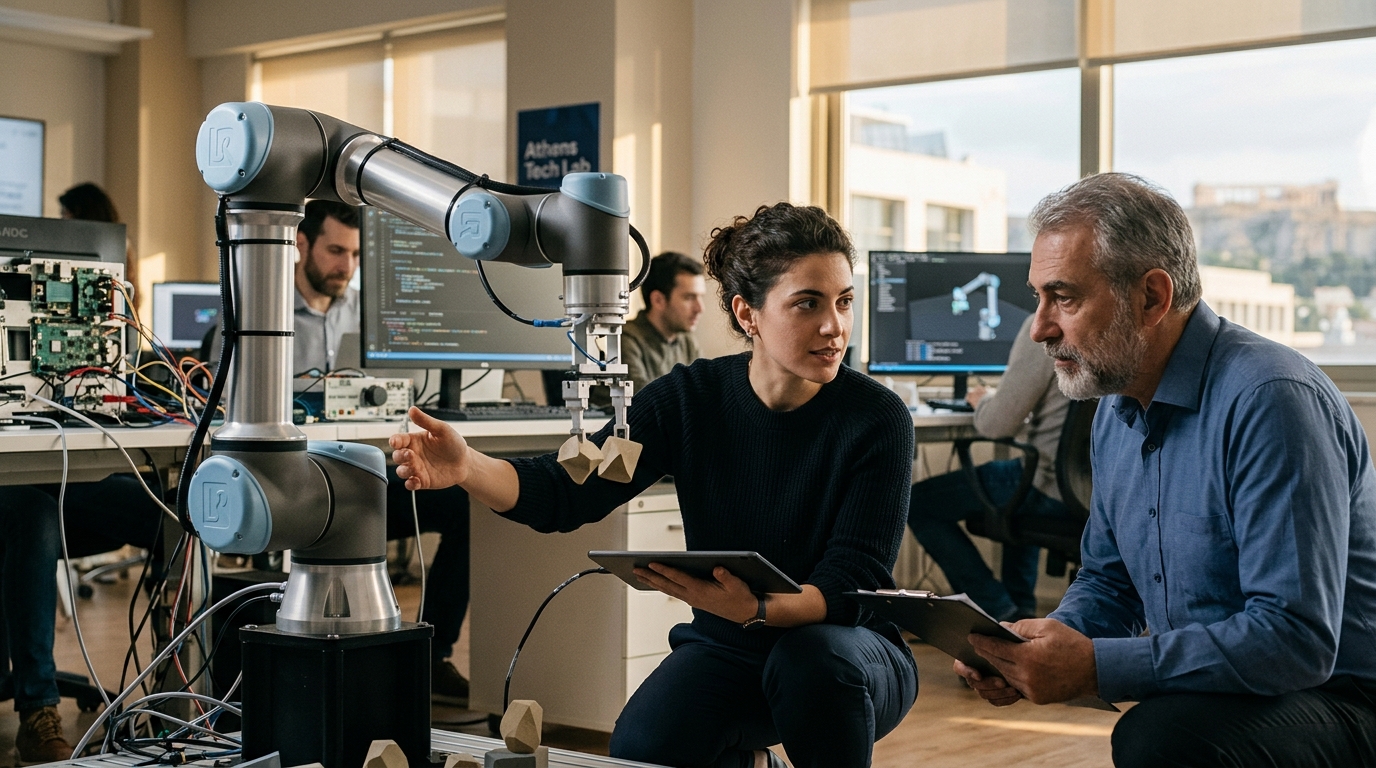
For decades, the primary obstacle to the advancement of robotics was not a lack of powerful motors or sophisticated sensors, but the so-called "reality gap." Robots could be trained in virtual environments for thousands of hours, achieving flawless results, only to become dysfunctional the moment they were introduced to the physical world. The slightest discrepancy in friction, lighting, or air resistance would render their learned behaviors useless. Today, a breakthrough in Artificial Intelligence promises to bridge this gap once and for all, paving the way for a new generation of machines that learn much like humans do.
The Sim-to-Real Challenge
Training a robot in the real world is a slow, expensive, and often hazardous process. If we want a robot to learn how to open a door, trial and error in physical reality can lead to broken hinges and damaged hardware. The solution has always been simulation: creating a digital twin of the world where a robot can fail millions of times within minutes without any real-world consequences.
However, simulations are, by definition, simplifications. The laws of physics in digital environments are mathematical approximations. When a robot is trained in a "perfect" digital world, it develops strategies that exploit these simulation inaccuracies. This phenomenon is known as "simulation overfitting." The new AI system recently unveiled utilizes a technique called "Adaptive Neural Embodied Learning," which doesn't just aim to make simulations more accurate but teaches the robot how to recognize and adapt to the differences between digital and physical worlds in real-time.
The Revolution of World Models
At the core of this new technology lie "World Models." Instead of a robot following a static sequence of commands, the AI system builds an internal representation of physics. During training, the system intentionally introduces "noise" and random variables into the simulation—varying gravity levels, changes in object mass, and unpredictable slips. This forces the robot to develop a more robust and flexible understanding of its environment.
- Dynamic Adaptation: The robot perceives material resistance and adjusts its grip strength in milliseconds.
- Skill Transfer: Skills acquired for a specific task (e.g., placing objects) can be transferred to similar tasks without retraining.
- Cost Reduction: The need for expensive testing facilities is drastically reduced, as 99% of learning occurs in the cloud.
In regions like Greece, the implications of this technology could be transformative for the agricultural and manufacturing sectors. Imagine robotic arms capable of harvesting delicate fruits like peaches or strawberries, adjusting their pressure based on the fruit's ripeness, despite never having set foot in a real orchard, but having "lived" through thousands of virtual harvests.
From the Factory Floor to the Living Room
Bridging the gap between simulation and reality is the "holy grail" for creating general-purpose domestic robots. To date, home robots have been limited to simple tasks like vacuuming because the domestic environment is incredibly chaotic. With this new AI architecture, robots gain the ability to manage unpredictability. A robot that learned to pick up toys in a digital room can now do so with equal ease in a living room where furniture has been moved or the carpet is slippery.
"We are no longer teaching robots how to perform a movement, but how to understand the consequences of their actions in physical space," says one of the lead researchers on the project.
However, this progress brings serious questions. The speed at which machines are acquiring physical skills may outpace society's ability to adjust to changes in the labor market. If a robot can be digitally trained to perform any manual task within hours, the value of human experience in certain sectors risks being undervalued.
The Future of Embodied Intelligence
The next step is the integration of Large Language Models (LLMs) with these physical adaptation systems. This will allow humans to provide instructions in natural language ("Clean up the spilled milk carefully") and have the robot translate that command into a series of movements tested across millions of simulations. The convergence of digital thought and physical action is now a reality. The era where robots were bound by their code is ending; the era where robots perceive the world has just begun.