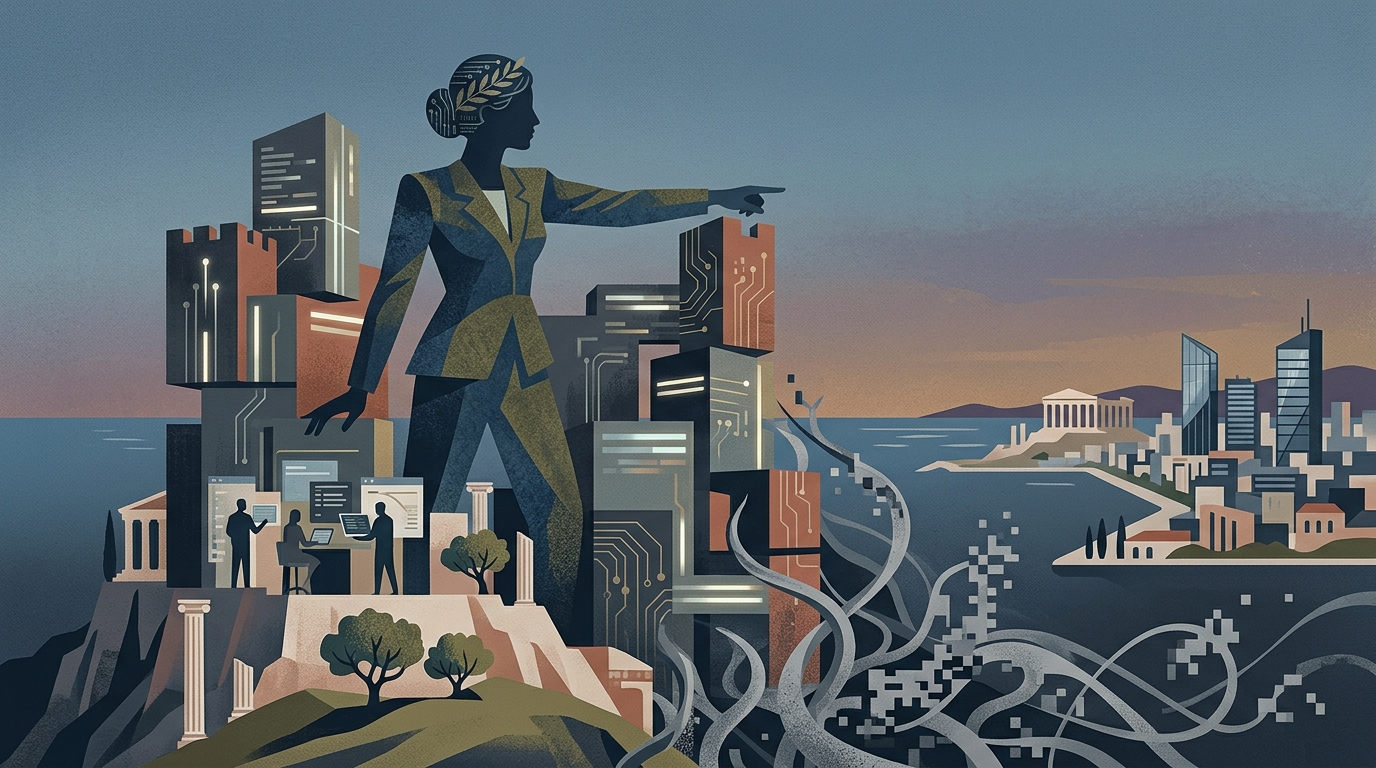
At the foot of Mount Parnassus, the Oracle of Delphi was more than just a religious destination; it was the decision-making hub of the ancient world. Today, Silicon Valley’s server farms and Large Language Models (LLMs) seem to have inherited this mantle. The human need to know the future remains constant, but the tools have mutated from prophecy to algorithm.
The Psychology of Prediction: The Terror of the Unknown
Why do humans love predictions? The answer lies in our evolutionary biology. The human brain is, at its core, a "prediction engine." Since antiquity, the ability to foresee the changing of seasons, the movement of prey, or the intentions of enemies was a matter of survival. Uncertainty is experienced by the organism as a physical threat, triggering anxiety and cortisol release.
The Oracle of Delphi provided what psychologists call "cognitive closure." Even when the prophecy was ambiguous—like the famous warning to King Croesus that a great empire would fall (which turned out to be his own)—it gave the seeker a framework for action. In the 21st century, Artificial Intelligence offers a modern version of this certainty. When a model like GPT-4 or Claude predicts the next token in a sentence, or when an algorithm forecasts stock market trends, it satisfies the same primal urge for control over chaos.
From Pythia to Big Data
The transition from metaphysics to statistics was not abrupt. It passed through Renaissance astrology, the emergence of probability theory in the 17th century, and the computing explosion. However, AI introduces a qualitative shift: the ability to process volumes of data that the human mind cannot possibly grasp. The Pythia relied on "divine madness" and vapors from the chasm; AI relies on trillions of parameters and correlation rather than causality.
This is where the great misunderstanding lies. AI models do not "know" the future. They are statistical mirrors of the past. They predict what is likely to happen based on what has already occurred. This creates a trap: if we over-rely on algorithmic forecasts, we risk becoming trapped in a future that is merely a recycling of the past, stifling innovation and the unpredictability of human will.
The Danger of Digital Fatalism
In antiquity, hubris was the human attempt to transcend fate. Today, the new hubris may be total surrender to the "fate" dictated by algorithms. AI predictions are already used for credit scoring, predictive policing, and disease diagnosis. But when a prediction becomes a self-fulfilling prophecy, the problem becomes political and ethical.
- Algorithmic Bias: If past data contains prejudices, the prediction will amplify them.
- The Loss of Intuition: Over-reliance on data can atrophy human judgment.
- The Black Box: We often don't know *why* an AI made a specific prediction, reminiscent of the enigmatic oracles of old.
In conclusion, the allure of prediction is deeply rooted in human nature. Whether it is laurel leaves or Nvidia chips, we desperately seek a map for tomorrow. The challenge for our society is to use AI as a navigation tool without forgetting that the steering wheel of history must remain in human hands. The future is not something that just happens; it is something we co-create, beyond any statistical probability.