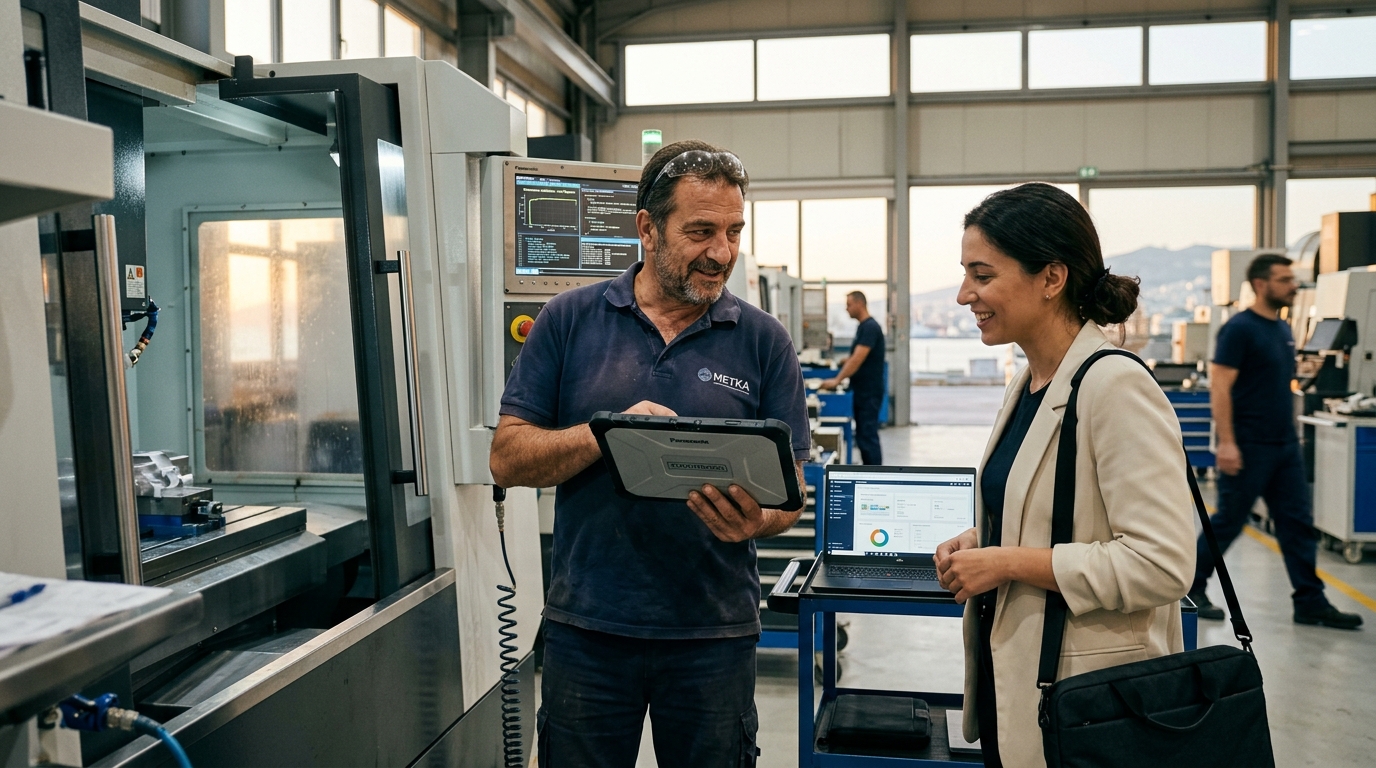
At the heart of the Fourth Industrial Revolution, Greece finds itself at a critical crossroads. The traditional approach of "if it breaks, we fix it" (reactive maintenance) is giving way to a model based on prediction and real-time data analysis. Artificial Intelligence (AI) is no longer a futuristic promise but an essential tool for the survival of domestic industry, shipping, and energy infrastructure.
The Predictive Maintenance Revolution
Predictive Maintenance (PdM) utilizes IoT (Internet of Things) sensors to collect data from equipment, such as vibration, temperature, pressure, and noise. Subsequently, sophisticated machine learning algorithms analyze these data streams to identify anomalies that precede a failure. According to recent analyses, implementing such systems can reduce downtime by 50% and maintenance costs by 10% to 40%.
For the Greek reality, where the industrial base consists of many medium-sized enterprises alongside global giants in energy and metals, adopting AI in maintenance is a "passport" to competitiveness. Greek companies are called upon to manage legacy systems by integrating modern sensors, a process known as retrofitting, which allows for digitalization without the need for complete machinery replacement.
Shipping and Energy: The Pillars of Digitalization
Two sectors where Greece leads, shipping and energy, are the first to reap the benefits. In the shipping sector, predicting failures in the main engines of vessels at sea can prevent catastrophic delays and environmental accidents. Digital Twins—virtual replicas of ships fed with real-time data—allow shore-based technicians to monitor the fleet's condition in every corner of the globe.
In energy, the Public Power Corporation (PPC) and private providers are investing in AI systems to monitor distribution networks and renewable energy sources. For instance, the use of drones equipped with thermal imaging cameras and AI allows for the detection of wear on wind turbine blades or solar panels with speed and precision that was impossible until a few years ago.
The Challenges: Data and Human Capital
Despite the obvious advantages, the road to full automation is not without obstacles. The first major challenge is data quality. "AI is only as good as the data that feeds it," industry experts note. Many businesses possess disconnected systems (data silos), making it difficult to create a unified picture of their operations.
Furthermore, there is the issue of skills. The transition to smart maintenance requires technicians who are not only knowledgeable in mechanical engineering but also in data analysis. The need for upskilling the existing workforce is imperative, as technology does not replace humans but radically changes their role from "fixer" to "analyst and decision-maker."
The Future: Autonomous Maintenance and Sustainability
Looking toward the end of the decade, Artificial Intelligence will lead to "autonomous maintenance," where machines themselves will be able to order spare parts or schedule their own repairs during low-demand hours. This is inextricably linked to sustainability, as optimized equipment operation means lower energy consumption and less waste.
Greece has the opportunity to emerge as an innovation hub in the Southeast European region, leveraging its high-level scientific potential. Investing in smart maintenance is not just a technical upgrade; it is a strategic choice for a more resilient and green economy.