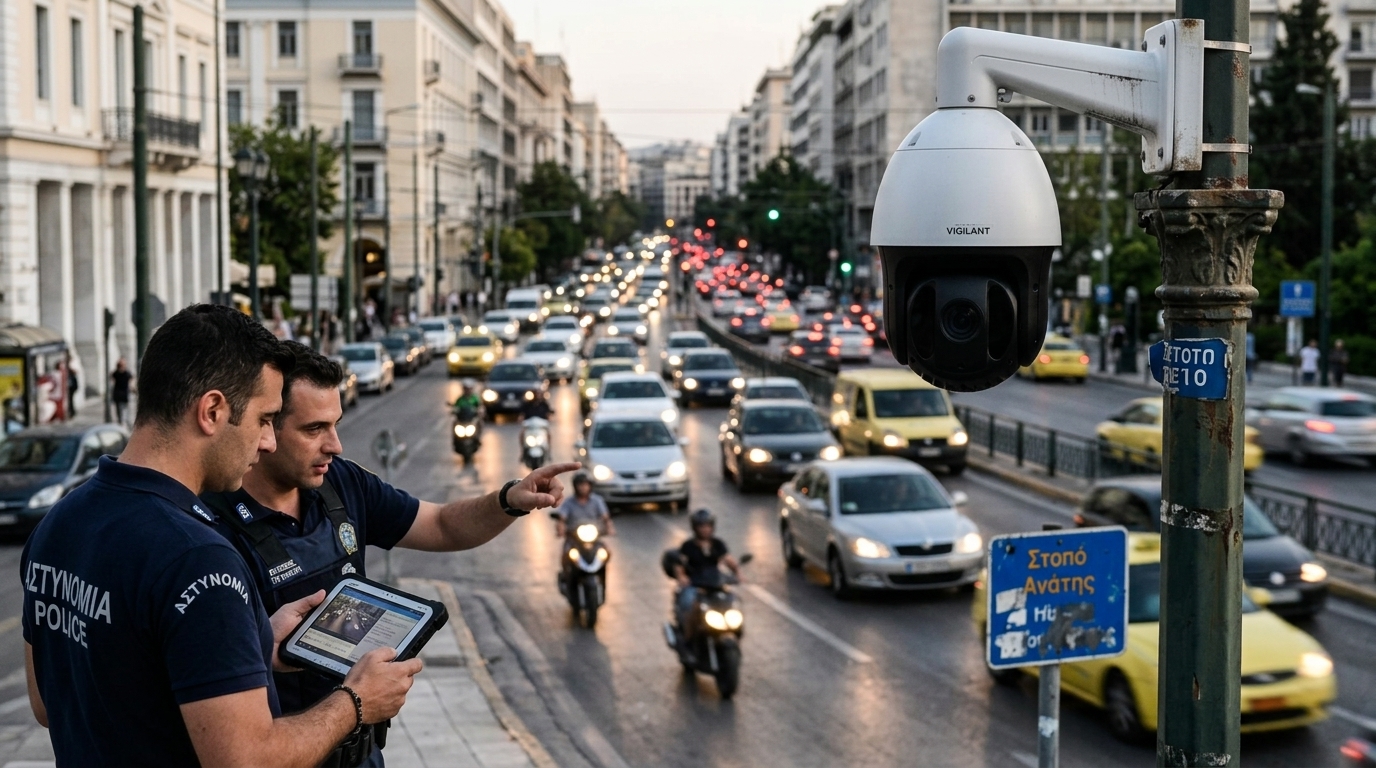
The image of a traffic officer manually scribbling on a ticket pad is rapidly becoming a relic of the past. Greece, a country traditionally plagued by high road accident rates and a pervasive culture of impunity, is taking a decisive leap toward the digital transformation of policing. Recent data is revealing: within a two-month window, new digital cameras and automated systems recorded more than 2,400 violations, proving that technology can enforce order where human presence often failed or turned a blind eye.
A Breakdown of the Violations
According to official statistics, the volume of digital tickets covers a wide spectrum of dangerous driving behaviors. Speeding remains the 'king' of infractions, followed closely by red-light violations—one of the deadliest habits on Greek roads. However, the innovation of these new systems lies in their ability to accurately detect mobile phone use while driving, as well as the failure to use seat belts or protective helmets.
- Excessive speeding in urban and national road networks.
- Red-light violations captured via high-resolution cameras.
- Mobile phone usage without hands-free devices.
- Failure to wear seat belts by drivers and passengers.
The most striking element, however, is not the sheer number of tickets, but their resilience against legal challenges. Only 2.11% of the total digital tickets were canceled following citizen appeals. This exceptionally low percentage demonstrates the reliability of digital evidence. When a violation is captured in high-definition video or photography, the room for subjective interpretation or the infamous 'fixing' of tickets through political connections narrows dramatically.
The End of Clientelism
For decades, traffic enforcement in Greece was intertwined with the concept of 'favors.' The digitalization of the process, through the direct connection of cameras to the central databases of the Ministry of Infrastructure and Transport and the Police, creates an incorruptible system. The ticket is no longer 'lost' on its way to the station, nor can it be hidden in a drawer. It is automatically verified and sent to the offender's digital wallet (Gov.gr Wallet) within a few days.
"Digitalization is not just a matter of speed; it is a matter of justice. Only when the law is applied horizontally and without exceptions does driving behavior truly begin to change," state officials from the Ministry of Digital Governance.
This interconnection also allows for the immediate deduction of points from the Driver Behavior Control System (the well-known point system). In the past, updating the point system could take months or even years, allowing dangerous drivers to remain on the road. Today, the penalty follows the violation almost in real-time.
Economic and Social Implications
Beyond the obvious improvement in safety, digital enforcement has a significant economic dimension. Revenue from fines, which in the past often remained uncollected due to bureaucratic malfunctions, is now directly certified through the tax authorities (AADE). This ensures resources that can—and must—be reinvested in road maintenance and driver education.
However, the social acceptance of these measures remains a challenge. Many citizens speak of a 'revenue-hungry' state, especially in areas where signage is deficient or speed limits are perceived as irrationally low. The challenge for the state is to prove that the goal is not profit, but the reduction of deaths and serious injuries, which constitute a constant 'bleeding' for Greek society.
Towards a Future Without Accidents?
The installation of these systems is just the beginning. The national strategic plan for road safety envisions the expansion of the camera network to all major urban centers and high-risk road axes. The use of Artificial Intelligence to analyze traffic flow and predict accidents is the next step. If Greece manages to combine strict enforcement with infrastructure improvements, then the goal of a 50% reduction in accidents by 2030 may not just be a wish, but a tangible reality.