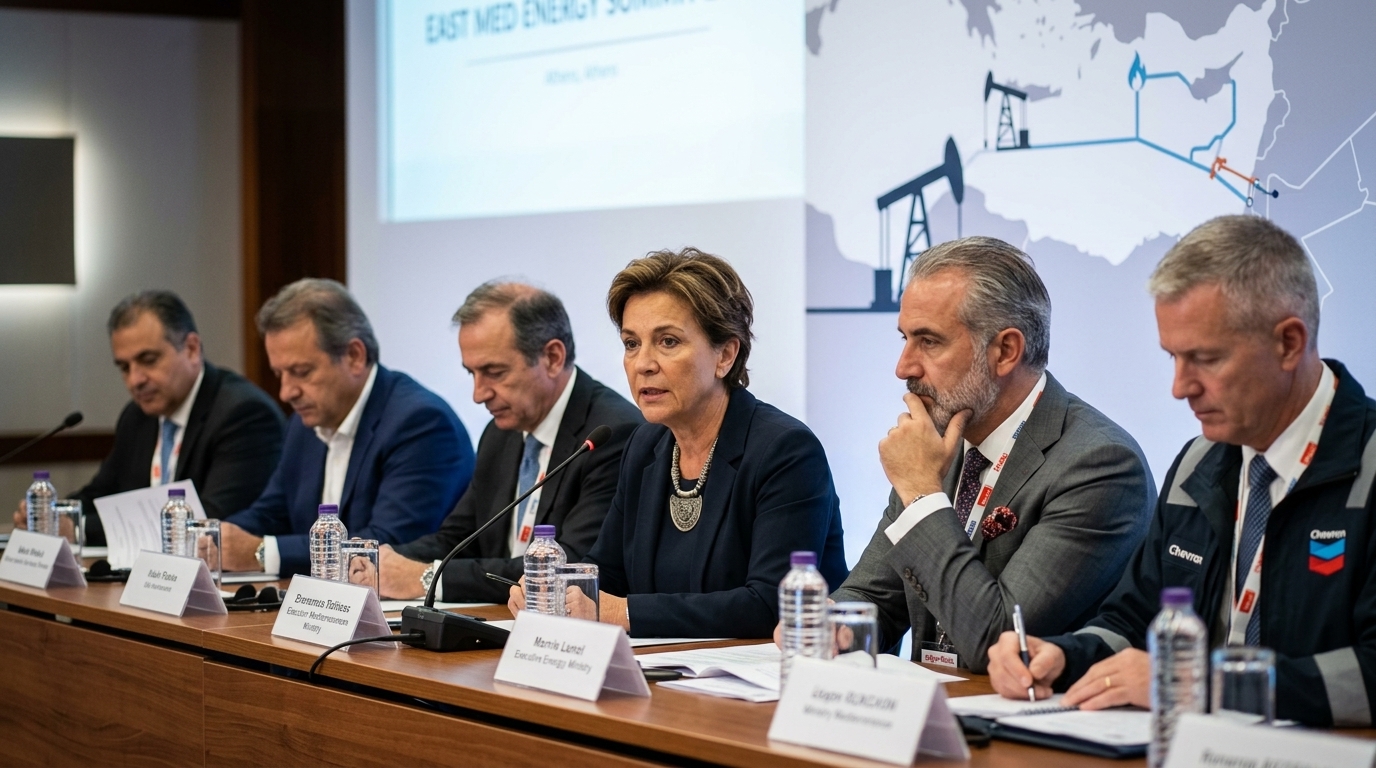
The recent statements by Stavros Papastavrou regarding the activities of Chevron and Exxon Mobil in Greece are not merely political rhetoric; they represent a confirmation of the shifting geopolitical gravity in the Eastern Mediterranean. The involvement of the world's two largest private oil companies in the south and southwest of Crete, as well as the Ionian Sea, constitutes a "vote of confidence" that transcends narrow economic boundaries, touching upon the core of national security and European energy autonomy.
The Geopolitical Dimension and Energy Security
In a global environment shaken by geopolitical upheavals in Ukraine and the Middle East, the European Union's need to diversify its energy sources has become imperative. Greece, through its strategic alliances with the US and the strengthening of its energy infrastructure, is emerging as a critical hub. The presence of Exxon Mobil and Chevron is no coincidence. It reflects a long-term US strategy to ensure that the Levantine Basin and Greek blocks will serve as the new "wellspring" to supply the continent, reducing dependence on Russian natural gas.
Exploration efforts south of Crete are considered among the most promising globally. The geological structures identified show similarities to the massive fields in Egypt (Zohr) and Israel (Leviathan). However, the depth of the waters and the complexity of the subsoil require expertise that only players of this magnitude possess. The involvement of these companies provides Greece with an informal but potent "security umbrella," as the interests of American giants are now aligned with the stability and integrity of Greek maritime zones.
The AI Revolution in Exploration
An aspect often overlooked in public discourse is the role of high technology and Artificial Intelligence (AI) in modern hydrocarbon exploration. Chevron and Exxon Mobil utilize advanced machine learning algorithms to process 2D and 3D seismic data. In the past, interpreting this data took years and carried a high risk of failure. Today, AI models can "see" through kilometers of sediment and salt, accurately predicting the location and size of natural gas reservoirs.
- Seismic Data Analysis: Using neural networks to identify subsurface anomalies.
- Environmental Risk Reduction: Simulations that minimize the need for multiple exploratory wells.
- Production Optimization: Digital Twins of reservoirs for more efficient resource management.
This technological superiority is what makes collaboration with these giants indispensable. Greece gains not only access to capital but also to a technological infrastructure that could be shared with the domestic scientific community, creating an innovation ecosystem around energy.
Economic Prospects and Environmental Challenges
The economic implications of successful extraction would be colossal. Estimates suggest revenues of billions of euros over a twenty-year period, which could fund the social security system and reduce public debt. Furthermore, the creation of thousands of high-skill jobs could serve as a buffer against brain drain. However, the path to exploitation is not without obstacles. The environmental sensitivity of the Mediterranean requires the strictest protection protocols, especially in areas with rich biodiversity like the Ionian and Libyan Seas.
"Energy is the new link connecting economic prosperity with national sovereignty," market analysts note.
The challenge for the Greek government is to maintain a balance between accelerating processes and adhering to EU environmental commitments for the green transition. Natural gas is considered the "bridge fuel" toward a net-zero economy, and Greece has the opportunity to become the primary supplier for this transition for all of Europe. The presence of Chevron and Exxon Mobil is the first, and perhaps most significant, step in this long journey.