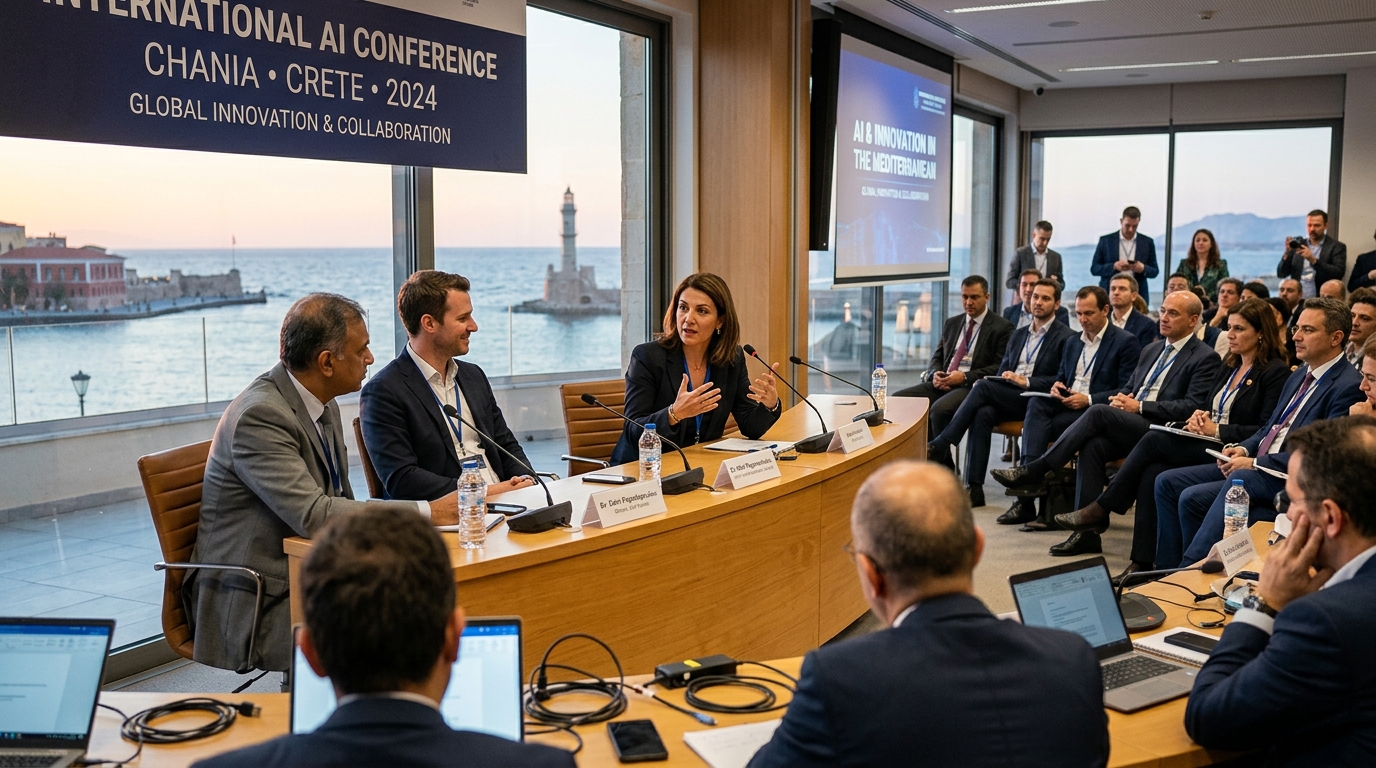
In the heart of the Mediterranean, where history meets the infinite blue, Chania is assuming a new, leading role: that of a digital crossroads. The International Conference on Artificial Intelligence and New Technologies, currently taking place in this historic Cretan city, is not merely an academic gathering but a critical forum for charting the course humanity will take at the dawn of the fifth industrial revolution.
The Vision of Digital Convergence in Chania
The selection of Chania as the host for such a significant event is no coincidence. With the Technical University of Crete serving as a major research pillar in Greece and the local community demonstrating remarkable adaptability, the city provides the ideal backdrop for connecting theoretical research with practical application. The conference features over 500 delegates from 30 different countries, including researchers from top-tier universities like MIT and Stanford, alongside executives from global tech giants.
The central theme of the discussions is "Democratic Artificial Intelligence." Speakers emphasize the need for technology to be more than a privilege of a few powerful nations or corporations; it must be a tool that empowers local economies. For Crete, this translates into AI applications in tourism, where personalized visitor experiences can be radically upgraded, and in agrifood, through precision agriculture that promises to reduce production costs and protect natural resources.
Ethics and Legislation: The European Challenge
One of the most compelling sessions of the conference focuses on the EU's regulatory framework for Artificial Intelligence (AI Act). Legal experts and ethicists participating in the Chania panels stress that Europe stands at a crucial junction. On one hand, the need for safety and personal data protection is imperative; on the other, excessive regulation risks stifling innovation, potentially leaving the continent lagging behind the US and China.
"Artificial Intelligence is not just code; it is a mirror of our values. In Chania, we are discussing how this mirror will remain clear and human-centric," stated one of the keynote speakers during the opening ceremony.
Particular emphasis was placed on the use of Large Language Models (LLMs) in education and public administration. Experts warn of the danger of AI "hallucinations" but simultaneously highlight the potential for a more efficient and transparent state apparatus—something that remains a perennial goal for Greece.
From Olive Groves to Algorithms: Local Impact
The conference is not limited to theoretical analysis. Specific projects already being implemented in Crete were presented. One involves the use of drones and AI for the early diagnosis of olive tree diseases, an innovation that could save millions of euros for the island's producers. Simultaneously, the phenomenon of "digital nomads" in Chania was discussed, with the city emerging as a model destination that combines quality of life with high technological demands.
- Development of fire prediction systems using satellite data and AI.
- Optimization of water resource management in drought-prone areas.
- Augmented Reality (AR) applications to showcase the cultural heritage of the Old Town.
However, this transition is not without obstacles. The lack of specialized personnel and connectivity infrastructure in remote areas remain the "Achilles' heels" of the digital strategy. Delegates called on the Greek state to invest more in education and the reskilling of the workforce to ensure that Artificial Intelligence does not lead to new social inequalities.
Conclusions and the Future
As the initial days of the proceedings conclude, the message from Chania is clear: Artificial Intelligence is here, and it is not a threat but an opportunity for redefinition. Crete, with its rich tradition and restless spirit, can become the laboratory where technology learns to speak the human language. The Chania international conference lays the groundwork for continuous collaboration between the global scientific community and local society, proving that innovation does not only flourish in the glass buildings of Silicon Valley but also under the Aegean sun.