At the intersection of history and technology, a quiet revolution is unfolding in classrooms and research centers alike. Ancient Greek, a language that for centuries was considered the ultimate domain of human intellectual exercise and philological depth, has found an unexpected ally: Artificial Intelligence (AI). Recent discussions within the educational community, spurred by reports from Crete and specifically Rethymno, highlight a new reality where algorithms are not merely translation tools but bridges to a lost world.
The Revolution of Digital Epigraphy and 'Ithaca'
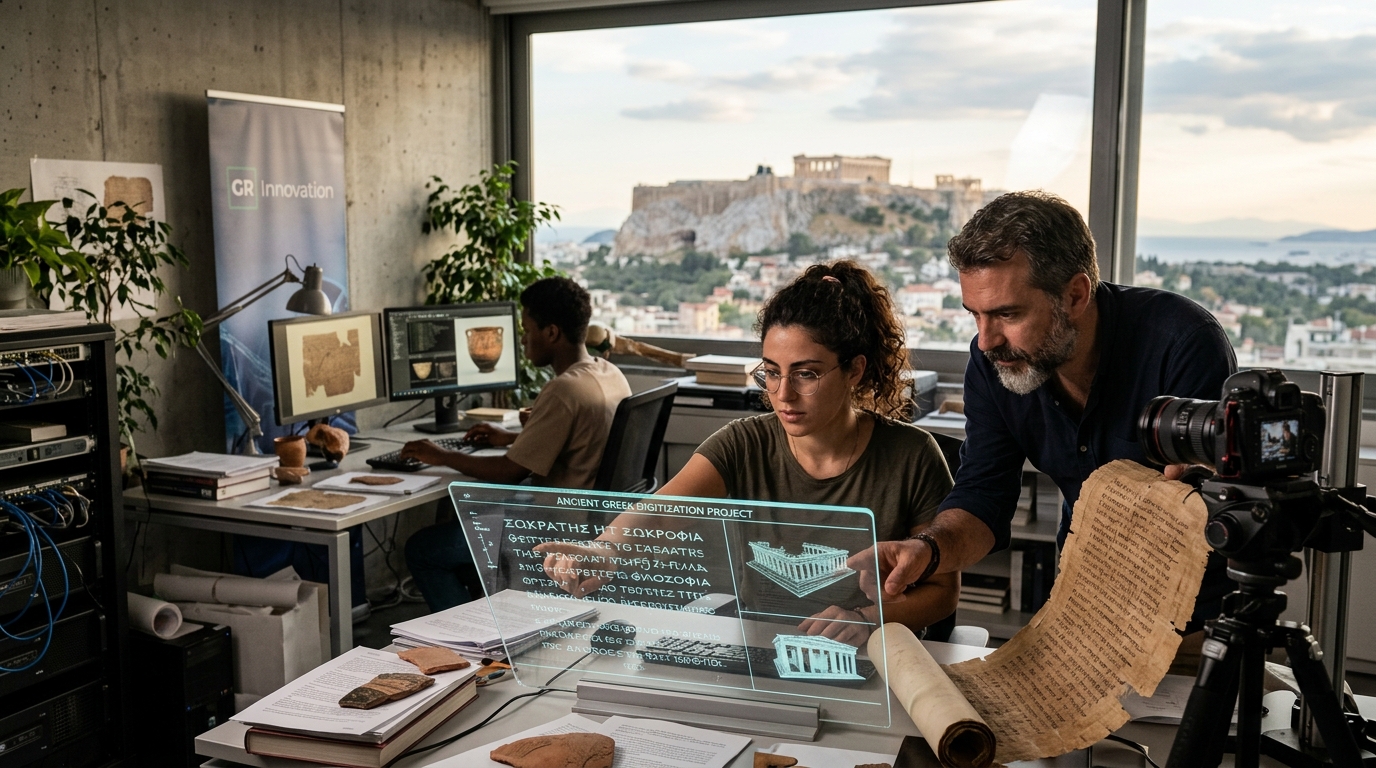
One of the most impressive applications of AI in classical studies is the restoration of ancient texts. DeepMind’s 'Ithaca' model was the first deep neural network designed to restore missing inscriptions and identify their origin and date. In Greece, the use of such tools allows archaeologists and philologists to fill gaps in texts worn by time with an accuracy reaching 72%. This is not just technical assistance; it is a reconstruction of historical memory. Algorithms are trained on vast databases, such as the Thesaurus Linguae Graecae (TLG), recognizing speech patterns, syntactic structures, and stylistic features that the human eye would take decades to process.
AI in the Classroom: From Rote Learning to Engagement
Beyond research, AI is dynamically entering pedagogical practice. In Greek schools, teaching Ancient Greek is often perceived by students as a sterile process of memorizing grammar rules and syntax. AI promises to overturn this. Through personalized learning platforms, a student can now have a 'personal Socrates.' These applications can analyze a student's errors in real-time—whether in verb conjugation or sentence structure—offering immediate feedback and adjusting the difficulty level to their specific needs.
- Interactive Translation: Large Language Models (LLMs) like GPT-4 and Claude have improved dramatically in understanding Ancient Greek, allowing students to experiment with the language rather than passively copying translations.
- Visualizing the Ancient World: The connection between text and image through generative AI allows for the representation of scenes described in Homer or Thucydides, making the lesson more engaging and immersive.
- Sentiment Analysis: Using algorithms to analyze tone and emotion in tragedies offers a new perspective on interpreting classical texts.
The Perils of 'Algorithmic Philology'
However, the integration of technology is not without its risks. Many academics warn of the danger of AI 'hallucinations.' A model might produce a grammatically correct but historically or contextually flawed translation. The subtle nuance of a word like 'hubris' or 'arete' carries a cultural weight that an algorithm, no matter how advanced, struggles to fully grasp without human oversight. Furthermore, there is a fear that the ease provided by AI could lead to a superficial engagement with texts, bypassing the deep mental effort required to truly master the language.
"Artificial intelligence should be the philologist's crutch, not their replacement. Understanding the ancient world requires empathy—something codes do not yet possess," note experts in Digital Humanities.
Toward a New Humanistic Paradigm
The future of teaching Ancient Greek appears to be hybrid. Greece, as the cradle of this civilization, has the responsibility to lead in developing specialized AI models trained exclusively on Greek sources. Initiatives in regions like Rethymno demonstrate that the periphery can be a nursery for innovation. The challenge for the Ministry of Education is to integrate these tools into the curriculum not as an extra burden, but as a medium that makes classical authors accessible and vibrant for the TikTok generation. Artificial Intelligence does not threaten Ancient Greek; on the contrary, it offers them digital immortality, allowing Plato and Aristotle to 'converse' with modern humanity in a language it can finally understand.