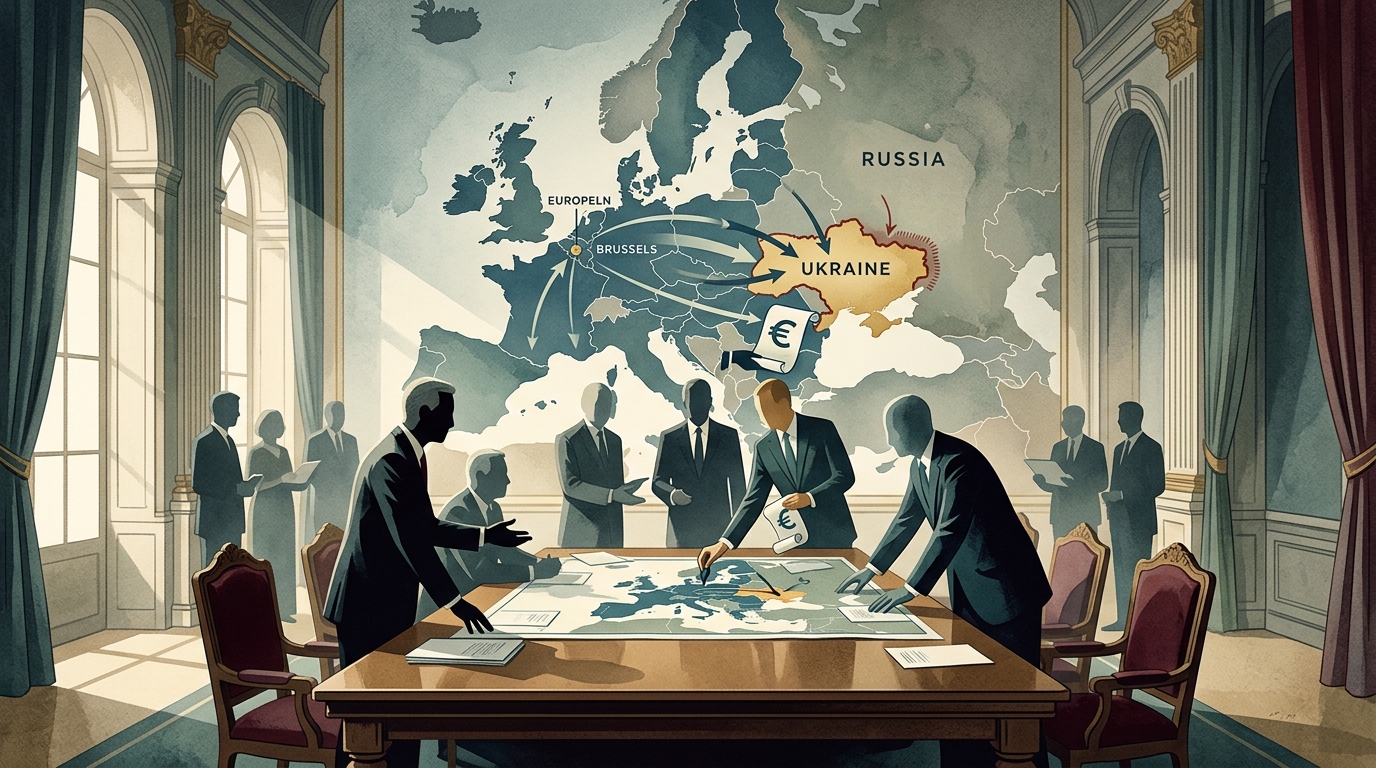
In a move that signals a new era for European foreign policy and economic diplomacy, the European Union has formally ratified a massive €90 billion loan package for Ukraine. This decision, reached in Brussels after exhaustive negotiations, is not merely a liquidity injection for a nation at war, but a clear statement of intent directed at Moscow and a rigorous test of the Union's internal cohesion.
The End of the Political Deadlock
For months, the European capital was held in a state of political gridlock. Viktor Orbán’s government in Hungary had repeatedly used its veto power to block the funding, raising demands ranging from the release of EU funds for his own country to the protection of the Hungarian minority's rights in Ukraine. The final approval suggests that Brussels found the leverage—either through concessions or intense pressure—to break Budapest's resistance, ensuring that Ukraine will not face financial collapse in 2026.
The €90 billion package is structured to cover the immediate needs of the Ukrainian budget, maintaining essential public services and, most importantly, rebuilding critical infrastructure damaged by Russian strikes. This funding will be disbursed in tranches, conditional on Kyiv continuing its reforms in the judicial system and anti-corruption efforts—steps essential for its EU accession path.
The Innovation of Frozen Russian Assets
One of the most complex and innovative aspects of this agreement is its link to frozen Russian sovereign assets. The EU, in coordination with the G7, has decided to utilize the windfall profits from the immobilized funds of the Russian Central Bank to service and repay the loan. This legal maneuver creates a significant international precedent: the aggressor state is indirectly forced to finance the survival and recovery of its victim.
- Utilization of interest earned on €300 billion of Russian reserves.
- Guarantees from the EU budget to ensure high credit ratings.
- A long-term repayment horizon extending beyond 30 years.
This approach aims to reassure European taxpayers, as the burden of repayment does not fall solely on their shoulders but leverages resources already within the Western financial system. However, the move is not without risk, as Moscow has already warned of retaliatory measures, targeting Western companies still operating on Russian soil.
Geopolitical Implications and Strategic Autonomy
The approval of the loan comes at a critical juncture on the international stage. With uncertainty prevailing in the United States regarding future support for Ukraine, Europe is now stepping up as the primary financier. This bolsters the narrative of EU "strategic autonomy," proving that the continent can act independently and protect its interests in its immediate neighborhood.
"Today's decision is a victory for European unity and a loud message to the Kremlin that our endurance will not be broken," stated a senior Commission official.
In Kyiv, the news was received with profound relief. President Zelenskyy emphasized that these funds are "vital for social stability." Indeed, without this aid, Ukraine would face the risk of hyperinflation, as it would be forced to print money to cover military and social expenditures. The stability of the Ukrainian economy is inextricably linked to the security of Europe; an economic collapse would trigger new waves of refugees and complete destabilization on the EU's eastern borders.
Challenges and Transparency
Despite the celebrations, implementing the agreement will be a daunting task. The EU has established a rigorous monitoring mechanism to ensure that every euro reaches its intended destination. Transparency is key to maintaining the support of European citizens, many of whom are struggling with the cost of living and the energy crisis. Opposition parties in countries like Germany and France often ask: "Why are we sending billions abroad when our own infrastructure is crumbling?" The leadership in Brussels offers a clear rebuttal: the cost of a Ukrainian defeat would be exponentially higher for the European economy and security in the long run.
In conclusion, the €90 billion loan is a milestone. It demonstrates that the EU, despite its internal squabbles, remains a global player capable of mobilizing immense resources. The success of this venture will be judged not only on the battlefield but also by Kyiv's ability to transform into a modern, European state amidst the fires of war.