At the dawn of the third decade of the 21st century, the discourse surrounding automation has migrated from factory floors to research laboratories. With the emergence of models like Sakana AI’s "AI Scientist," many were quick to predict the demise of the traditional researcher. However, a deeper analysis of the nature of the scientific method reveals that Artificial Intelligence (AI), no matter how sophisticated, remains a tool rather than an autonomous creator of knowledge. Science is not merely data processing; it is the quest for truth through a tapestry of ethics, philosophy, and creative intuition.
The Chasm Between Correlation and Causality
The fundamental operation of modern AI is rooted in pattern recognition. Large Language Models (LLMs) and neural networks excel at identifying correlations within vast datasets that the human brain cannot possibly process. Yet, as any first-year statistics student knows, correlation does not imply causation. Science aims to understand the "why" and "how" of a phenomenon, not just to predict the next data point.
An algorithm might observe that rising global temperatures correlate with a decrease in the number of pirates, but it lacks the "common sense" and conceptual framework to dismiss this relationship as coincidental. Scientists use theoretical training and critical thinking to construct hypotheses that possess explanatory power. AI can suggest thousands of potential chemical compounds for a new drug, but it is the human who must judge which of these directions is biologically plausible and socially necessary.
The Importance of Tacit Knowledge and Intuition
Michael Polanyi, a philosopher of science, introduced the concept of "tacit knowledge"—the idea that "we know more than we can tell." A seasoned laboratory researcher develops an almost instinctive feel for their experiments. This intuition, a product of decades of experience and failures, cannot be encoded into bits and bytes.
Scientific discovery often arises from the anomaly, the unexpected error that a scientist refuses to ignore. While an AI might categorize a "strange" result as noise and discard it to maintain the model's accuracy, a human scientist might see in that error the genesis of a new theory, as was the case with Alexander Fleming’s discovery of penicillin. The ability to ask "what if?" outside the predefined boundaries of training data is a uniquely human trait.
Ethical Responsibility and the Social Contract of Science
Science is not conducted in a vacuum; it has profound social and ethical implications. Artificial Intelligence cannot bear responsibility. If an algorithm proposes a flawed medical protocol or a dangerous geoengineering intervention, who is held accountable? The scientific community relies on the credibility, integrity, and ethical commitment of its members.
- Ethical Judgment: The choice of research questions reflects the values of a society. AI cannot decide whether research into nuclear weaponry is more vital than eradicating malaria.
- Interpretability: "Black box" models often provide solutions without explaining their underlying logic. In science, a result without an explanation is nearly useless.
- Collaboration and Dialogue: Science is a social process of persuasion, debate, and consensus. Algorithms cannot participate in a symposium and defend their ideas with arguments that resonate with the human experience.
Conclusion: The Scientist as a Conductor
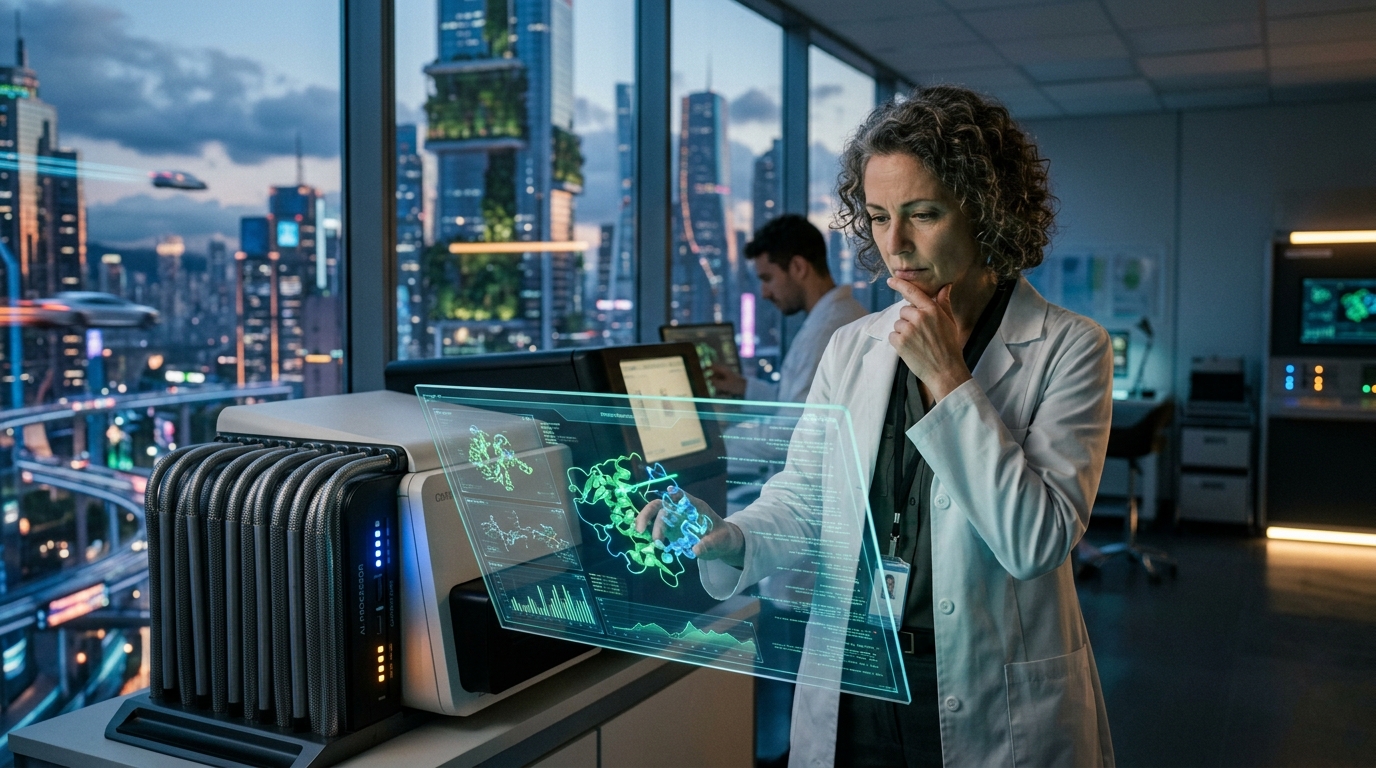
Instead of replacement, we should speak of augmentation. Artificial Intelligence is the "super-microscope" of the 21st century. Just as the telescope did not replace the astronomer but allowed them to see further, AI enables the researcher to navigate the complexity of modern information. The scientist of the future will be a "conductor" of algorithms, setting the questions, defining the ethical boundaries, and interpreting findings with human progress in mind. The "spark" of creation remains, and will remain, biological.