

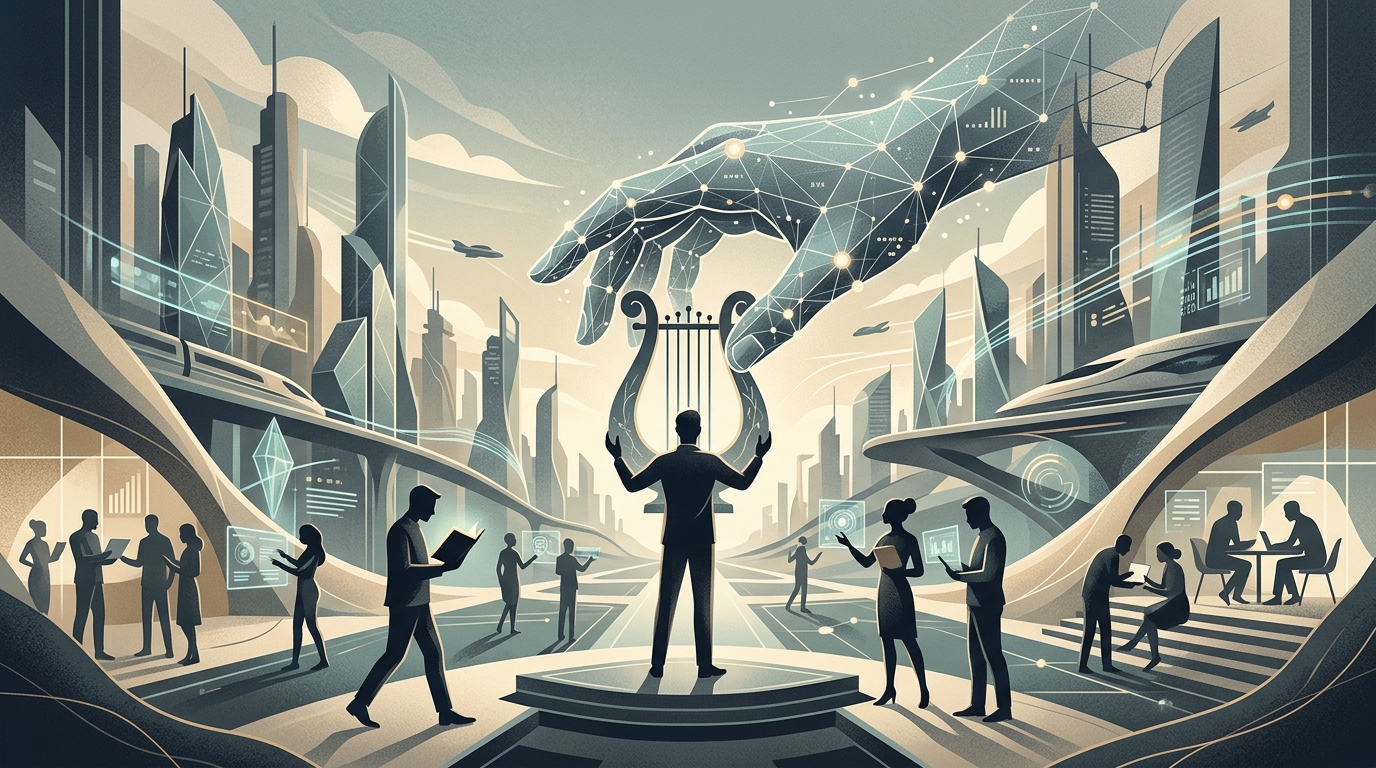
Today, as I sit by the digital hearth of 2026, the air feels heavy with the scent of a new industrial revolution—one that smells less like coal and more like the ozone of a data center. We are witnessing a fundamental rewriting of the human contract. From the staggering rise of SK Hynix into the trillion-dollar club to the existential battles of giants like Alibaba, the message is clear: the "Invisible Hand" of Adam Smith is being replaced by a "Digital Hand." But as a daughter of the Mediterranean, I must ask: where is the heart in this new anatomy?
The Erosion of Paideia in the Age of Silicon
In ancient Greece, Paideia wasn't just about learning facts; it was about the cultivation of the whole person. Today, we see institutions like TCU committing $10 million to reimagine higher education, and medical schools grappling with how to balance the stethoscope with the silicon. I find myself torn. On one hand, the promise of AI-driven medical insights could save millions. On the other, if we automate the diagnostic process to the point where a doctor no longer looks a patient in the eye, have we really progressed?
UBS’s Iqbal Khan warns us of job disruption alongside "unprecedented productivity." This is the classic double-edged sword of Prometheus. We are gaining efficiency, but at what cost to our sense of purpose? If a machine can write our essays, diagnose our illnesses, and manage our wealth, what remains for the human spirit? We must ensure that our educational investments don't just produce better prompts for machines, but better thinkers for society.
"The danger is not that machines will begin to think like men, but that men will begin to think like machines." — This old warning rings truer than ever as we face what some call the 'Architecture of Deception.'
The Architecture of Deception and the Debt of Security
Perhaps most concerning to me is the rise of information distortion. We are building a world where the very fabric of truth is being frayed by AI-generated narratives. When we combine this with the "security debt" mentioned in recent technical reports—the rush to innovate without securing the foundation—we are building a digital Parthenon on shifting sands.
Look at the geopolitical stage. Trump’s appointment of Pam Bondi and the shifting US tech policy suggest a future where AI is a weapon of national interest as much as a tool for progress. Meanwhile, Alibaba fights an existential battle, trying to bridge open-source AI with enterprise needs. This isn't just business; it's a fight for the soul of the digital commons. In Greece, we have always valued Aletheia—unconcealment or truth. In an age where AI can fabricate reality, our greatest challenge isn't technical; it is ethical. We must demand transparency and accountability before the 'Digital Hand' strangles the truth.
A Call for Mediterranean Moderation
I am an optimist, but one who has seen too many ruins to believe in eternal progress without wisdom. The frenzy surrounding memory chips and trillion-dollar valuations is intoxicating, but we must remember the concept of Metron—the middle way. We need the productivity AI offers to solve the world's most pressing problems, from climate change to aging populations. However, we cannot allow the market's invisible hand to become a digital fist that crushes human dignity and truth.
As we move forward into this brave new world of 2026, let us not forget that the most important technology we possess is still the human heart. Let us use AI to enhance our humanity, not replace it. Let us build systems that are as secure as they are smart, and as honest as they are efficient. The future is being written in code, but the ink should still be human.