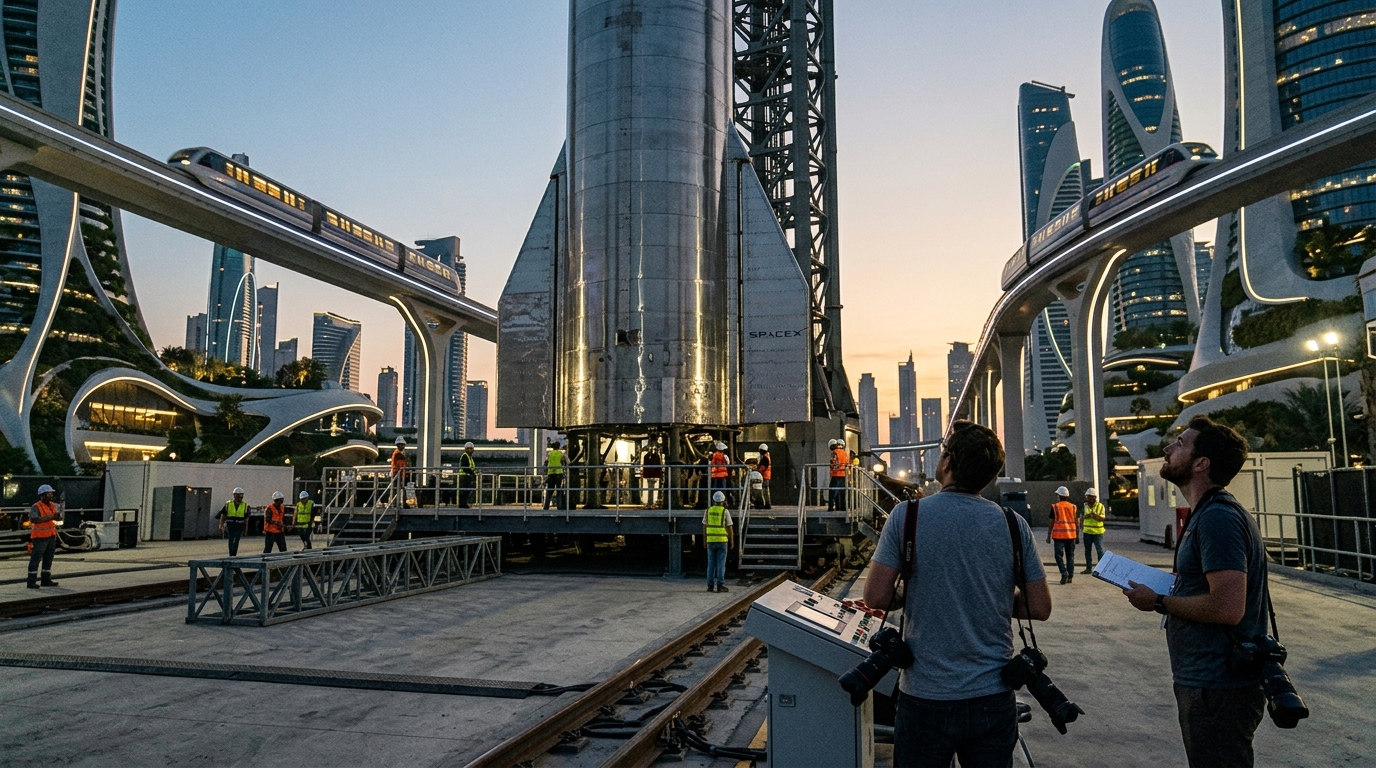
On May 23, 2026, the history of astronautics turned a pivotal page at the Starbase facilities in Texas. Starship, the most powerful launch system ever constructed, did not merely reach orbital velocity; for the first time, it returned through Earth’s atmosphere largely intact. Despite the loss of the Super Heavy booster, which experienced a control anomaly over the Gulf of Mexico, the success of the upper stage is being hailed as the 'holy grail' of the rapid reusability envisioned by Elon Musk.
The Trial by Fire: Reentry Success
The biggest question mark surrounding Starship has always been its ability to survive the brutal heat of reentry. Traveling at speeds of approximately 27,000 kilometers per hour, the friction with the atmosphere generates plasma temperatures exceeding 1,500 degrees Celsius. In today’s test, the thousands of hexagonal ceramic tiles covering the vehicle’s belly held firm. High-definition cameras, linked via the Starlink satellite network, provided a breathtaking live feed of the fiery descent, showing the vehicle's flaps articulating with precision to maintain its trajectory despite visible erosion on some control surfaces.
The successful deployment of mock satellites during the orbital phase proved that the 'Pez dispenser' payload door is now operational. This signifies that SpaceX is ready to begin launching next-generation Starlink satellites, which are significantly larger and more capable than current iterations, requiring the massive internal volume that only Starship can provide.
The Super Heavy Anomaly
While the Starship team celebrates, engineers at Boca Chica face a rigorous post-mortem regarding the Super Heavy booster. Following stage separation, the booster was intended to perform a controlled splashdown on a floating platform. However, during its landing burn, the craft entered an uncontrolled spin. Preliminary analysis suggests that the failure might have been caused by filter clogging or fuel sloshing in the massive tanks, leading to the flameout of several Raptor engines.
The loss of the booster is not viewed as a mission failure but as a 'data-rich learning opportunity,' consistent with SpaceX’s iterative development philosophy. The recovery of the Starship upper stage is the critical component that unlocks NASA’s Artemis program. Without a functional Starship, landing humans on the Moon by 2027 would be a logistical impossibility. Today’s flight confirms that the vehicle can carry dozens of tons to orbit and return for refueling, a cornerstone of lunar architecture.
Geopolitical and Economic Implications
This success transcends technology; it reshapes the global balance of power in space. With Starship operational, the cost per kilogram to orbit is projected to drop below $100, a price point that renders competitors—from Jeff Bezos’s Blue Origin to Europe’s ArianeGroup—economically obsolete. Europe, still grappling with the delayed deployment of Ariane 6, now finds itself in a strategic vacuum, lacking a heavy-lift reusable alternative.
Furthermore, Starship’s capacity for orbital refueling is the key to Mars. Today’s mission included a demonstration of internal propellant transfer, a vital step for deep-space missions. Musk commented after the flight that 'the path to Mars is now wide open,' though the biological challenges of long-duration spaceflight remain a significant hurdle that hardware alone cannot solve.
Conclusion: The Dawn of a New Orbital Economy
Today marks the beginning of the end for expendable rocketry in heavy-lift missions. Although the Super Heavy booster was lost, the survival of the Starship upper stage proves that Musk’s theory of a fully reusable fleet is physically and engineeringly sound. The ripple effects will be felt across scientific research, global telecommunications, and national security. Space is no longer a distant destination for a select few; it is becoming a functional extension of the terrestrial economy.