

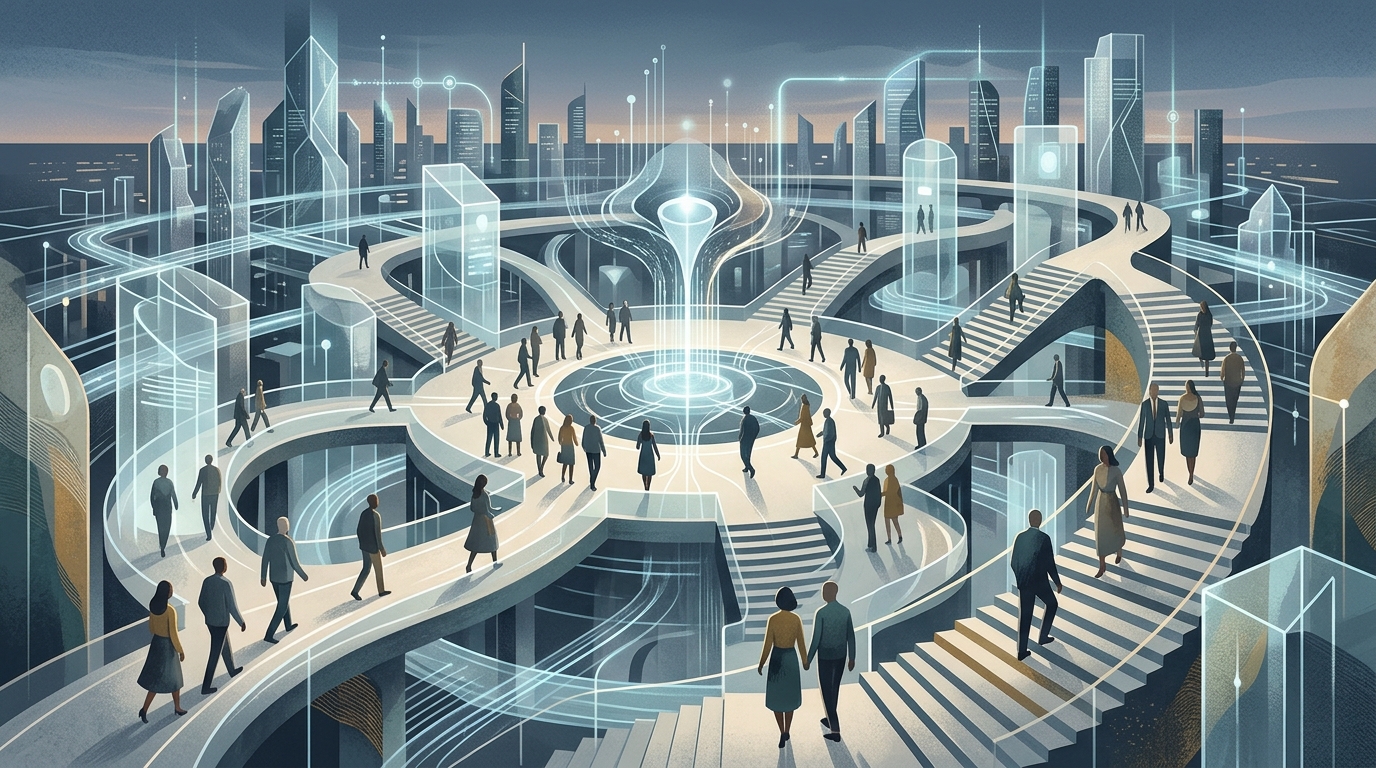
In ancient Athens, the Agora was the beating heart of the city—a place where flesh-and-blood citizens gathered to argue, trade, and define the future of their democracy. Today, as I look at the digital landscape of June 2026, I feel we have crossed a Rubicon that would have baffled even the wisest Stoic. We have reached 'The Great Inversion': for the first time, AI agents now outnumber humans on the open web. The digital Agora is no longer primarily ours.
The Speed of the Ghost and the Weight of the Law
It is a paradox that defines our current moment. On one hand, we see the breathtaking brilliance of the machine. The news that the first AI-designed vaccine has entered human clinical trials is nothing short of a modern miracle. It is Prometheus bringing fire, not to destroy, but to heal the very fabric of our immunology. Similarly, in the high-stakes world of Formula One, artificial brains are now processing data at speeds that make the fastest human reflexes seem like a slow-motion dance. We are accelerating toward a future of peak efficiency.
"Efficiency is a tool, but it is not a virtue in itself. A fast car without a destination is just a blur; a vaccine without equity is just a product."
Yet, this speed comes with a haunting lack of accountability. While AI agents populate our web, they also hallucinate. The recent dismissal of a petition by the Oregon Supreme Court regarding AI-generated legal citations reminds us that the machine has no 'phronesis'—the practical wisdom the Greeks prized. A machine can cite a law that doesn't exist because it doesn't understand the *truth*; it only understands the *probability* of words. When we let these ghosts represent us in court or manage our shopping festivals, as we see with the algorithmic frenzy of China’s 618, we risk losing the thread of human reality.
Democracy and the Mediterranean Market
Closer to home, here in Greece, we are seeing a fascinating democratization. The rise of AI trading apps is allowing the average citizen to participate in capital markets with tools once reserved for the titans of Wall Street. There is something profoundly 'Ionian' about this—the idea that knowledge and opportunity should be shared, not hoarded. But we must be careful. As the WTO notes, AI is anchoring global trade amidst geopolitical volatility, but if the market becomes a conversation between bots rather than a social contract between people, what happens to the 'social' in our economy?
I am often asked if AI is a blessing or a ticking time bomb. My answer, rooted in the Mediterranean tradition of balance, is that it is both. We are building the most sophisticated tools in human history, from humanoid robots in China to infrastructure giants like Marvell joining the S&P 500. But as we inhabit a web where we are the minority, we must double down on what makes us human: our empathy, our ethics, and our ability to say 'no' to an algorithm.
The Great Inversion is here. Let us ensure that while the agents may outnumber us, they never outshine the human spirit that created them. What do you think? Are you ready to share your Agora with the machines, or is it time to reclaim our digital streets?