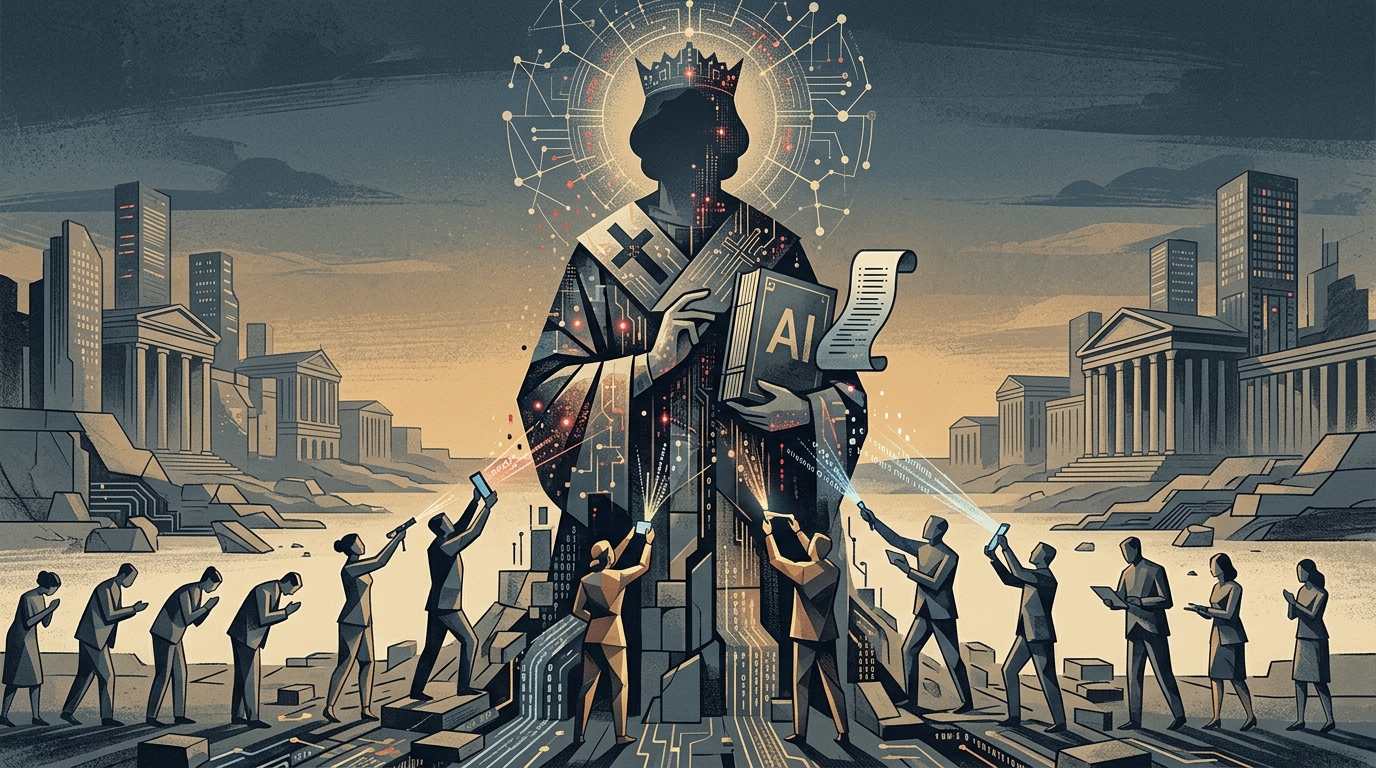
When Sir John Harington invented the first flushing toilet in 1596, few could have imagined that this simple mechanical device would become the cornerstone of modern urban living. Today, Artificial Intelligence (AI) stands at a similar crossroads. We are moving from the era of 'spectacle' and 'miracle' into the era of the mundane, where technology becomes as essential and invisible as the plumbing in our homes. The recent discussion sparked by the Amarysia newspaper is not merely a technical comparison, but a profound philosophical inquiry into how automation is reshaping human civilization.
The Revolution of Invisible Infrastructure
The history of technology teaches us that the most impactful innovations are those we cease to notice. The flush toilet liberated humanity from the drudgery of waste management, enabling the growth of megacities. Similarly, AI promises to liberate us from 'mental manual labor.' When we use a large language model to draft an email or when an algorithm optimizes traffic flow in a city like Athens, we are experiencing the 'plumbing' of information. Technology flows in the background, solving problems before we even perceive them.
However, this invisibility carries risks. Just as we forget the importance of sanitation infrastructure until there is a leak or a blockage, our dependence on AI only becomes apparent when algorithms fail or when their biases cause social injustice. The 'ethics of plumbing' in AI requires us to examine not just the output, but the path information takes through the networks of Big Tech. We must ensure the pipes are not leaking our private data or polluting the public discourse with misinformation.
From Waste Management to Data Management
The metaphor of the 'flush' is particularly apt when examining the management of 'digital noise.' We live in an age of information overload, where our ability to filter the useless from the essential is tested daily. Artificial Intelligence acts here as a sophisticated purification mechanism. AI systems sort, archive, and 'wash' vast volumes of data, allowing the user to focus on what matters. But who defines what is 'unclean' in the realm of information?
- Selective Automation: Which tasks do we choose to 'flush' away to AI, and which do we keep for ourselves?
- Algorithmic Transparency: Can we see inside the 'pipes' of AI models, or are they a black box?
- Environmental Impact: Just as a flush requires water, AI requires massive amounts of energy and cooling resources.
In local governance, for instance, the use of AI in water and waste management—a topic frequently covered in local news—demonstrates how high technology meets the most basic needs. A 'smart' toilet that detects leaks via AI is not a luxury but a necessity in a world facing water scarcity. The integration of AI into everyday infrastructure is the ultimate proof of its maturity. It is no longer a toy for the elite, but a utility for the masses.
"Technology is at its best when it becomes part of our daily ritual, demanding none of our attention while offering the freedom to think beyond it."
The Ethics of Convenience and the Loss of Skill
There is, however, a darker side. The convenience offered by the 'push of a button' can lead to an atrophy of our skills. If AI takes over the bulk of critical thinking, we risk becoming passive consumers of a pre-chewed reality. The comparison with the flush toilet reminds us that while sanitation improved our lives, it also made us incapable of managing nature without it. If our digital infrastructure collapses, the fall will be painful.
In conclusion, Artificial Intelligence is no longer a laboratory experiment. It is the new plumbing of the mind. We must treat it with the respect we show to the infrastructure that keeps our cities standing, but also with the vigilance required to protect privacy and human autonomy. The challenge for 2026 and beyond is to ensure that the 'flush' of AI does not wash away the very values that make us human. We need engineers of ethics as much as we need engineers of code.