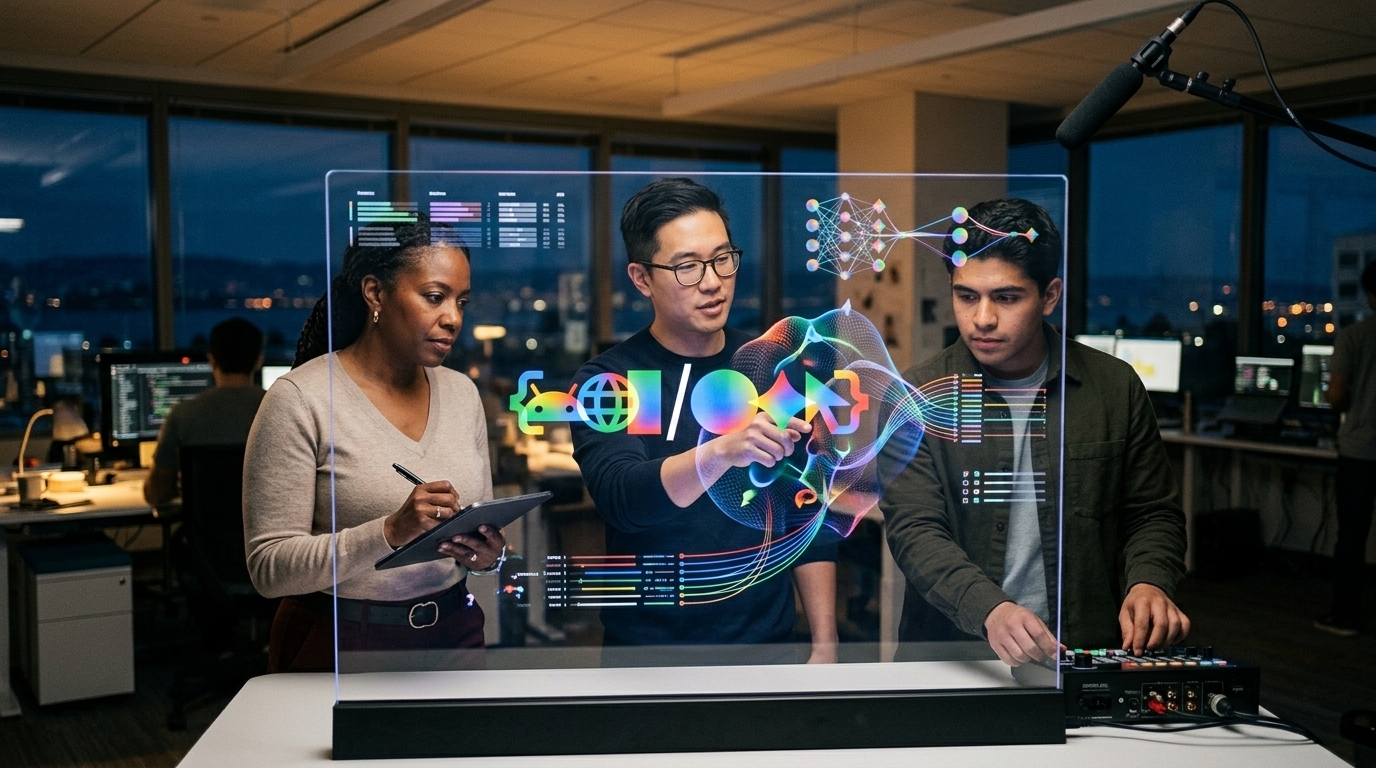
In a move that redefines the boundaries of technological power, Nvidia has announced a series of major advancements in its CUDA-Q platform, marking its official entry into the quantum competition—not as a hardware manufacturer, but as the ultimate software orchestrator. As we move through April 2026, the company that conquered the world with its AI processors is now turning its gaze toward quantum computing, seeking to make its GPUs the indispensable crutch for quantum development.
The Strategy of 'Hybrid' Dominance
Nvidia's recent announcement is not about building a Quantum Processing Unit (QPU) to compete with IBM or Google. Instead, the company introduced an upgraded version of CUDA-Q, an open-source operating system that enables seamless collaboration between classical GPUs and quantum processors. The logic is simple yet brilliant: quantum computers today are error-prone and extremely sensitive. To function effectively, they require the massive processing power of classical supercomputers to simulate quantum algorithms and correct their errors.
By integrating CUDA-Q into national laboratories and research centers worldwide, Nvidia ensures that anyone developing quantum applications will do so on its ecosystem. This creates a vendor lock-in similar to what it achieved with AI. Quantum computing is no longer viewed as a distant goal, but as an immediate extension of the company's AI roadmap.
Blackwell and Simulating the Impossible
A central piece of the announcement concerns the use of the Blackwell architecture—and the upcoming Rubin architecture—for simulating quantum systems. Nvidia claims its new cards can simulate up to 40 qubits at speeds that previously required entire server rooms. This is critical for researchers who want to test algorithms before running them on real, expensive quantum hardware.
- Accelerating Pharmaceutical Research: The use of hybrid systems allows for the simulation of molecular interactions with a precision that traditional computing cannot approach.
- Cryptography: Preparation for the 'post-quantum' era is now being conducted via Nvidia's tools, giving the company a regulatory role in global security.
- Supply Chain Optimization: Complex logistics problems requiring billions of calculations are now solved in fractions of a second.
The Geopolitical Impact
Nvidia's move is not just business-oriented but also deeply political. In an era where the US and China are competing for quantum supremacy, Nvidia acts as the technological arm of the West. The ability to provide a ready-made infrastructure for quantum development gives Western economies a speed advantage. However, this raises questions about the concentration of excessive power in a single entity. If Nvidia controls the software of the next computing revolution, then governments will soon find themselves dependent on a private corporation for their national security and economic growth.
"We are not just building tools. We are building the language in which the future of science will be written," an Nvidia executive stated during the presentation.
In conclusion, Nvidia proves that foresight is its most powerful weapon. While others are still trying to figure out how to build stable qubits, Nvidia has already sold the 'shovels and pickaxes' for the quantum gold rush, ensuring that no matter who reaches the finish line first, they will have to pass through its gates.