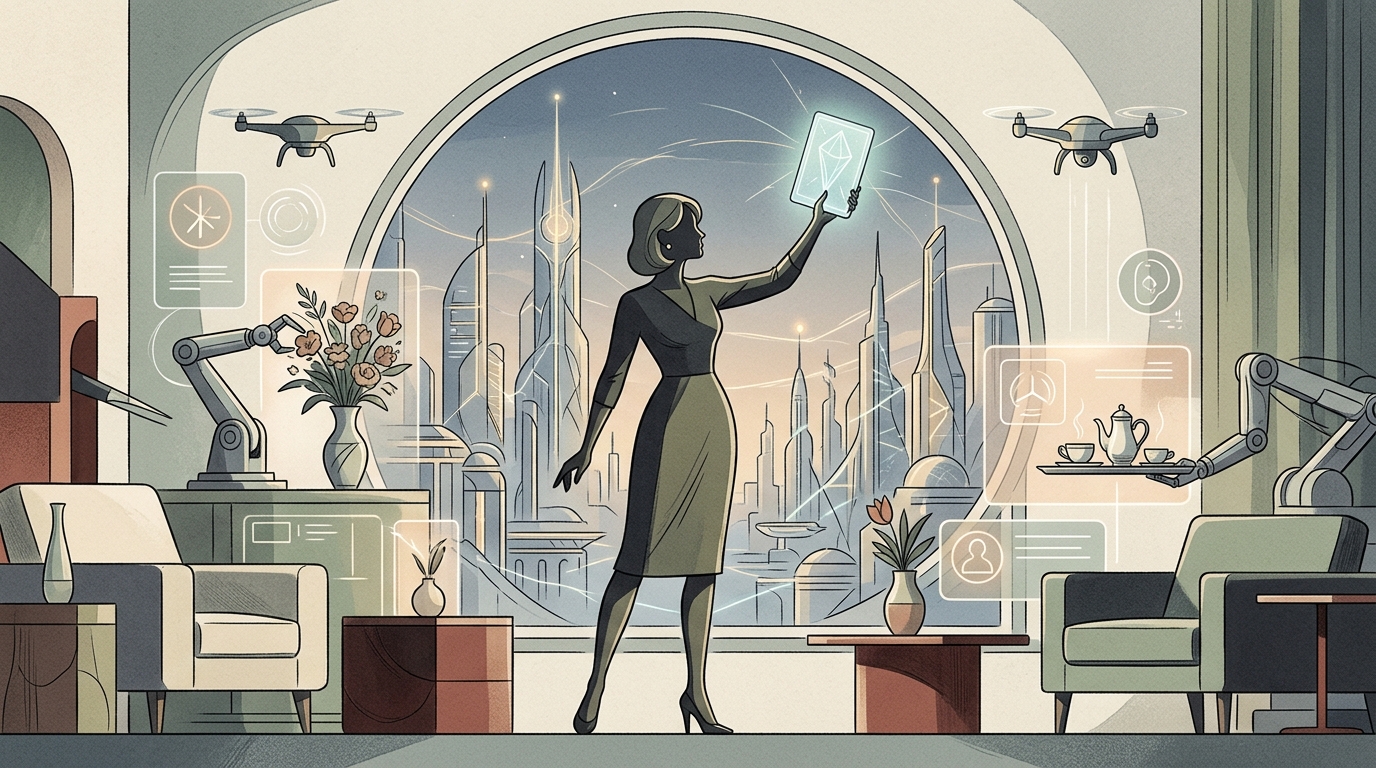
In an era where Artificial Intelligence (AI) is permeating every aspect of our professional lives, Martha Stewart, the undisputed doyenne of American domesticity, is turning her gaze toward the future of the home. Stewart, who has built an empire based on order, aesthetics, and efficiency, is now openly advocating that AI is not just a tool for developers, but the next essential assistant for every household. Her intervention, highlighted recently via PYMNTS.com, underscores a significant shift: technology is no longer just about the "smart home" of gadgets, but the total automation of living.
The Evolution of Domestic Management: From Notebooks to Algorithms
For decades, Martha Stewart taught people how to organize their pantries, how to plan their dinners, and how to maintain a garden. Today, at 84 (in 2026), she recognizes that the "mental load" of managing a home has become overwhelming for the modern individual. Her proposal is simple yet radical: let AI handle the tedious details. Imagine a system that doesn't just remember to order milk, but analyzes your nutritional habits, suggests menus based on seasonal produce in your fridge, and coordinates deliveries without any intervention from you.
Stewart does not see AI as something cold or impersonal. On the contrary, she perceives it as a means of freeing up time for creativity. According to her, if technology can manage appliance maintenance, bill payments, and cleaning schedules, then the homeowner can focus on the art of hospitality and personal expression. This approach shifts the AI narrative from the threat of replacement to the promise of lifestyle enhancement.
The "Martha Standard" in the Digital Age
The question that arises is whether AI can possess "taste." Stewart is known for her rigorous standards and aesthetic perfection. The integration of Generative AI into home control systems could theoretically allow users to "load" Stewart's style—or that of any other expert—into their digital assistant. An AI system could suggest table settings for a dinner party, taking into account lighting, the season, and the guest profile, following the principles Stewart has advocated for half a century.
- Automated inventory management of food and consumables.
- Smart energy consumption scheduling to reduce costs.
- Personalized decor and space organization suggestions.
- Coordination of home services (cleaners, technicians) via AI agents.
However, this digital perfection carries risks. Relying on algorithms for decision-making within the home could lead to a homogenization of everyday life. If everyone follows the "best practices" of an AI, the element of spontaneity and personal clutter that makes a home feel alive is lost. Stewart, nevertheless, seems to believe that the discipline offered by technology is the key to true freedom.
Social Implications and the Automation Divide
The adoption of AI in the home is not just a matter of convenience, but also of economic power. As Martha Stewart promotes this vision, a question emerges: who can afford the "perfect" AI home? There is a risk of creating a new social stratification, where the wealthy enjoy the luxury of free time thanks to automation, while others struggle with the complexity of traditional domestic tasks.
"AI in the home is not a luxury; it is the evolution of domestic economy that began with the washing machine and the electric iron," say market analysts.
Furthermore, data security remains the major stumbling block. A home run by AI is a home that is constantly monitored. The cameras, microphones, and sensors needed to operate Stewart's envisioned system collect sensitive information about people's most private moments. The challenge for tech companies will be to convince consumers that the convenience offered by AI is worth the surrender of part of their privacy.
Conclusion: The Future is Curated
Martha Stewart is not just proposing the use of gadgets, but a new philosophy of living. In her vision, the home of the future is a living organism that cares for its occupants, anticipates their needs, and maintains a level of aesthetics that previously required a fleet of domestic staff. Whether it's adjusting the temperature or creating the perfect playlist for a party, AI becomes the invisible butler that never tires. Whether this future will be a utopia of order or a golden cage of algorithms remains to be seen.