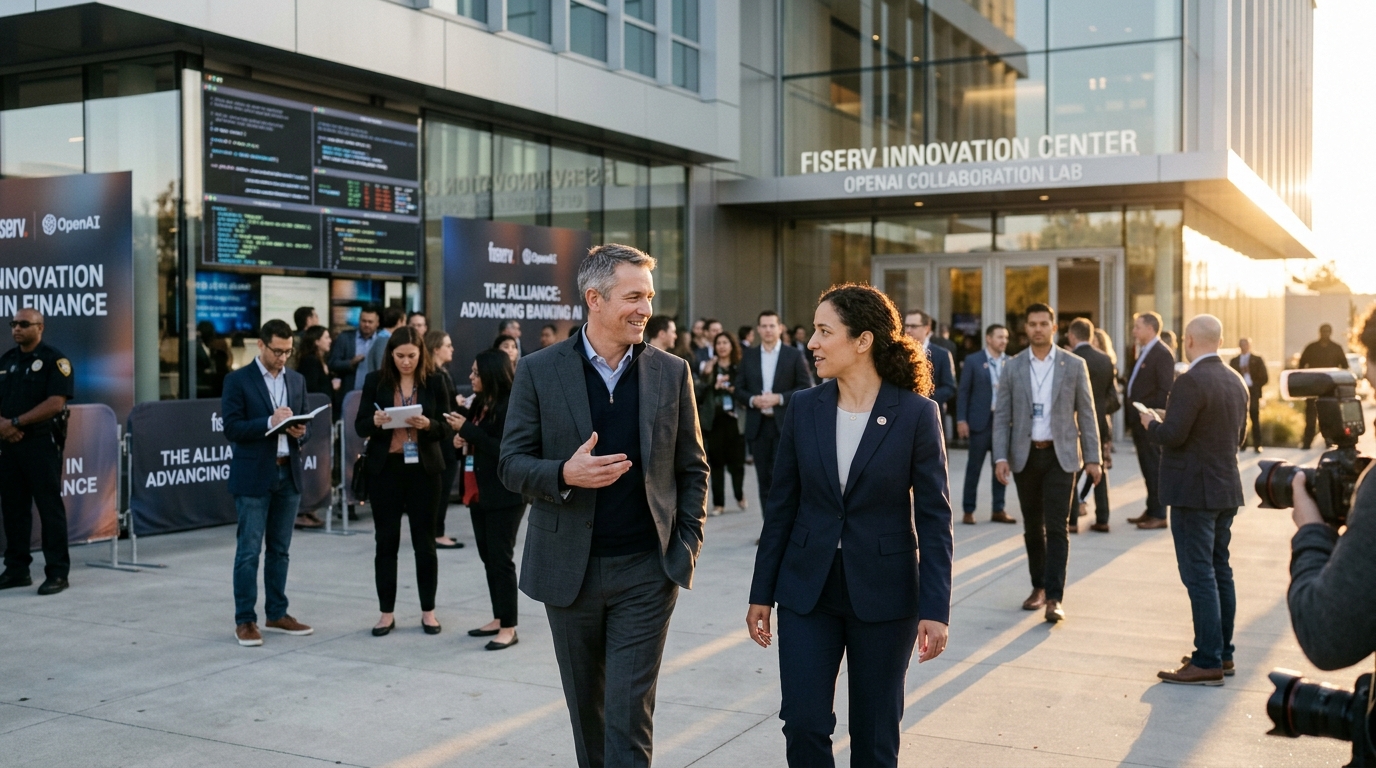
In an era where digital convergence redefines every aspect of economic activity, the announcement of a partnership between Fiserv, a global leader in payments and financial services technology, and OpenAI, the company that ignited the generative AI revolution, marks a critical turning point. This collaboration is not merely a technical upgrade; it is a structural shift in how banks—especially small and mid-sized ones—interact with customers and manage risk.
Democratizing AI for Banks
For decades, access to cutting-edge technology was the privilege of Wall Street giants who possessed the resources to develop proprietary systems. Fiserv, which serves thousands of financial institutions and millions of merchants, acts as the vital bridge. By integrating OpenAI’s models (such as GPT-4o and its subsequent iterations) into its ecosystem, Fiserv enables regional banks and credit unions to offer services that were previously the domain of science fiction.
The partnership focuses on delivering "bank-grade" solutions. This means the power of Large Language Models (LLMs) is combined with rigorous security protocols, data privacy protections, and regulatory compliance—elements that represent the "Holy Grail" for the financial sector. The goal is to move beyond experimentation and into industrial-scale deployment where reliability is non-negotiable.
From Customer Service to Risk Prediction
The applications of this technology span across three main pillars. First, Customer Experience (CX). Traditional chatbots, which often frustrated users with their rigidity, are being replaced by sophisticated digital assistants that understand context, sentiment, and complex financial needs. A customer can now ask for a personalized spending analysis or advice on loan repayment in natural language, receiving responses that mimic a human advisor’s nuance.
Second, Operational Efficiency. Fiserv is leveraging AI to automate code generation, document analysis, and back-office management tasks. This drastically reduces operational overhead, allowing banks to reinvest capital into innovation rather than the maintenance of legacy systems. The internal productivity gains for a bank's workforce can be transformative, freeing humans to focus on high-value strategic roles.
Third, and perhaps most crucially, is Fraud Mitigation. OpenAI's models can analyze vast volumes of transaction data in real-time, identifying patterns that escape traditional rule-based algorithms. In a world where cyberattacks are becoming increasingly sophisticated and AI-driven, Frontier AI serves as the essential first line of defense, shifting from reactive to proactive security postures.
Challenges and Ethical Dilemmas
Despite the enthusiasm, the integration of AI into banking is not without its perils. The "black box" nature of some AI models raises questions about the explainability of decisions, especially regarding loan approvals or credit scoring. There is a persistent risk that algorithms may replicate historical biases, leading to unintended discrimination against certain demographics.
Furthermore, the reliance on a single provider like OpenAI creates questions about systemic resilience. If a central AI model experiences a catastrophic failure, the repercussions could ripple through the entire banking system. Fiserv and OpenAI must prove that their architecture is robust enough to withstand the pressures of a global economic crisis or a coordinated cyber offensive. Regulatory bodies like the SEC and the ECB are watching closely, demanding that AI in finance remains accountable and auditable.
The Future of Banking is Intelligent
Fiserv’s move is a clear statement: artificial intelligence is no longer an experiment in Silicon Valley labs but the core operating system of the modern economy. As we move further into 2026 and beyond, the distinction between a "tech company" and a "bank" will continue to blur. Banks that embrace these technologies will secure a distinct competitive moat, while those that hesitate risk being marginalized in a world that moves at the speed of an algorithm. The partnership between Fiserv and OpenAI is the blueprint for this new, intelligent financial landscape.