In an era where technological evolution outpaces human adaptability, Jensen Huang, the visionary leader of Nvidia, is sending a powerful message to parents and the educational establishment. The traditional obsession with "correct" degrees—usually translating into computer science diplomas and learning programming languages—may now be an anachronism. According to Huang, Artificial Intelligence (AI) has already begun bridging the gap between human thought and technical execution, making "soft skills" the new hard currency of the labor market.
The Dethroning of Coding as a "Must-Have" Skill
For decades, the advice to every young person was simple: "learn to code." Huang, however, argues that AI has turned our natural language into the most powerful programming language in the world. "It is our job to create computing technology such that nobody has to program," he recently stated, causing a stir in the academic world. His logic is straightforward: if AI can write code, then human value no longer lies in syntax and commands, but in high-level conceptualization and problem-solving.
This shift means that children currently being pressured to master Python or C++ might find themselves with skills that are automated before they even graduate. Instead, the ability to ask the right questions (prompt engineering) and understand the broader context of a problem is becoming the critical dividing line between success and obsolescence.
The Return of the Liberal Arts
Perhaps the most disruptive point of Huang's approach is his emphasis on creativity, storytelling, and human judgment. In a world where content production and data analysis are performed instantaneously by machines, the ability to tell a compelling story or make ethical decisions gains new value. Huang urges parents not to underestimate the arts and humanities. History, philosophy, and literature offer the tools for understanding human nature—something that AI, despite its impressive mimicry, does not authentically possess.
- Critical thinking allows for the evaluation of AI-generated outputs.
- Creativity drives innovation that algorithms cannot predict.
- Empathy remains the key to collaboration and leadership.
Huang emphasizes that "domain expertise" is now more important than technical expertise. A biologist who understands how to use AI to discover new drugs is far more valuable than a programmer who does not understand biology. Technology becomes the tool, not the end goal.
A New Paradigm for Career Longevity
The implications for the future of work are profound. If technical barriers to entry are lowered, competition will shift toward those who can best integrate AI into their specific fields. This requires a multidisciplinary approach to education. Rather than focusing on a single, narrow specialization, students should aim for a "T-shaped" skill set: deep expertise in one area combined with a broad understanding of how other fields—including AI—interact with it.
"Our world needs people who can dream, not just people who can execute orders. AI will handle the execution. We must hold onto the dream."
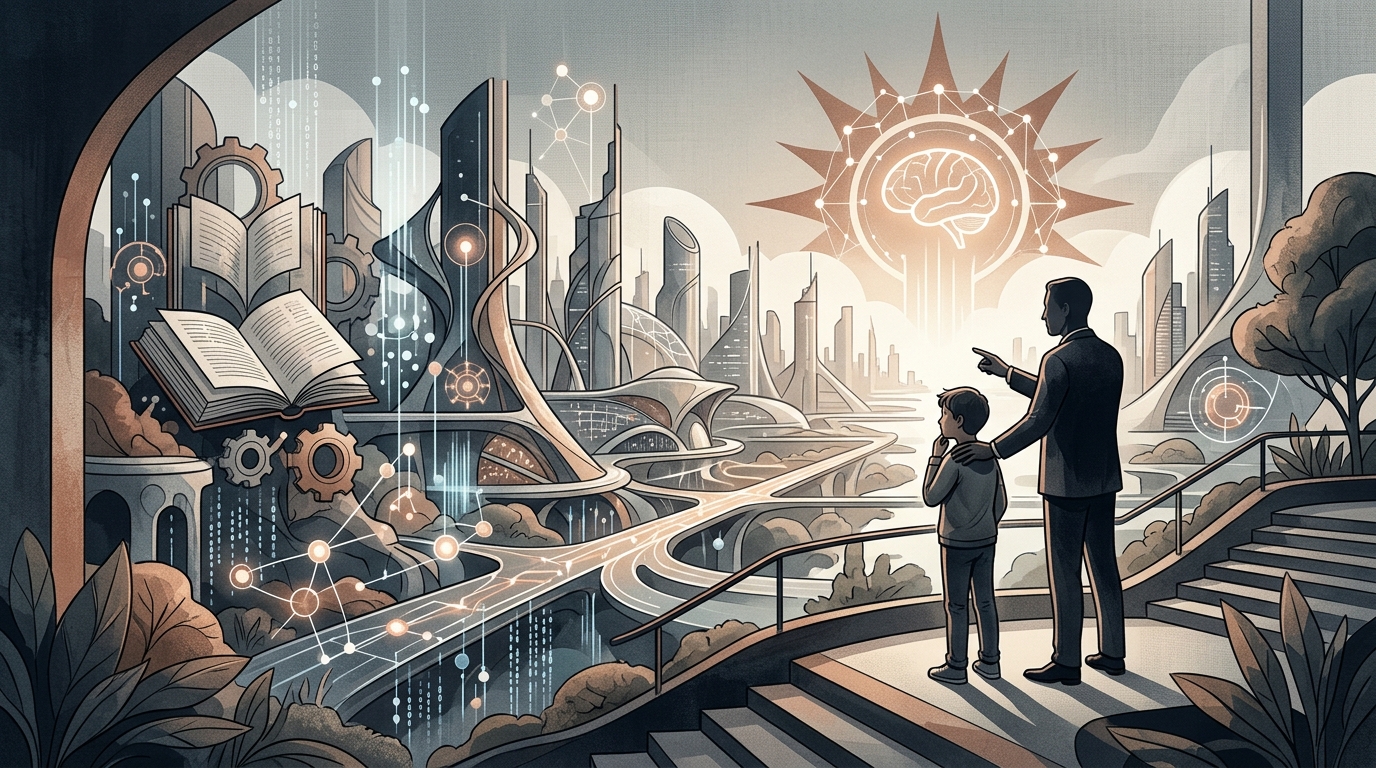
Huang’s perspective suggests that the most successful individuals of the future will be those who view AI as a co-pilot rather than a replacement. By offloading the mechanical aspects of work to algorithms, humans are freed to focus on what they do best: innovating, empathizing, and leading. For parents, this means fostering a child's natural curiosity and resilience rather than forcing them into a pre-defined technical mold.
In conclusion, Jensen Huang’s exhortation is not a call to abandon technology, but a call to return to the essence of human education. AI is not the enemy of knowledge, but the liberator of the human spirit from repetitive and technical tasks. Parents who manage to cultivate curiosity, adaptability, and a love for creation in their children will be the ones who best prepare them for the challenges and opportunities of the 21st century.