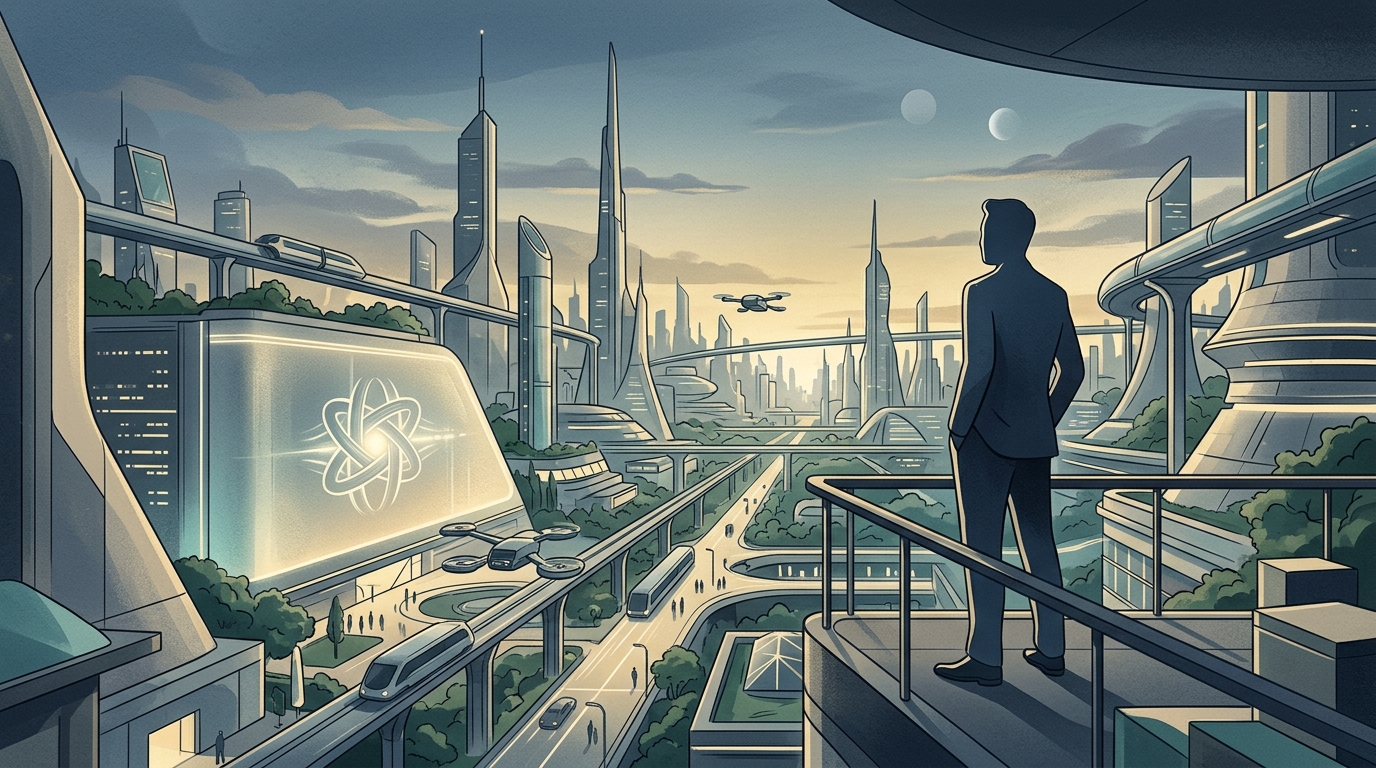
In an era where humanity is still grappling with inflation, energy crises, and social inequalities, Elon Musk proposes a future that feels more like science fiction than economic forecasting. In his recent remarks, most notably at the VivaTech conference, the billionaire founder of Tesla and xAI described a scenario where Artificial Intelligence (AI) will make work "optional" and money, in its current form, obsolete.
The Shift from Scarcity to Absolute Abundance
Musk’s central thesis rests on the assumption that AI and robotics will lead to an "abundance economy." Currently, the value of goods and services is determined by resource scarcity and the cost of human labor. However, if labor is replaced by robots (like Tesla’s Optimus) that can operate 24/7 at a negligible cost, then the production cost of almost everything will trend toward zero.
In this context, Musk introduces the term "Universal High Income" (UHI), distinguishing it from the well-known "Universal Basic Income" (UBI). While UBI aims to cover basic survival needs, UHI promises a life without deprivation, where everyone has access to any good or service they desire. "There will be no shortage of goods or services," he stated, signaling the end of the economic pressure that has defined human history since its dawn.
The Role of Optimus and the Automation of Physical Labor
To achieve this vision, technology must transcend the digital realm and enter the physical world. This is where Optimus, Tesla’s humanoid robot, comes in. Musk argues that the market for humanoid robots will eventually surpass that of cars, as they will be capable of performing everything from simple household chores to complex industrial tasks. Once the cost of such a robot falls below that of a car, global productivity will skyrocket to levels currently unimaginable.
- Complete automation of the supply chain.
- Reduction in housing costs through robotic construction.
- Elimination of hazardous and repetitive occupations.
The Existential Challenge: Finding Meaning in a Post-Labor World
Perhaps the most intriguing—and unsettling—point of Musk's prediction is not economic, but psychological. If work is no longer necessary for survival, what will give human lives meaning? For centuries, an individual's identity has been inextricably linked to their profession and their contribution to society through labor.
"The big question will be one of meaning. If AI can do everything better than you, what is the reason for existence?"
Musk admits that this could lead to a global existential crisis. The challenge for future generations will be to redefine happiness and success away from productivity and wealth accumulation, perhaps focusing instead on the arts, philosophy, and human connection.
Geopolitical and Social Implications: Who Controls the Abundance?
Despite Musk’s optimism, critics point to the inherent risks of this transition. If AI makes labor redundant, power will likely concentrate in the hands of those who own the technology and infrastructure. How will we ensure that "high income" is distributed fairly? Furthermore, reliance on closed AI systems raises serious questions about individual liberty and democracy.
In such a scenario, the state would need to transform from a market regulator into a manager of abundance. However, the transition is expected to be volatile, with millions of jobs lost before support mechanisms are fully established. Musk, while promoting this future, simultaneously warns that AI remains the greatest threat to our civilization if not developed with safety and ethics at the forefront.
Conclusion: Utopia or a New Form of Dependency?
Musk’s vision of the end of work is a bold challenge to the status quo. Whether it is an inevitable evolution of technological progress or the overly optimistic prediction of a tech messiah, one thing is certain: the debate over AI's role in the economy is no longer theoretical. Humanity is called to decide if it is ready to live in a world where toil is a choice rather than a necessity, and if it can manage the freedom that such a shift would bring.