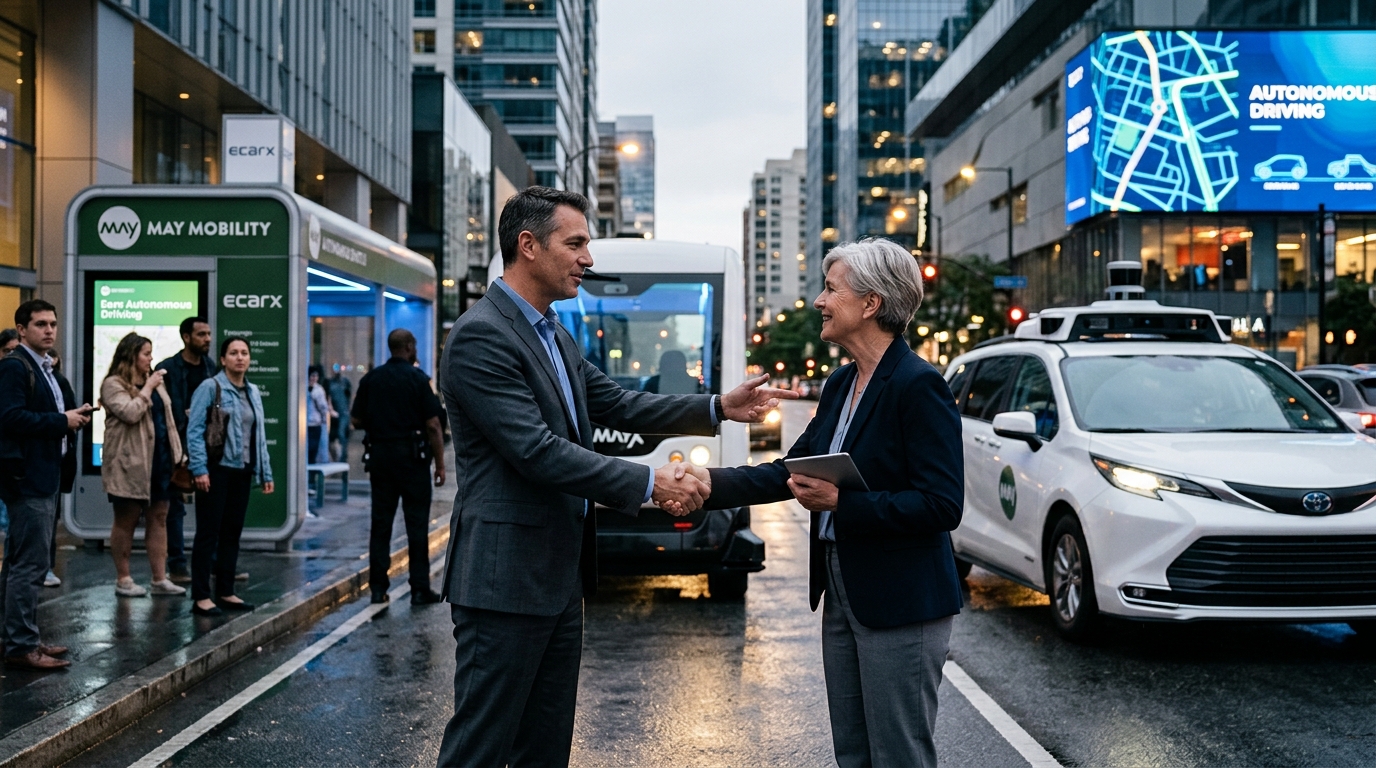
In an era where trade relations between Washington and Beijing resemble a minefield, autonomous driving technology seems to be finding its own path to bridge the world's two largest economies. Ecarx Holdings Inc., the vehicle technology company backed by Geely’s billionaire founder Li Shufu, has announced a landmark $750 million agreement with US-based startup May Mobility. This deal is not merely a hardware sale; it represents a strategic convergence that could redefine the landscape of urban transportation in the United States.
May Mobility, headquartered in Ann Arbor, Michigan, specializes in autonomous driving software for micro-transit. Until now, the company relied on retrofitting production vehicles. However, this new partnership with Ecarx allows it to access specialized robotaxi platforms, designed from the ground up for autonomous operation, integrating the computing power and sensors required for full Level 4 automation.
The Strategic Weight of Li Shufu and Geely
Li Shufu, the visionary behind Volvo’s renaissance and the emergence of Polestar, is once again proving that the automotive industry of the future knows no borders. Ecarx, which went public on the Nasdaq via a SPAC merger, serves as the technological arm of the Geely ecosystem. Its ability to ink deals of this magnitude with American entities highlights a critical reality: China currently holds the reins of production scale and the supply chain for smart vehicles.
The agreement outlines the delivery of thousands of units over time, which May Mobility will use to expand its services across US cities. The interesting element is the vehicle architecture. Ecarx is not just providing a "box on wheels" but a comprehensive technology stack that includes AI processors and safety systems, upon which May Mobility will layer its proprietary Multi-Policy Decision Making (MPDM) software.
Political Hurdles and the National Security Challenge
Despite the financial optimism, the deal arrives at a time of intense scrutiny from the US government regarding Chinese technology in connected vehicles. The US Department of Commerce has raised concerns about data collection from sensors and cameras manufactured in China. Ecarx and May Mobility will have to navigate a labyrinth of regulations to ensure that American citizens' data does not end up on servers outside the country.
Analysts suggest that the structure of the deal—where the control software remains American while the hardware is of Chinese origin—might serve as a blueprint for future collaborations. It is a delicate balance between the cost efficiency of Chinese manufacturing and the political necessity for domestic control over software. If May Mobility can deploy these vehicles without friction, it will prove that the market can transcend geopolitical rivalries when the stakes are dominance in the next phase of mobility.
The Future of Urban Transit
The $750 million investment signals a transition from experimental stages to commercial scaling. Robotaxis are no longer a vision of the future but a business reality requiring massive capital and reliable hardware. Ecarx, through this partnership, positions itself as a global supplier of "brains" and chassis for autonomous driving, regardless of who operates the fleet.
For May Mobility, accessing Ecarx's technology means faster deployment. In an industry where giants like Google’s Waymo and GM’s Cruise dominate, smaller players must find clever ways to reduce cost-per-mile. Partnering with a giant like Li Shufu provides the exact economy of scale needed to make autonomous transit affordable for the general public.
- Ecarx provides the hardware platform and computational power.
- May Mobility focuses on software and operational deployment in the US.
- The deal's value reflects high demand for turnkey robotaxi solutions.
- Geopolitical challenges remain the primary risk for implementation.
In conclusion, this move by Ecarx is a bold statement of confidence in the global market. In a world leaning toward isolationism, technology continues to seek efficiency, reminding us that the AI revolution on our streets will be, whether we like it or not, an international affair.