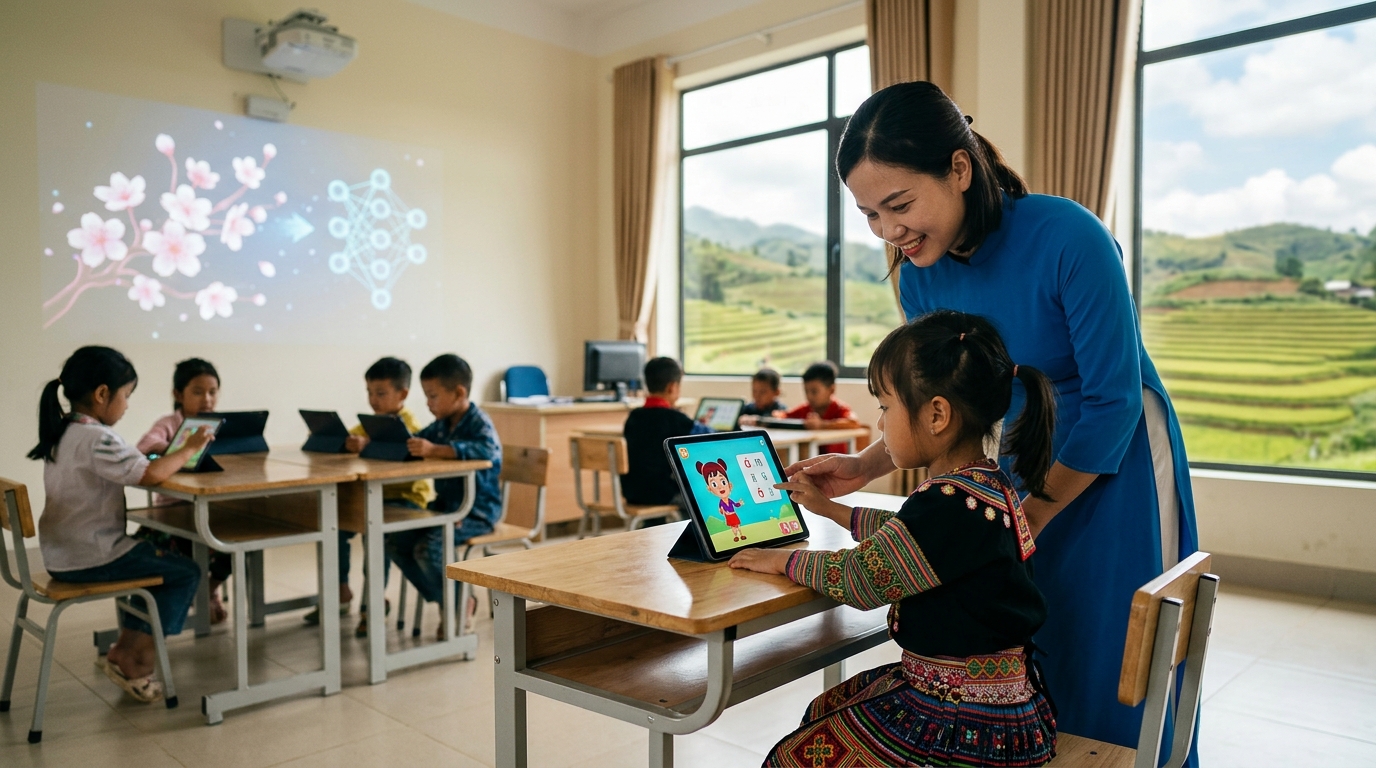
In one of the most scenic yet economically challenging regions of northern Vietnam, the Tuyen Quang province, a quiet revolution is taking place. Where misty peaks meet traditional communities, Artificial Intelligence (AI) is no longer a science fiction scenario, but a daily tool in the hands of preschool teachers. The recent success of the region's educators in provincial-level competitions is not just a piece of local news; it is a global example of how technology can democratize the quality of education, regardless of geographical constraints.
AI as a Pedagogical Partner
Preschool teachers in Tuyen Quang have begun integrating Generative AI tools to create rich audiovisual material that previously required hours of work or specialized graphic design skills. Using platforms for image generation and video editing, educators are transforming Vietnamese folk tales into vivid, interactive experiences. The ability to produce personalized content that responds to local cultural nuances, while simultaneously introducing children to modern visual languages, is what gave them the edge in recent competitions.
According to reports from local educational officials, the use of AI is not limited to aesthetic upgrades of lessons. Teachers are using Large Language Models (LLMs) to design more effective curricula, find creative ways to explain difficult concepts, and organize their administrative work, freeing up valuable time for direct interaction with their students. This "hybrid" approach—where the machine takes on the heavy lifting of content production and the human focuses on empathy and guidance—represents the new standard for early childhood education.
The Leapfrogging Strategy and State Support
The case of Tuyen Quang is no coincidence. It fits into the broader framework of Vietnam's National Digital Transformation Program to 2025. The country's government has strategically invested in the digital training of teachers, recognizing that AI can act as an accelerator for developing regions. What we are observing is the phenomenon of "leapfrogging": areas lacking traditional infrastructure (such as large libraries or high-tech labs) are jumping directly into the AI era, bypassing intermediate stages of technological development.
- Enhancing creativity through tools like Canva AI and ChatGPT.
- Personalizing learning for children with different developmental paces.
- Reducing the digital divide between urban and rural areas.
- Promoting local culture through modern media.
The competitions where the teachers excelled did not only evaluate technical proficiency but primarily the pedagogical value of AI use. Judges were impressed by how educators managed to maintain the human-centric nature of teaching, using technology as a "magic wand" that makes knowledge more attractive to toddlers.
Challenges and Ethical Dilemmas in the Classroom
Despite the enthusiasm, integrating AI into early childhood education brings significant questions. How much exposure to digitally generated content is healthy for a three- or four-year-old? How do we ensure that AI does not replace the teacher's critical thinking but enhances it? Educators in Tuyen Quang seem to perceive these risks, using technology primarily for material preparation and less as a direct interface for the children.
"Artificial Intelligence is my assistant, not my replacement. It allows me to dream bigger things for my students," said one of the award-winning teachers.
This success sends a powerful message to the international community: innovation does not always require massive budgets, but it does require vision, proper guidance, and the will to embrace the new. Tuyen Quang is showing the way for how AI can become the tool that levels the playing field for every child, in every corner of the world.