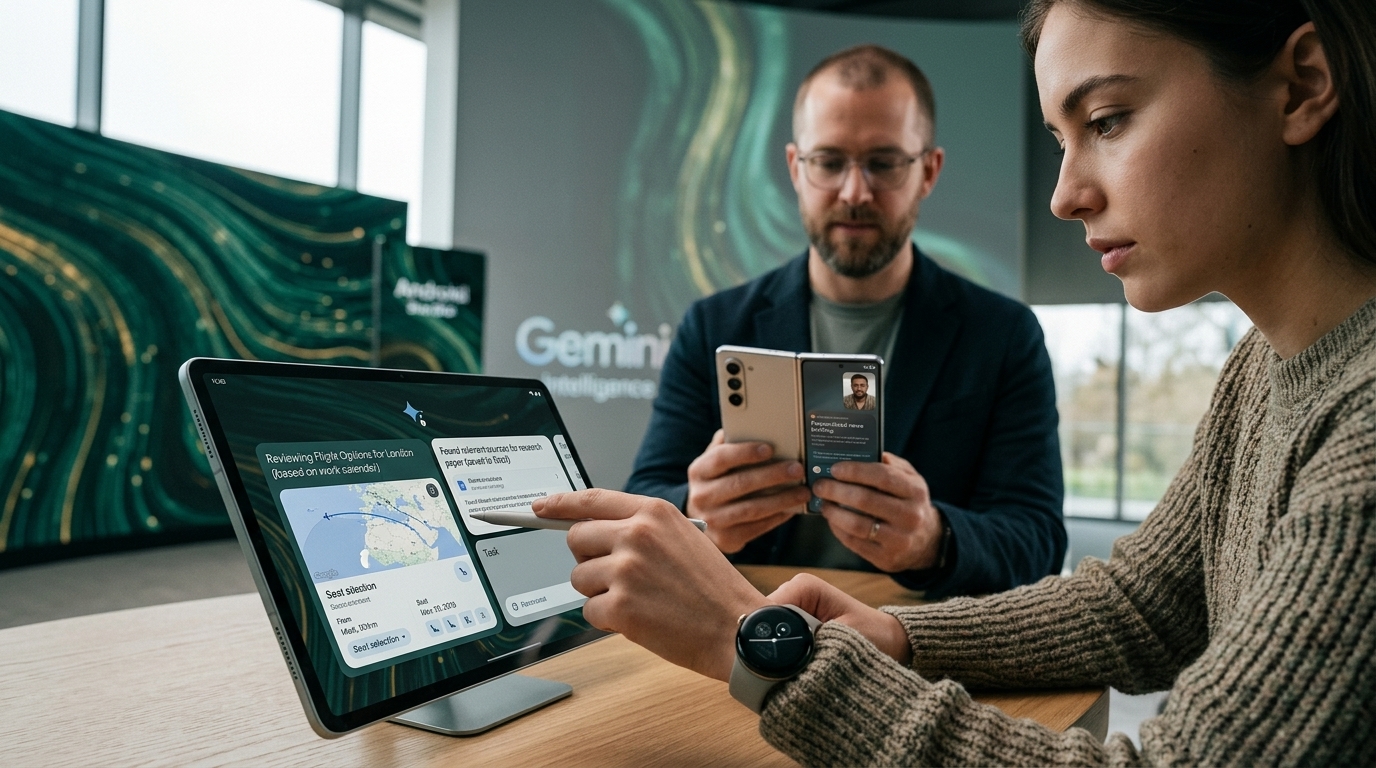
At the landmark Android Show 2026, Google unveiled the next major milestone in the history of mobile computing: Gemini Intelligence. This is not merely a software update; it is a fundamental paradigm shift. For over a decade, Android functioned as a passive intermediary between the user and their applications. Today, with the integration of proactive AI at every level of the OS stack, the smartphone stops waiting for commands and begins anticipating needs.
From App Ecosystems to Agent Ecosystems
The core philosophy behind Gemini Intelligence is the dissolution of silos between applications. Until now, users had to open a calendar to view a meeting, maps to find a route, and Gmail to confirm a reservation. Gemini Intelligence acts as a "web" that connects these data points in real-time. Utilizing the new Gemini Nano 3.0 model, which runs exclusively on-device, Android can now perceive the context of our activities without needing to send data to the cloud.
For instance, if you receive a message on WhatsApp about a dinner on Friday, the system won't just suggest adding it to your calendar. It will check traffic patterns, suggest a reservation via OpenTable, and remind you to send flowers if the calendar indicates an anniversary. This "proactivity" is what differentiates the new Android from anything we have seen before.
Multimodal Context: The Device That "Sees" Your Screen
One of the most impressive features introduced is Live Overlay. This is a transparent AI layer that "reads" whatever is happening on the user's screen, regardless of the app in use. If you are watching a YouTube video about Renaissance architecture, you can ask "Where is this building located?" and Gemini will answer instantly, recognizing visual data in real-time.
- Continuous Learning: The system learns user habits without violating privacy by storing a "Personal Knowledge Graph" locally on the device.
- Natural Flow Voice Interaction: Communication with Gemini Intelligence no longer requires specific keywords; it recognizes pauses, hesitations, and emotional nuances.
- Autonomous Task Execution: Android can now execute complex sequences of actions, such as organizing an entire trip, by communicating directly with service APIs.
The Privacy Paradox and Data Security
Turning a phone into an assistant that knows everything about us raises legitimate concerns. Google addressed these challenges with the "Private Compute Core." Every proactive action by Gemini Intelligence is processed in an isolated sector of the processor, inaccessible even to Google or third-party apps. The use of encrypted local memory ensures that our digital footprint remains personal.
"We are not just building a smarter phone; we are building an AI that respects human autonomy while augmenting our capabilities," stated Rick Osterloh during the keynote.
However, analysts point out that the fine line between "helpfulness" and "manipulation" is becoming increasingly blurred. If Android always suggests the same shop or service because it "fits our preferences," there is a risk of creating a digital echo chamber that restricts our choices.
The Battle for AI Mobile Supremacy
This move by Google is a direct response to Apple Intelligence and the continuous evolution of iOS. With Gemini Intelligence, Google leverages its massive data advantage from Search and Maps, offering an experience that is far more "connected" to the physical world than its competition. 2026 will go down in history as the year the smartphone ceased to be a tool and became a partner.
In conclusion, the new era of Android promises to relieve us of the "cognitive load" of managing multiple apps. Its success will be judged by whether users trust this technology enough to allow it to permeate every aspect of their daily lives.