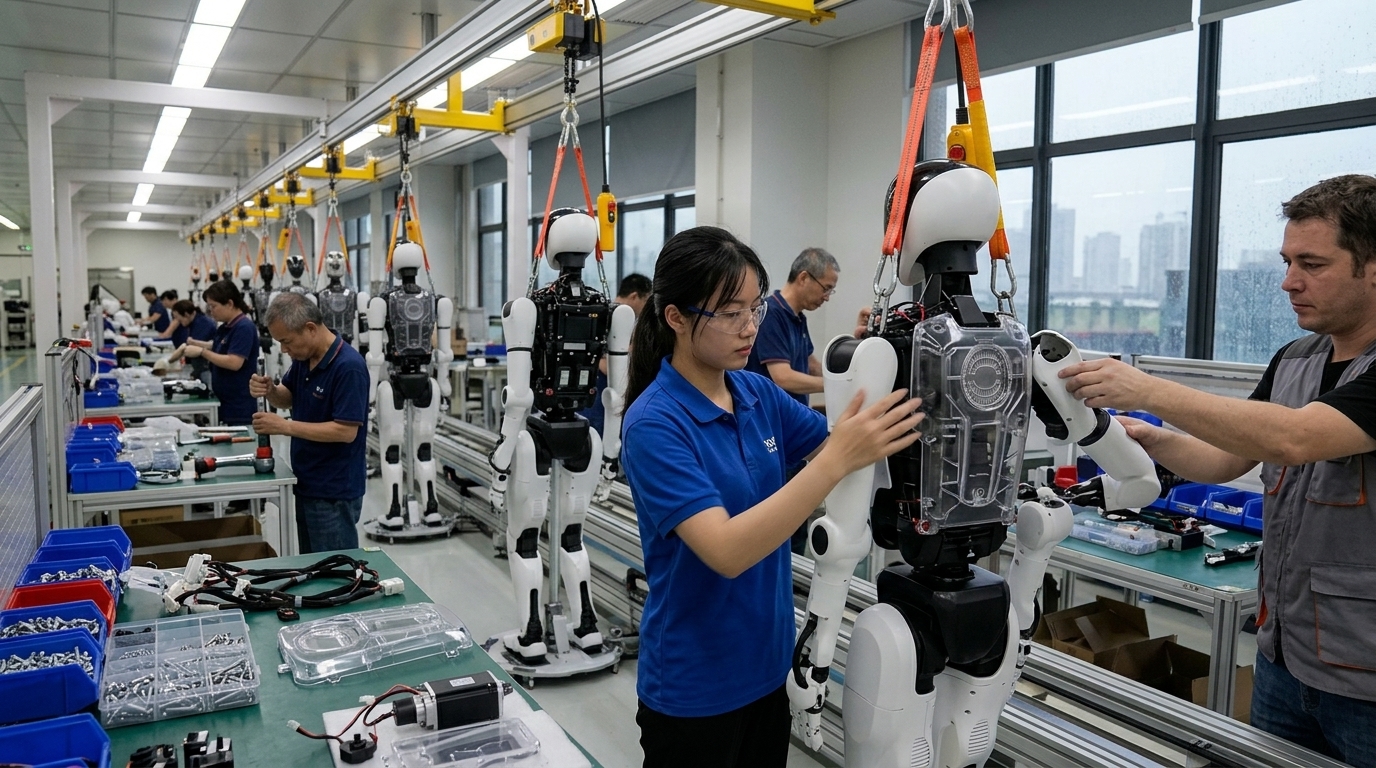
In the bustling tech hubs of Shenzhen and the R&D corridors of Hangzhou, a new army of steel and silicon is preparing for a global deployment. China, true to its tradition of dominating through industrial scale, has already begun shipping thousands of humanoid robots annually, vastly outstripping Western competitors in sheer volume. However, a closer inspection reveals a sobering reality: while these robots can perform impressive backflips, dance in perfect synchrony, or serve coffee at trade shows, their actual utility in complex industrial environments remains largely performative.
Scale Over Substance: The Beijing Strategy
The Chinese government has set an ambitious national goal: to lead the global robotics market by 2027. Through massive state subsidies and the mobilization of industry giants like Unitree, Fourier Intelligence, and Agibot—the startup founded by former Huawei prodigy Peng Zhihui—the country has managed to drive down the cost of humanoid hardware to levels Silicon Valley considers impossible. Yet, this speed comes with a trade-off. Industry experts point out that the current focus is heavily weighted toward hardware and aesthetics, while the "embodied AI" required to navigate complex, unpredictable human environments lags significantly behind.
As reported by Fortune AI, the problem is structural. "Without the demand and without that scale from the market, these companies are not able to really go into mass production" in a way that generates real-world value, analysts note. The robots being shipped today are primarily ending up in research labs, universities, or serving as high-tech mascots in corporate lobbies. They are "performative"—a display of manufacturing prowess and potential that lacks the fine motor skills and autonomous decision-making required to replace a human worker on a dynamic factory floor.
Geopolitical Competition and the AI Arms Race
Dominance in humanoid robotics is not merely an economic objective; it is a profound geopolitical imperative. Under the banner of "New Productive Forces" championed by Xi Jinping, robotics is the key to solving China's looming demographic crisis. With a shrinking working-age population, Beijing is betting on automation to maintain its status as the "world's factory." However, Washington is watching closely. US export restrictions on advanced AI chips have forced Chinese manufacturers to innovate with domestic processors, which often lack the computational density required to train the massive vision-language-action (VLA) models that drive truly autonomous behavior.
- The Unitree G1, priced starting at $16,000, is the most prominent example of an attempt at mass-market commercialization.
- Agibot is aiming to integrate Large Language Models (LLMs) directly into its robots, allowing them to understand and execute verbal instructions.
- Fourier Intelligence is pivoting toward medical rehabilitation, a field where repetitive precision is more valuable than general-purpose adaptability.
The Software-Hardware Chasm
The critical question remains whether China can bridge the software gap. While Western firms like Tesla with its Optimus project and Figure AI focus on developing "end-to-end neural networks"—where the robot learns tasks through observation and trial—Chinese firms often rely on more traditional, scripted motion control. This means a Chinese robot can perform a pre-programmed choreography flawlessly but may struggle to pick up a fallen object it hasn't encountered before in its training data.
"Mass production without functional value risks creating a bubble similar to the early days of the EV market," warns a senior market analyst.
Ultimately, China's strategy appears to be: "build it, and the utility will come." By flooding the market with affordable hardware, they hope the global developer community will discover the "killer apps" that make these machines indispensable. It is a bold gamble. If it succeeds, it will redraw the map of global industry. If it fails, it will be remembered as a costly parade of sophisticated, but ultimately hollow, iron dolls.