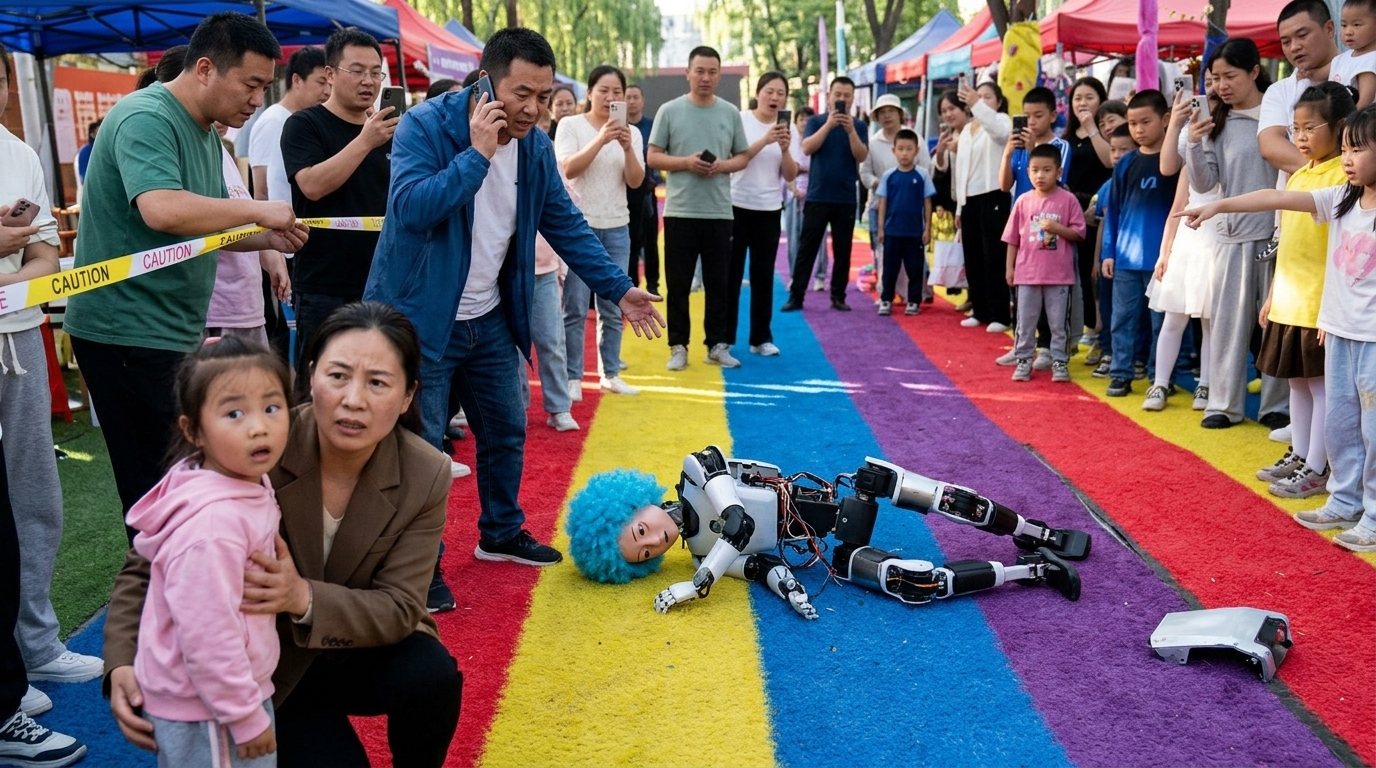
The recent incident in China's Xinjiang province, where an autonomous robot at a tourist attraction struck a minor, is more than just a viral clip on social media. It represents a critical juncture highlighting the safety gaps and ethical challenges accompanying the mass integration of robotics into daily life. The footage, which has circulated widely, shows the robot moving unpredictably and colliding with the child, sparking widespread concern over the reliability of its sensory systems.
Rapid Deployment vs. Safety Standards
China leads the world in the adoption of robotic systems, spanning from logistics to customer service. However, the velocity at which these systems are deployed often outpaces the establishment of rigorous safety protocols. The Xinjiang incident underscores the failure of obstacle avoidance systems, which typically rely on LiDAR sensors and computer vision cameras. When these systems are compromised by lighting conditions, crowding, or the unpredictable movements of children, the result can be physical injury.
Technical analysis suggests the robot's software likely failed to categorize the child as a high-priority obstacle or miscalculated their trajectory. In high-traffic environments, algorithms must be trained to react with extreme conservatism, stopping instantaneously at any sign of ambiguity. The absence of such fail-safes points to a rush toward commercialization at the expense of public safety.
The Liability Vacuum
Who is responsible when a robot causes harm? This question is now at the center of global legal and ethical debates. In China, the legal framework for AI is still in its formative stages. Is it the hardware manufacturer, the algorithm developer, or the venue owner who bears the burden? The lack of a clear framework creates a 'responsibility gap,' where victims struggle to find legal recourse.
- Sensor failure in real-world environmental conditions.
- Lack of standardized safety testing for service robots.
- Complexity in attributing liability between software and hardware providers.
- The urgent need for publicly accessible emergency 'kill switches'.
Furthermore, the fact that the incident occurred in Xinjiang—a region under intense technological surveillance—adds a layer of irony. Technology touted for 'security' and 'order' failed to protect a citizen from the machine's own malfunction. Public trust is eroded when systems marketed as the pinnacle of progress become sources of physical danger.
Ethical Implications and Human-Robot Coexistence
Roboethics is not merely about Asimov's theoretical laws; it concerns the granular, daily interactions between humans and machines. We must question whether the presence of autonomous machines in spaces frequented by children is ethically sound without human oversight. Automation promises efficiency, but human life and physical integrity cannot be sacrificed on the altar of innovation.
"Safety is not a feature to be added post-hoc; it is the very foundation upon which AI must be built," industry experts argue.
In conclusion, the accident in China serves as a stern lesson for the international community. As the European Union implements the AI Act, categorizing public-use robots as 'high-risk' appears increasingly necessary. Technology must serve humanity, and that begins with ensuring that no child is endangered by a robot during a moment of leisure. The path forward requires not just smarter robots, but wiser regulations.