In an era where the boundaries between reality and digital fabrication are becoming increasingly blurred, Donald Trump has once again chosen to defy the conventions of political communication. The recent release of a music video created entirely with Artificial Intelligence (AI) tools, titled "Wherever I go, they love me," is not merely an attempt to reach a younger audience; it marks a milestone in the evolution of political propaganda in the 21st century.
The Aesthetics of Digital Populism
The video depicts the former U.S. President in a series of heroic, almost biblical scenes: walking through adoring crowds, standing resolute before the American flag, and exuding an aura of invincible power. The aesthetic is hyper-realistic, featuring vibrant colors and a cinematic quality reminiscent of a high-budget film production, despite being generated with just a few clicks on a computer.
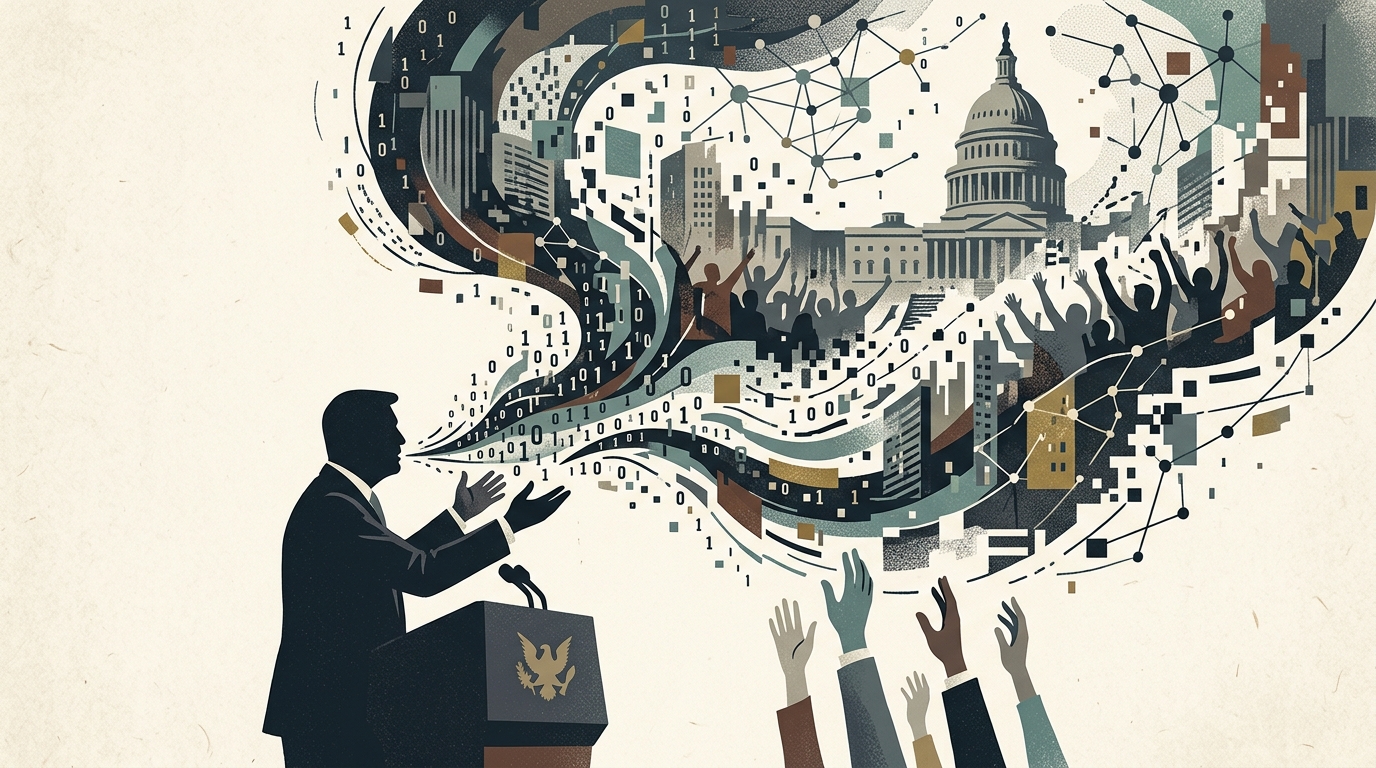
This use of AI allows Trump to bypass traditional media filters and construct his own version of reality. As communication analysts note, AI provides politicians with the ability to "correct" history or fabricate a future that serves their narrative, free from the constraints of physical presence or actual events.
"We are not just watching a video; we are witnessing the dissolution of objective truth in the political arena. When the image ceases to be evidence, democracy enters uncharted waters," notes a professor of political science.
The Ethical Quagmire of Synthetic Sincerity
The deployment of AI in politics raises profound ethical questions. Chief among them is the concept of "synthetic sincerity." Can a leader authentically connect with voters through an image that never existed? Trump's campaign response seems to be a resounding "yes." For his supporters, the video isn't a "lie" but an artistic expression of the emotional truth they feel regarding their leader.
However, the risks are manifest:
- Voter Deception: The difficulty in distinguishing between real footage and AI-generated content can lead to total confusion of public opinion.
- Erosion of Trust: If everything can be fabricated, then nothing can be believed, leading to a cynicism that damages democratic institutions.
- Regulatory Vacuum: Despite efforts in the EU and the US, legislation lags far behind the speed of deepfake technology evolution.
From Fake News to Fake Reality
If 2016 was the year of "fake news," 2026 appears to be the year of "fake reality." Trump is not using AI to falsify a specific event but to build an entire parallel universe. In this universe, his legal troubles and political controversies vanish, replaced by a digital hagiography.
This strategy targets emotion rather than logic. The music, the rhythm, and the imposing imagery create an experience that is easily "swallowed" by social media users, who often do not take the time to verify the validity of what they see. The speed at which such content spreads makes effective fact-checking nearly impossible.
The Challenge for the Future
The question is no longer whether AI will be used in politics, but how we will learn to live with it. The case of Trump's AI music video serves as a warning signal for all democratic societies. The need for digital literacy among citizens is more urgent than ever. We must be trained to see beyond the "AI filter" and seek the substance behind the digital noise.
In conclusion, the "Wherever I go, they love me" video may not change the election outcome on its own, but it certainly changes the rules of the game. Political communication is no longer a battle of arguments but a battle of algorithms and digital aesthetics. And in this battle, truth risks becoming the first casualty.