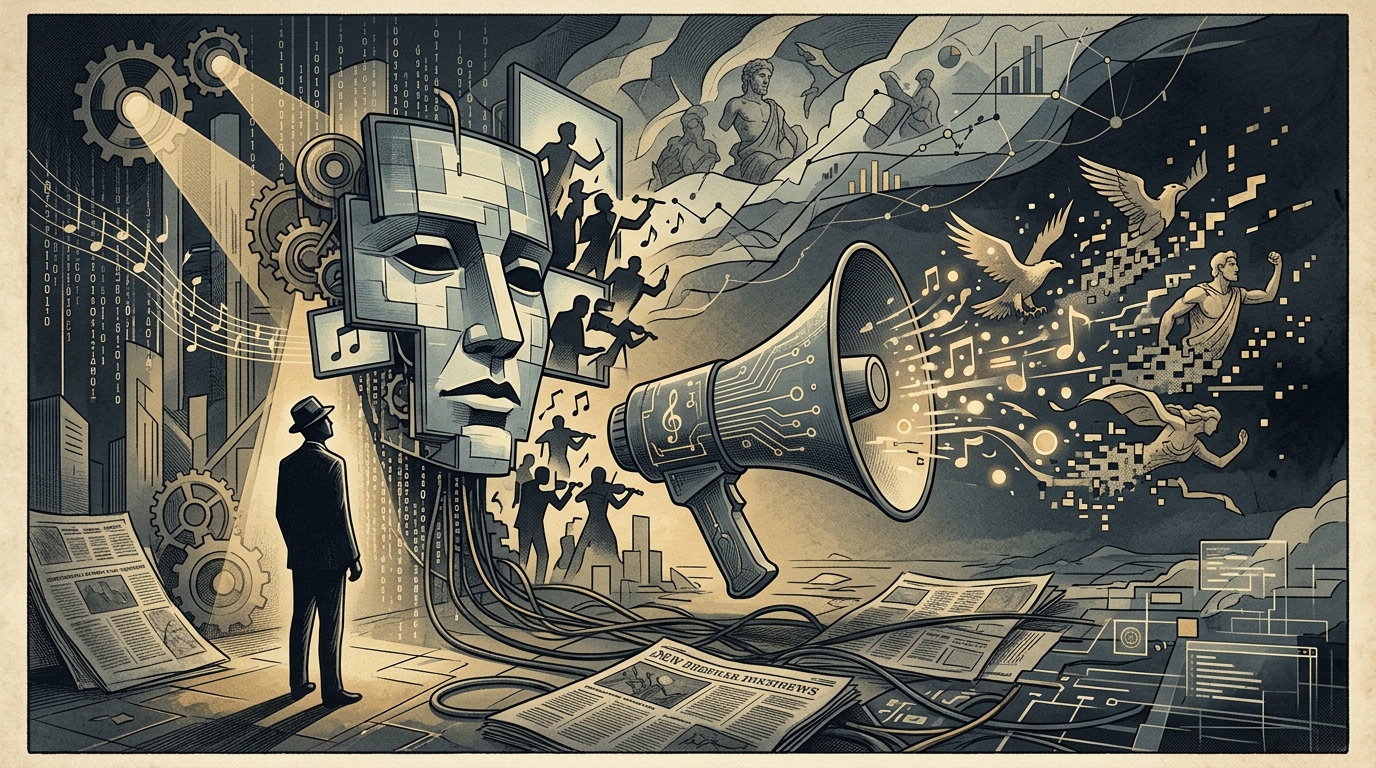
For years, Meta’s relationship with the world of publishers and journalism has been a symbiotic yet deeply adversarial one. Facebook and Instagram served as the primary conduits through which information reached the masses, with publishers tethered to Mark Zuckerberg’s algorithms for their very survival. Today, Meta appears to be finally severing that umbilical cord. With the introduction of a new "For You" section in its standalone Meta AI app, the company is no longer merely redirecting users to external news sources; it is creating its own stories, powered entirely by artificial intelligence.
The Anatomy of Digital "Slop"
What makes this move particularly unsettling is the nature of the content being produced. This is not serious investigative journalism, nor is it even an objective relaying of facts. It is what has come to be known as "AI-generated clickbait"—stories featuring sensationalist headlines, often accompanied by surreal, AI-generated imagery, designed with the sole purpose of triggering clicks and maximizing time spent within the app. Meta AI scrapes the day’s trends and processes them into short, digestible blurbs, completely bypassing the need for human editorial oversight or journalistic ethics.
This phenomenon is the epitome of "slop"—a term increasingly used to describe low-quality, unsolicited content churned out en masse by AI. While clickbait in the past was the work of humans trying to game the algorithm, the algorithm itself has now become the creator. This creates a closed loop where the machine produces content to satisfy its own optimization parameters, leaving quality, nuance, and factual integrity as secondary concerns at best.
The Death of the Open Web and the Walled Garden
From an economic and strategic perspective, Meta’s move is a transparent attempt to fortify its "walled garden." If Meta can provide content that mimics news without having to pay publishers or send traffic to their websites, it wins on two fronts: it retains all advertising revenue and avoids the mounting legal pressure to compensate news organizations in jurisdictions like Canada and Australia.
"It is no longer about the distribution of information, but about the simulation of information," industry analysts suggest.
This trend lends weight to the "Dead Internet Theory," which posits that the majority of web activity and content is now generated by bots for bots. When a user consumes an AI-generated story, based on data that may have been generated by another AI, the connection to physical reality begins to fray. The implications for democracy and public discourse are profound, as Meta AI is not bound by the rigorous standards of source verification or the professional accountability of a newsroom.
Ethical Minefields and Algorithmic Responsibility
Who bears the responsibility when an AI-generated news story contains false information or "hallucinations"? Meta maintains that the tool is experimental, yet its integration into an app with billions of potential users makes it a de facto information source. The use of AI-generated images, which often possess an uncanny or misleading aesthetic, further blurs the lines between reality and fabrication.
- Revenue Loss for Publishers: The diversion of traffic away from news sites threatens the financial viability of both local and national media outlets.
- Erosion of Trust: The mass production of clickbait undermines public confidence in everything they read online.
- Algorithmic Bias: Topic selection is driven by engagement metrics rather than societal importance, often amplifying polarizing or sensationalist narratives.
In conclusion, Meta AI and its new feed signal a new era where technology does not merely assist journalism but seeks to replace it with a synthetic substitute. The question remains whether users will accept this low-quality "digital fodder" or if they will seek out authenticity in a world increasingly saturated by artificially generated noise. As we move deeper into 2026, the battle for the truth is no longer just against fake news, but against the very machines that curate our reality.