In the high-stakes world of global health, Community Health Workers (CHWs) are the unsung heroes who bridge the gap between formal medical institutions and the world's most vulnerable populations. They are the frontline defense against epidemics, the primary educators on maternal health, and the trusted voices in remote villages. Recently, however, a new presence has entered their workspace: Artificial Intelligence. While Silicon Valley promises a revolution in efficiency, CHWs are pushing back with profound skepticism. As it turns out, their distrust is not a sign of technological illiteracy, but a sophisticated critique of how AI is being deployed in the Global South.
The Burden of 'Efficient' Technology
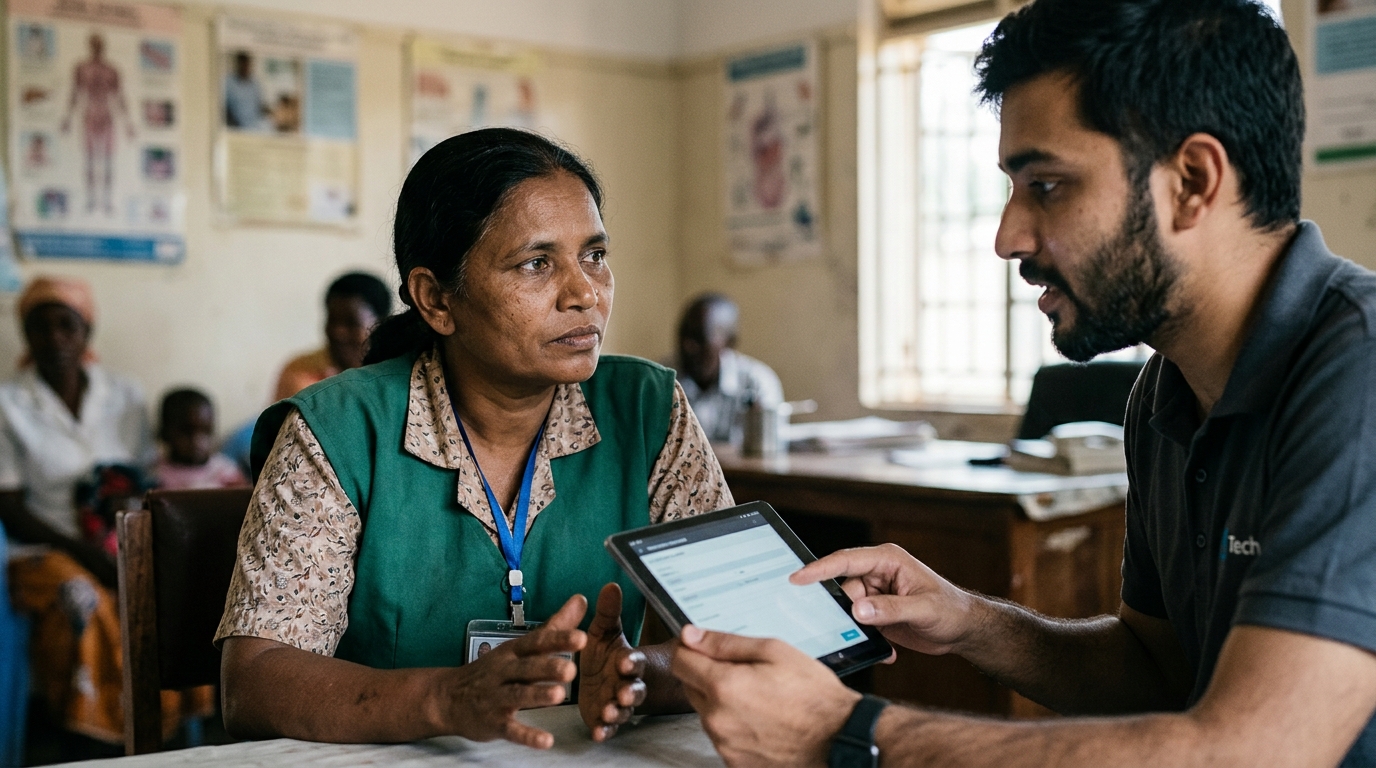
The primary marketing pitch for AI in global health is the optimization of scarce resources. Algorithms are designed to help CHWs diagnose diseases like malaria or pneumonia using nothing more than a smartphone. Yet, for many workers, these tools have become a source of 'digital labor' that complicates rather than simplifies their tasks. Instead of spending time with a patient, workers find themselves tethered to screens, navigating poorly designed interfaces that demand excessive data entry.
According to reports from ICTworks and other development analysts, many AI solutions suffer from a 'design-reality gap.' Tools built in San Francisco often fail to account for the lack of reliable internet, the intermittent electricity, or the specific cultural nuances of a village in rural Bihar or northern Nigeria. When an AI tool provides a recommendation that is locally irrelevant or logistically impossible, it is the CHW who loses face in front of their community, not the software engineer thousands of miles away.
Algorithmic Bias and Digital Colonialism
At the heart of the resistance lies a concern about data justice. AI systems require massive amounts of data to function, and the Global South has become a fertile ground for data extraction. This has led to accusations of 'digital colonialism,' where the health data of the poor is harvested to train models that primarily benefit wealthier markets. CHWs, who are the primary collectors of this data, are increasingly aware of the extractive nature of this relationship.
"AI in healthcare cannot be a top-down imposition. It must be a tool that enhances human judgment, not one that replaces it or treats local populations as mere data points for Western innovation," notes a prominent bioethicist.
Furthermore, the issue of algorithmic bias is a matter of life and death. Most AI models are trained on datasets that lack diversity, leading to significant inaccuracies when applied to different ethnicities or social contexts. CHWs intuitively understand that health is not just biological—it is social and political. An algorithm that cannot account for the impact of local water quality, seasonal migration, or political instability is a tool that is fundamentally flawed for the environment in which they operate.
The Erosion of Human-Centric Care
Community health is built on the foundation of trust and empathy. A CHW is not just a delivery mechanism for medicine; they are a neighbor, a confidant, and an advocate. The introduction of AI threatens to mechanize this relationship. When a tablet becomes the authority in the room, the CHW’s clinical intuition and personal knowledge of the patient are often marginalized. This 'de-skilling' of health workers is a significant ethical concern, as it reduces complex human interactions to a series of binary inputs.
The pushback from CHWs is a demand for autonomy. They are rightly skeptical of systems that turn them into 'human sensors' for a centralized AI. For AI to be truly effective, the power dynamic must shift. We need a model of 'participatory AI' where health workers are co-creators of the technology. They should have the power to audit the algorithms, define the data collection parameters, and, most importantly, override the machine when their human experience tells them otherwise.
Conclusion: A Call for Ethical Integration
The skepticism of Community Health Workers is a necessary safeguard against the hubris of the tech industry. AI has the potential to be a powerful ally in global health, but only if it is integrated with humility and respect for local expertise. The goal should not be to replace the human element of care but to provide tools that support it. Moving forward, the success of AI in global health will not be measured by the complexity of its code, but by the strength of the trust it builds with the people on the front lines.