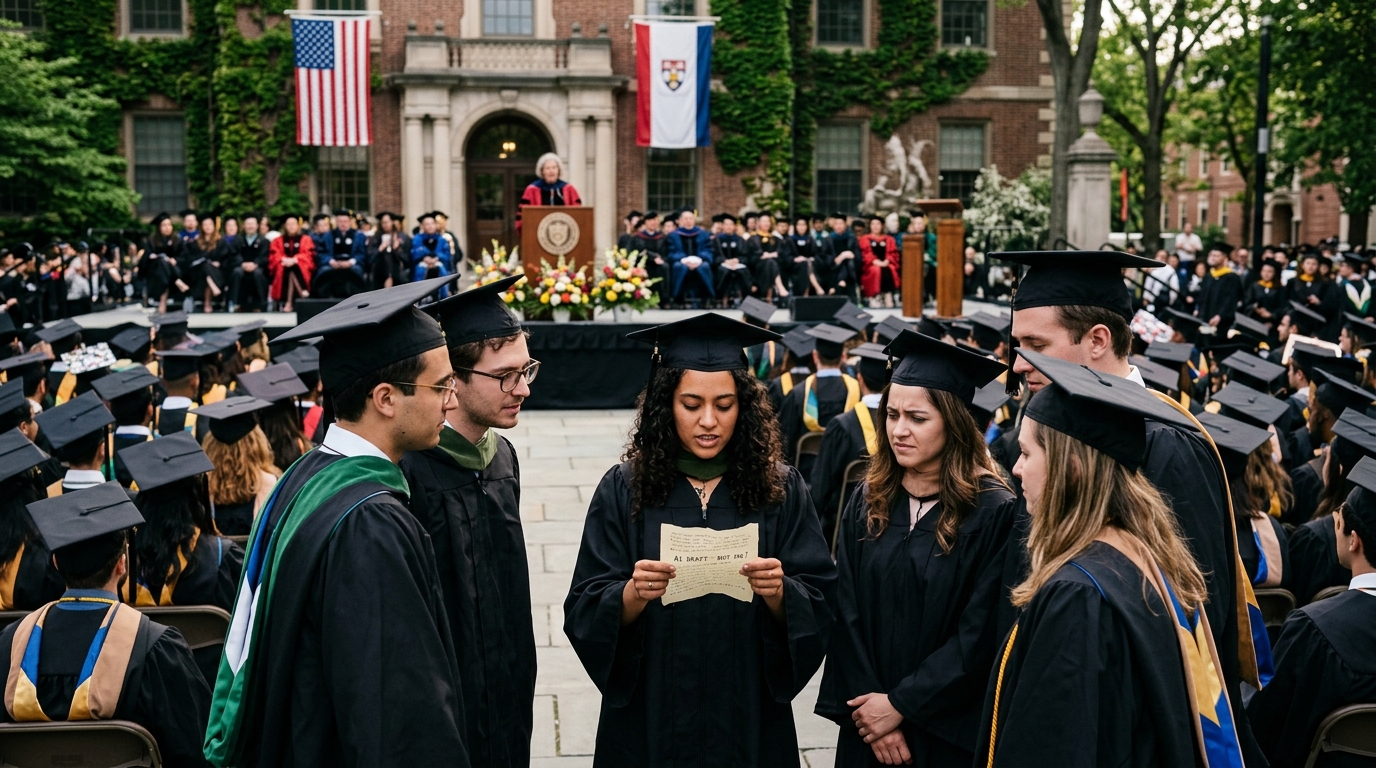
University graduation is traditionally a moment of culmination—the end of an arduous journey and the starting point of a new life. It is a rite of passage built on the promise of authenticity and personal testimony. However, this academic year in the United States has been marked by an unexpected clash: a student revolt against the use of Artificial Intelligence (AI) in commencement speeches. From the University of Vermont to Duke, reactions have ranged from icy silence to loud booing, sending a clear message to academic leadership.
The End of Sincerity? The Algorithmic Trap
The issue began when several commencement speakers and university officials, in an attempt to appear "forward-thinking" or to experiment with new technologies, revealed that portions of their addresses had been drafted by large language models like ChatGPT. What they considered an "interesting demonstration of technological progress," students perceived as a profound insult to the effort and tuition they had invested over four or more years.
Artificial Intelligence, by its nature, synthesizes the average of human thought. It produces texts that are grammatically correct and well-structured but lack the "edge" of lived experience. In a graduation speech, students look for vulnerability, specific anecdotes from campus life, and the wisdom derived from failure and triumph. When these are replaced by algorithmic clichés about "endless horizons" and "bright futures," the ceremony loses its sacred character and is transformed into a soulless corporate presentation.
The Ethics of Intellectual Laziness
The student backlash is not just about the aesthetic outcome; it is about the ethical dimension of the act. Over the past two years, universities have imposed strict rules against student use of AI in assignments, often labeling it as plagiarism or academic fraud. When, therefore, the administration itself or honorary guests use the same tools for the most important speech of the year, a glaring contradiction is created.
- The hypocrisy of double standards in academic ethics.
- The devaluation of rhetoric as a medium for communicating values.
- The sense that university leadership is detached from the emotional weight carried by students.
According to sociologists studying Generation Z, this generation possesses an intense desire for "radical authenticity." Having grown up in a digital environment filled with filters and fake news, today's graduates have developed an extremely sensitive "artificiality detector." For them, a mediocre but sincere speech is infinitely more valuable than a perfectly composed but robotic address.
The Emotional Uncanny Valley
In psychology, the term "uncanny valley" describes the revulsion people feel when a robot looks nearly, but not quite, human. A similar phenomenon occurs with AI speeches. They sound "almost" right, but there is a subtle lack of rhythm, an absence of a pause at the right moment, and an inability to connect with the current social and political climate that makes them unsettling.
"We didn't pay hundreds of thousands of dollars to be bid farewell by an algorithm that has never felt the stress of finals or the joy of a friendship," said a University of Michigan graduate following a controversial ceremony.
This reaction highlights a broader crisis of trust. If AI can write the graduation speech, what prevents the university from automating teaching, grading, and ultimately the human experience of learning itself? Students, through their boos, are setting a boundary: there are areas of human activity where efficiency is not the goal.
Seeking a New Balance
The future of academic ceremonies now stands at a crossroads. Artificial Intelligence is not going to disappear, but its use must be transparent and supportive, not substitutive. University leaders must understand that graduation is not a "problem to be solved" through automation, but a ritual that requires full human presence.
The "revolt" in the US serves as a lesson for the entire world. As AI invades every aspect of creativity, the value of "hand-crafted" speech will only increase. The ability to speak from the heart, with all the mistakes and imperfections that entails, is emerging as the ultimate privilege of human nature in the 21st century.