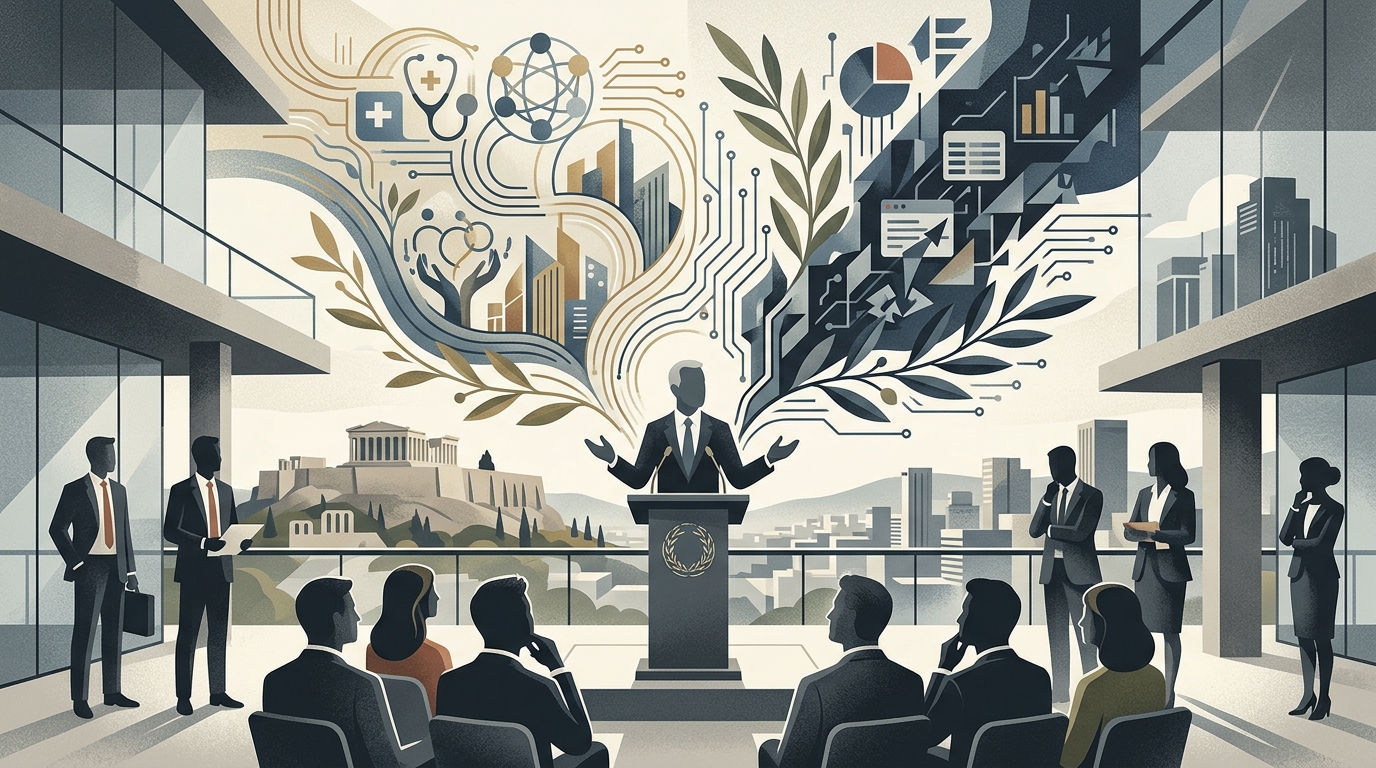
At the Aristotle Innovation Forum, an event that has become a cornerstone for dialogue on technology and entrepreneurship in Greece, Elias Mossialos, Professor of Health Policy at the LSE, delivered a profound and multi-layered analysis of Artificial Intelligence (AI). His speech was not merely a presentation of technological milestones but a stern warning about the structural changes threatening social cohesion, democratic governance, and healthcare systems if immediate measures are not taken.
The Dual Nature of the Technological Revolution
Professor Mossialos began by acknowledging the immense potential of AI, particularly in the medical field. The ability of algorithms to process billions of data points in seconds can lead to faster diagnoses, personalized treatments, and the discovery of new drugs that previously required decades of research. However, this "promise" is accompanied by a dark counter-narrative. Dependence on technology carries the risk of dehumanizing medical care, where the patient is reduced to a mere set of data.
The professor emphasized that Artificial Intelligence is not a neutral force. It carries the biases of its creators and the data on which it is trained. If this data is incomplete or biased, the decisions made by AI—from loan approvals to surgical prioritization—will replicate and amplify existing social inequalities. This "digital divide" is not just about access to technology but also about the quality of the outcomes it produces for different social groups.
The "Black Box" and the Democratic Deficit
One of the most critical points raised by Elias Mossialos concerned the lack of transparency in algorithms, the so-called "Black Box." When an AI system makes a decision, often even its developers cannot explain the exact path of its reasoning. In a democratic society, this poses a major accountability issue. Who is responsible if a diagnosis is wrong? How can a citizen challenge a decision made by an opaque algorithm?
Mossialos argued that we need a new "social contract" for the digital age. The regulation of AI should not be left exclusively in the hands of tech giants driven by profit. Intervention by states and international organizations is required to ensure the ethical use of technology. The European Union, with the AI Act, is taking a step in the right direction, but the professor warned that technology moves at speeds that legislation struggles to match.
Labor and Social Implications
The discussion at the Aristotle Innovation Forum inevitably turned to the labor market. Mossialos did not adopt a doomsday approach but highlighted the need for a radical overhaul of education and vocational training. AI will replace jobs, not only manual ones but also highly specialized roles. The risk here is the creation of a "useless class" of people who will lack the skills to survive in the new environment.
- Investment in "human" skills, such as critical thinking, empathy, and ethical judgment, is required.
- Lifelong learning must become the norm rather than the exception.
- The welfare state must adapt to support those affected by automation.
The professor concluded his speech with a message of hope but also of responsibility. Artificial Intelligence can be humanity's greatest ally in solving problems like climate change and pandemics, provided we guide it with a human-centric approach rather than technology for technology's sake. Greece, through initiatives like the Aristotle Innovation Forum, has the opportunity to participate actively in this global dialogue, ensuring that innovation always goes hand-in-hand with ethics.
"Technology is the tool, but humanity must remain the architect of its future. If we allow algorithms to govern without an ethical filter, then progress will be only superficial."
In conclusion, Elias Mossialos's intervention serves as a reminder that the digital transition is not a technical process but a deeply political and social challenge. Its success will be judged by whether we manage to democratize the knowledge and power that AI offers, avoiding its concentration in a few hands.