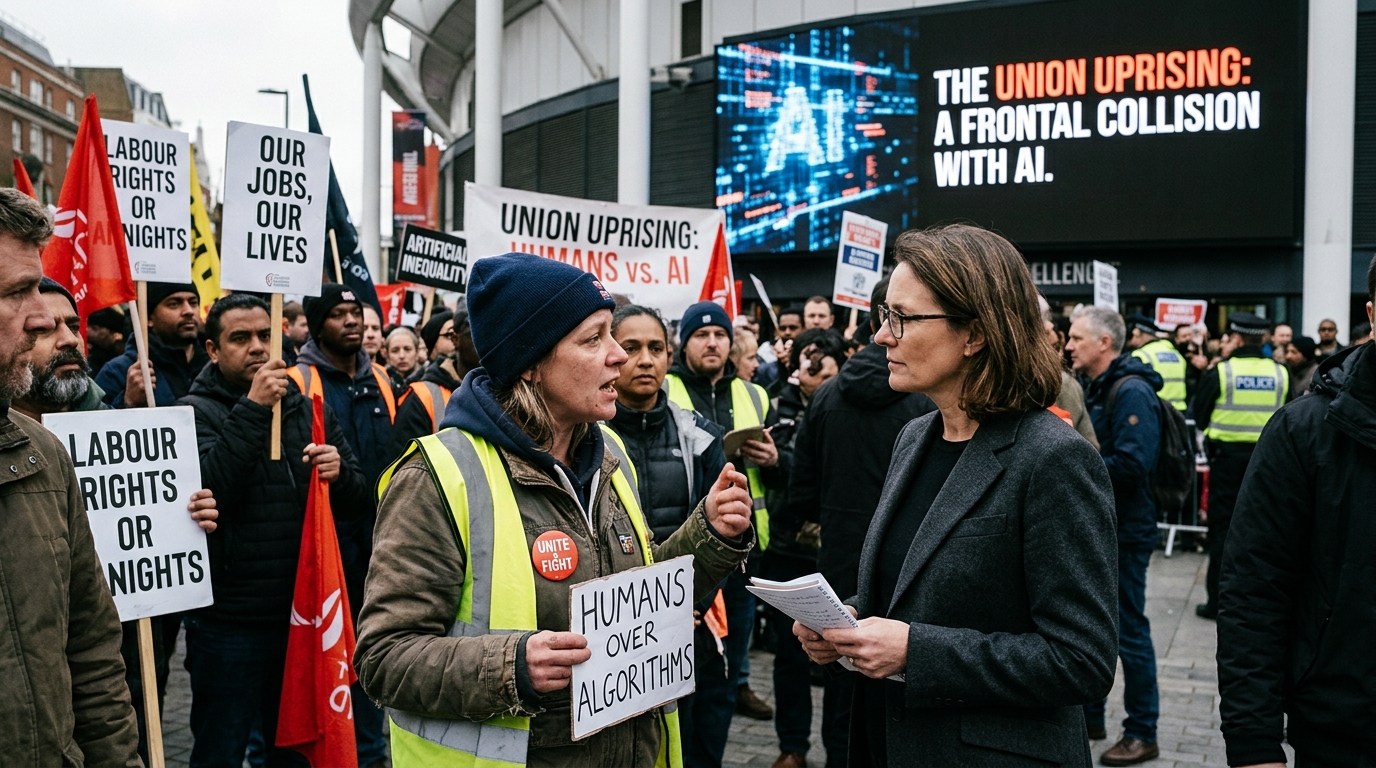
The history of labor has always been a sequence of collisions between technological innovation and human survival. From the Luddites of the Industrial Revolution to the automation waves of the 1980s, the fear of replacement has been a constant shadow. However, 2026 finds the global working class facing a threat of a different nature. Artificial Intelligence no longer just replaces muscle; it targets the spirit, creativity, and decision-making core of human identity.
The Digital Scab and the De-skilling of Labor
Unions worldwide, from Hollywood screenwriters to automotive assembly line workers, are denouncing AI as the ultimate tool for 'digital scabbing.' The concern is not merely the total elimination of jobs, but the systematic erosion of their quality. Through 'de-skilling,' corporations use algorithms to break complex professional tasks into simplistic fragments that can be executed by less experienced—and thus cheaper—personnel, guided by an AI interface.
- Wage suppression through automated surveillance and performance metrics.
- Loss of intellectual property rights for creative professionals.
- Opaque algorithms making life-altering decisions on hiring and firing.
In Europe, the European Trade Union Confederation (ETUC) warns that without a strict regulatory framework, AI will usher in a new era of 'techno-feudalism.' The battlefield has shifted from working hours to data ownership. Who owns the data a worker produces? If an AI is trained on a graphic designer's portfolio only to eventually replace them, is that progress or sophisticated theft?
The Collective Bargaining Frontier
The labor movement's response is the integration of 'AI clauses' into collective bargaining agreements. The SAG-AFTRA strike in the US was just the opening salvo. Now, unions across the globe are demanding the 'right to human intervention.' This principle dictates that no critical decision regarding a worker's livelihood can be made solely by an algorithm. This resistance is not a blind rejection of technology, but a strategic effort to keep humans at the center of the production process.
"Artificial intelligence must be a tool that augments human capability, not a weapon that exiles it from society," state labor federation representatives.
Ethics and the Future of Social Cohesion
The stakes are profoundly ethical. If productivity skyrockets due to AI, yet the resulting wealth is concentrated among a few capital owners while unemployment surges, social cohesion will shatter. Unions are increasingly proposing the taxation of robots and computing power to fund massive retraining programs. However, the sheer velocity of AI development often leaves traditional political and union reflexes looking desperately slow.
In conclusion, the clash between unions and AI is the tip of the iceberg in a broader debate about the meaning of 'work' in the 21st century. The outcome of this struggle will determine whether AI becomes humanity's liberator from drudgery or the jailer of a new, digital precariousness.