The global financial landscape is undergoing one of its most dramatic shifts in decades. While Europe struggles to find its footing amidst energy crises and geopolitical uncertainty, the Asian markets of Taiwan and South Korea are surging, fueled by the West's insatiable hunger for processing power. 2024 and 2025 have marked the tipping point where Artificial Intelligence (AI) ceased to be a future promise and became the primary driver of present profitability.
Taiwan's 'Silicon Shield' and the Dominance of TSMC
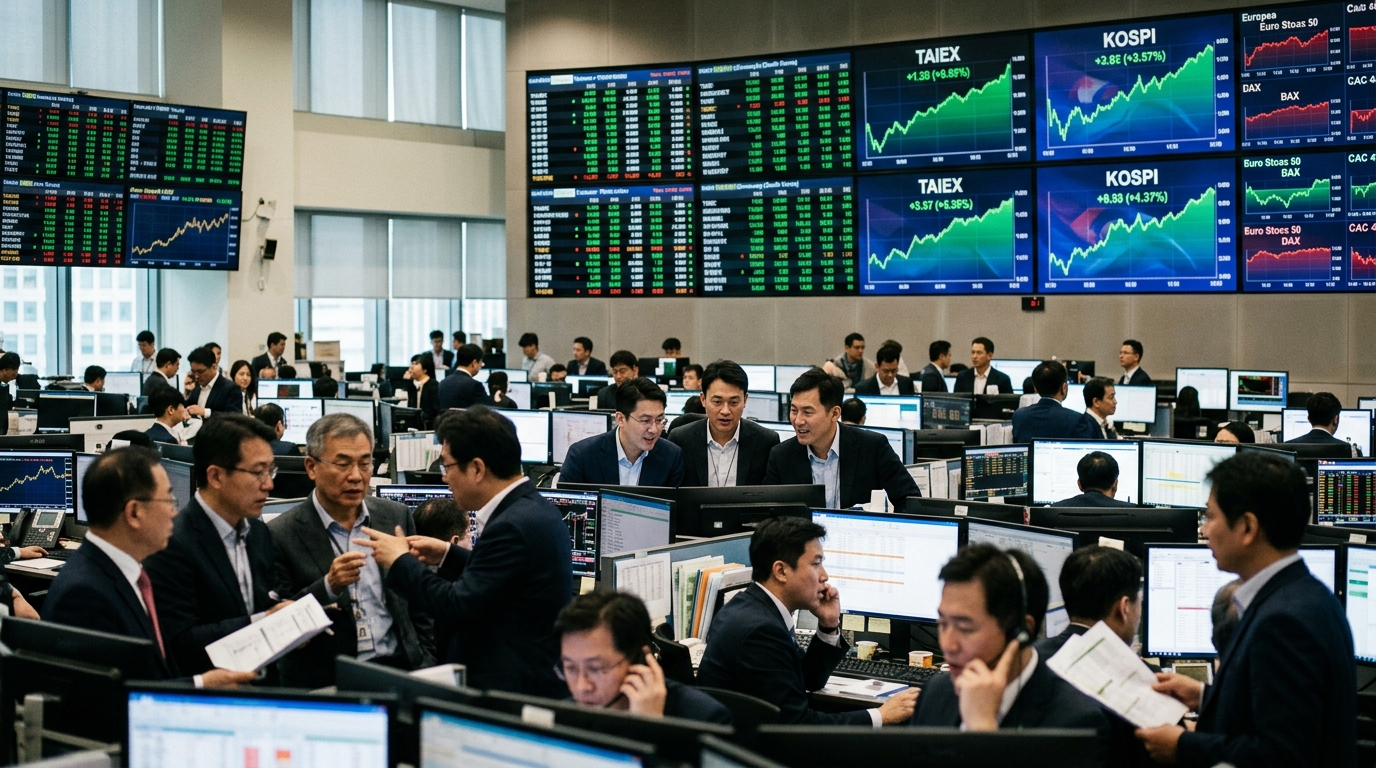
Taiwan is no longer just a Pacific island with geopolitical significance; it is the heart of global technological infrastructure. The Taiex index has posted performances that leave the German DAX and the French CAC 40 far behind. The reason is TSMC (Taiwan Semiconductor Manufacturing Company). As the world's only manufacturer of the most advanced chips, TSMC is the indispensable partner for Nvidia and Apple.
The rise in the market value of Taiwanese companies is not a speculative bubble but a reflection of the world's fundamental dependence on hardware. Without the 3-nanometer and 2-nanometer chips produced in Taiwan, the Large Language Models (LLMs) we admire today simply could not function. This manufacturing 'monopoly' has created a protective shield for the island's economy, despite constant threats from mainland China.
South Korea: The Battle of HBM Memories
If Taiwan is the brain, South Korea is the memory of AI. The explosive rise of the Kospi index is largely due to the competition between Samsung Electronics and SK Hynix. The latter has managed to take the lead in producing High Bandwidth Memory (HBM), which is essential for the rapid data transfer required by Nvidia's processors.
Investors are mass-exiting traditional European sectors, such as automotive and luxury goods, to position themselves in companies that produce the 'building blocks' of the digital age. South Korea, having invested billions in Research and Development (R&D) for decades, is now reaping the rewards of a strategy that Europe ignored, deeming manufacturing to be 'low added value'.
Why is Europe Falling Behind?
The comparison with European stock markets is sobering. While Asia produces the future, Europe seems to be managing the past. European indices are dominated by banks, insurance companies, automakers struggling to adapt to electrification, and energy firms. With the exception of the Dutch ASML, which manufactures the lithography machines for chips, the old continent has no other global champion in the AI hardware sector.
- Lack of Ecosystem: Europe lacks a comprehensive semiconductor ecosystem, despite the efforts of the European Chips Act.
- Regulatory Burden: Strict legislation (AI Act) often acts as a brake on innovation, focusing more on risks than opportunities.
- Investment Mindset: European funds remain conservative, preferring dividends over the explosive growth of tech giants.
"Europe risks turning into a museum of the industrial revolution, while Asia and the US build the infrastructure of the cognitive revolution," state analysts from Goldman Sachs.
Conclusions and Outlook
The outperformance of Asian markets over European ones is not a fleeting trend. It is the confirmation that power in the 21st century is not measured by oil or steel, but by transistors and algorithms. For investors, the message is clear: growth is found where AI is built. Europe must decide whether it will remain a mere consumer of technology or if it will dare to invest in its production before the gap with Taiwan and South Korea becomes irreversible.