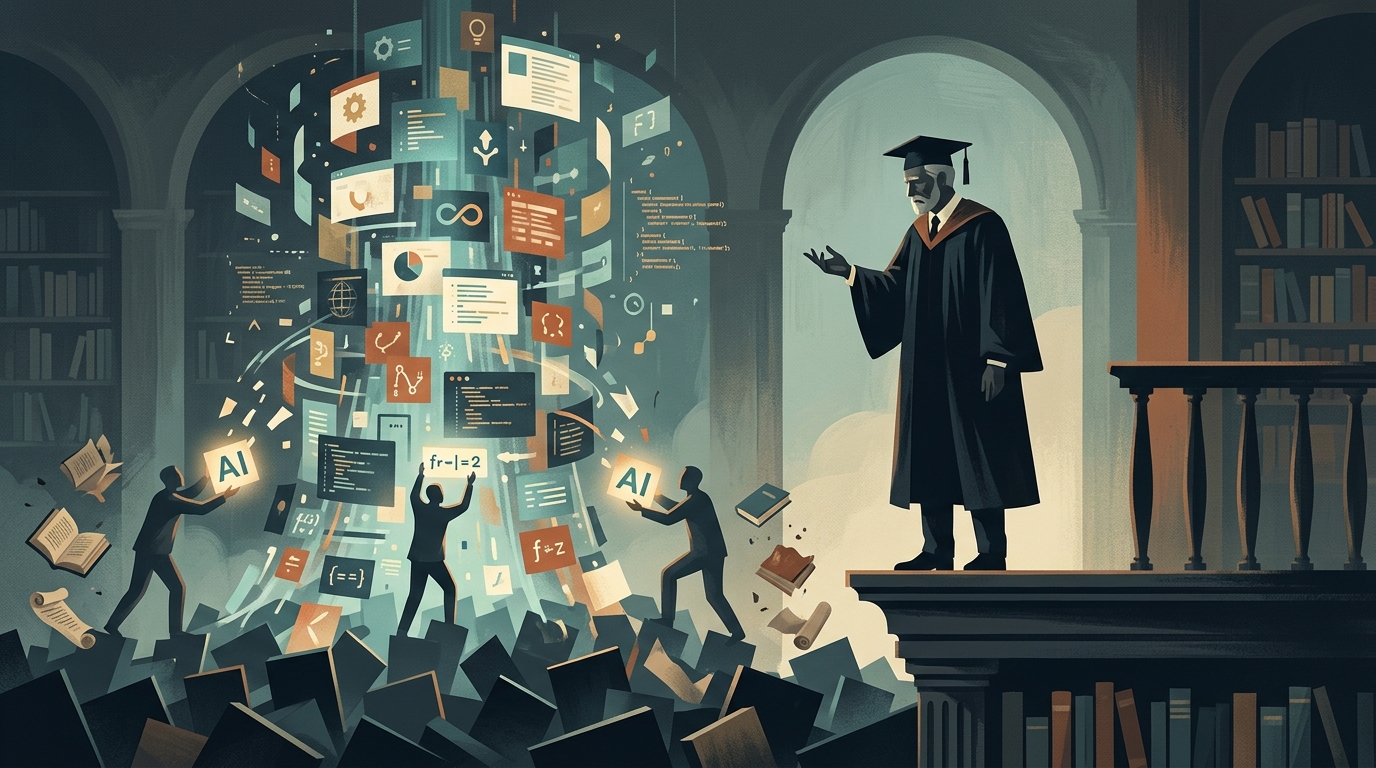
In the wake of a national tragedy, Roberto Serrano, a distinguished professor of economics at Brown University and a global authority on Game Theory, decided to lead with compassion. Following a mass shooting that left the campus community reeling, Serrano converted his final exams into take-home assignments, aiming to alleviate the psychological burden on his students. What followed, however, was not a reciprocal act of respect, but a systemic collapse of academic integrity that led him to a bitter conclusion: “Humanity has chosen to become idiots.”
The Irony of Game Theory
For a man who has spent his life studying strategic decision-making and incentives, the betrayal by his own students was an irony too sharp to ignore. In Game Theory, players often seek the path of least resistance to maximize their utility. In this scenario, the 'utility' was a grade achieved without effort, and the 'tool' was Artificial Intelligence. Serrano discovered that a disturbingly high number of students used Large Language Models (LLMs) to answer complex questions that demanded critical thinking and a profound grasp of the material.
“Why are you at a university if you refuse to learn, you refuse to work hard?” Serrano asked in an interview that sent shockwaves through academia. The problem, according to him, is not the technology itself, but the voluntary surrender of cognitive effort. Using AI to bypass learning isn't just cheating; it’s a form of intellectual suicide. When students at an Ivy League institution—the world's future leaders—choose to outsource their thinking to an algorithm, the very foundation of higher education begins to crumble.
Ethics and Trauma in the Age of AI
Serrano’s decision to offer a more flexible exam format was rooted in a desire to acknowledge the collective trauma of his students after the shooting. It was an act of humanity. However, the students' response revealed a profound shift in values. In the digital age, 'convenience' has been elevated to a supreme virtue, often at the expense of moral consistency. Serrano found that the omnipresence of AI acts as a constant temptation that erodes the concept of struggle as a prerequisite for growth.
This phenomenon is not unique to Brown. Universities worldwide are struggling to find a balance between integrating AI and maintaining academic rigor. Serrano’s case, however, is particularly poignant because of the context: exploiting a concession made for mental health reasons adds a layer of ethical bankruptcy to the act of cheating. It suggests that the 'social contract' between educator and student has been fundamentally broken.
The End of the Take-Home Exam?
Serrano’s reaction was swift and uncompromising. He announced that there would never be another take-home exam in his courses. The return to traditional methods—pen, paper, and proctored halls—seems to be the only way to ensure the validity of a degree. But is this a regression? Or is it the necessary 'purgation' required to save the educational process?
Serrano argues that the 'ease' AI offers is a trap. “If you cannot think for yourself, if you cannot wrestle with a problem, then your degree has no value,” he emphasizes. His concern is that we are producing a generation of graduates who are 'functionally incapable' of original thought, dependent on digital crutches that may fail or mislead them. The credential becomes a hollow shell, representing a seat occupied rather than a mind expanded.
A Call for Intellectual Awakening
Serrano’s critique serves as a dire warning. AI can be a powerful ally, but in education, using it as a substitute for cognition leads to what the professor calls “mass idiocy.” This isn't a lack of innate intelligence, but a conscious choice to avoid the labor of thought. It is the preference for the output over the process.
The challenge for the future is immense. How do we teach the value of difficulty in a world that promises instant solutions? The answer may lie in a return to the roots of the Socratic method, where knowledge is not a product to be consumed, but a transformative process requiring the individual's full participation. Serrano, despite his disillusionment, continues to teach, hoping his hardline stance will force at least some students to re-evaluate why they are there in the first place.