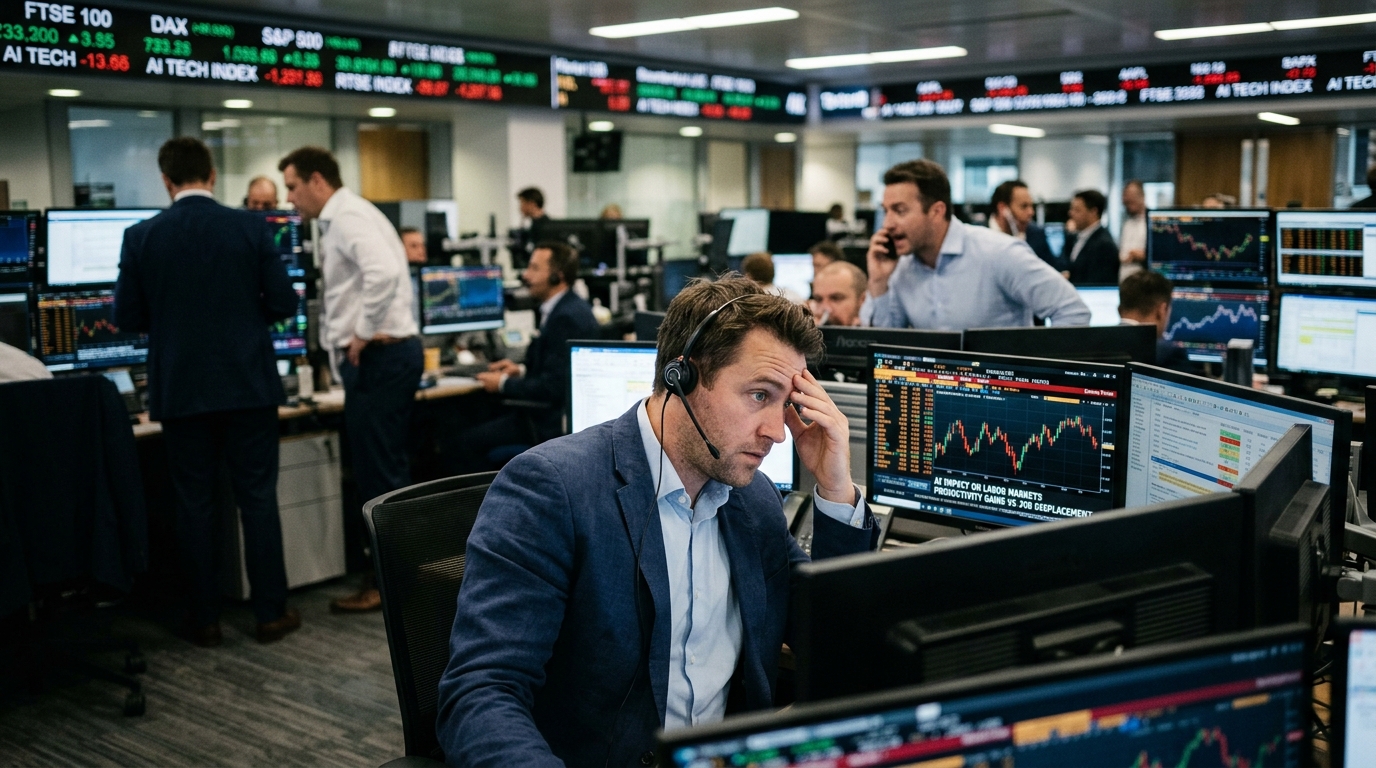
The classic image of a junior analyst at a New York or London hedge fund, fueled by excessive caffeine while trying to deconstruct thousands of pages of balance sheets and central bank minutes overnight, is becoming an anachronism. The era of "manual" intellectual labor in the high-stakes world of finance is giving way to a new reality, where Generative AI and autonomous agents are taking over the heavy lifting of research.
The Great Transition: From Spreadsheets to AI Agents
For decades, hedge funds were divided into two camps: discretionary traders who relied on intuition and fundamental analysis, and quants who utilized mathematical models. Today, this distinction is blurring. The advent of Large Language Models (LLMs) allows funds to process unstructured data—such as earnings call audio, court filings, and social media sentiment—with speed and precision that far exceeds human capability.
Former executives from top-tier firms like Goldman Sachs and Citadel are leaving their prestigious roles to launch startups that promise to automate the analyst workflow. These tools are not mere search engines; they are systems capable of synthesizing investment theses, identifying contradictions in financial reports, and simulating market reactions to geopolitical events. This automation is no longer just about trade execution; it’s about the very core of decision-making.
The End of the Junior Analyst?
The most immediate impact of this technological invasion is being felt at the entry-level. Traditionally, junior analysts served as the data filters for senior partners. Now, an AI agent can perform the work of a ten-person team in a fraction of a second. This poses an existential question for the industry: If machines do the work of novices, how will the next generation of top fund managers be trained?
"We no longer hire people to read documents. We hire people who know how to teach machines how to read documents," a senior hedge fund executive told Fortune.
This shift requires a new set of skills. The modern analyst must be less of a "bookkeeper" and more of a "data architect." The ability to discern AI hallucinations and steer algorithms in the right direction is becoming the most valuable skill on Wall Street.
Risks and Systemic Stability
However, the mass adoption of AI in hedge funds is not without significant risks. The greatest fear for regulators is "algorithmic convergence." If all major funds use similar AI models trained on the same datasets, there is a risk they will reach the same conclusions and execute the same trades simultaneously. This could lead to extreme volatility and "flash crashes," as liquidity could vanish in seconds.
Furthermore, there is the issue of transparency. Many of these models operate as "black boxes." When an investment fails, it is difficult to determine if the error was due to faulty data, an algorithmic glitch, or an unpredictable market variable. Accountability remains a gray area, as legal frameworks struggle to keep pace with the speed of technological evolution.
The Road Ahead: Human-Centric AI or Full Automation?
Despite the onslaught of algorithms, most experts agree that the human factor will not disappear entirely—at least not yet. Investing is, to a large extent, an exercise in psychology and risk management. AI can analyze the past and the present, but the ability to predict the "irrational" or "human error" remains, for now, a human prerogative.
The future of hedge funds appears to be hybrid. The firms that survive and dominate will be those that manage to marry the computational power of AI with the critical thinking and ethical judgment of humans. The AI "invasion" is not the end of the industry, but its forced maturation into a new digital era, where information is no longer the primary advantage, but the ability to correctly evaluate it is.