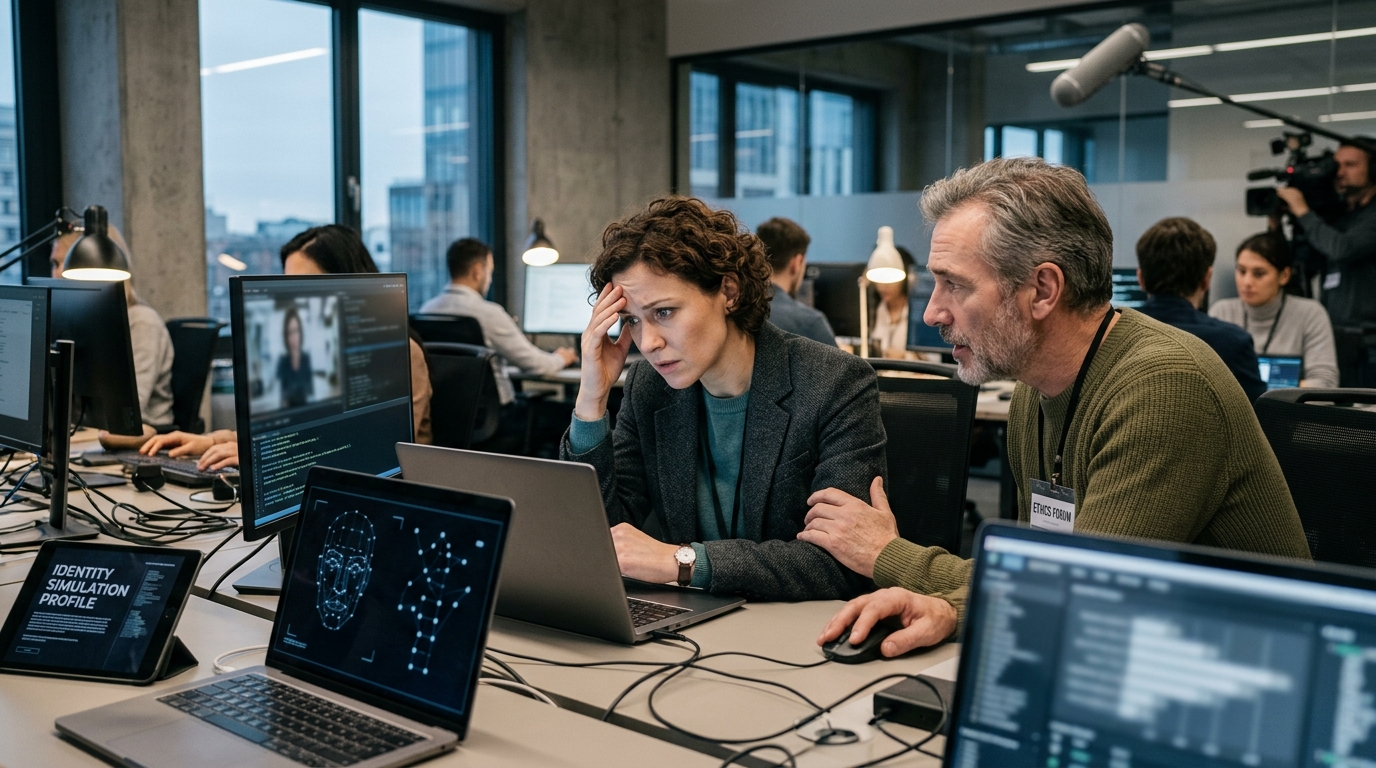
In a world obsessively pursuing the elimination of every point of friction, Wendy Liu, writing for The Guardian, poses a question that resonates deep within human nature: Is the convenience offered by Artificial Intelligence (AI) a threat to our very essence? The notion that thinking "is supposed to be hard" is not merely a Luddite reaction to technological progress, but a fundamental stance on the value of the human experience. As we navigate 2026, with Large Language Models (LLMs) having permeated every facet of writing and analysis, the decision to abstain from these tools is transforming into an act of political and existential resistance.
The Trap of Effortless Knowledge
Silicon Valley was built on the promise of a "frictionless" life. Every new app, every algorithmic update, aims to reduce the time and energy required to achieve a goal. However, in the case of thinking, "friction" is not a bug in the system; it is the system itself. The process of synthesizing an idea, the struggle with words, and the agony of logical consistency are the mechanisms through which we learn and evolve. When we outsource this process to an AI, we aren't just saving time; we are surrendering our right to cognitive self-formation.
Liu argues that the difficulty of thinking is what makes us human. This position finds grounding in neuroscience and pedagogy. The concept of "desirable difficulty" suggests that learning is deeper and more lasting when the brain exerts effort. Conversely, the instant gratification of answers from a chatbot creates an illusion of knowledge—a "cognitive ease" that leaves us intellectually atrophied. Knowledge that was not hard-won rarely becomes part of us; it remains external information, easily consumable and just as easily forgotten.
AI as a Cognitive Crutch
The use of AI tools for writing or problem-solving is often likened to using a calculator in mathematics. But the analogy is flawed. A calculator performs operations; an AI performs judgments, adopts styles, and suggests meanings. In reality, AI is not a tool for extending thought, but for replacing it. When a writer uses AI to "overcome writer's block," they are bypassing the most critical stage of creation: confronting the void and searching for a personal voice.
Furthermore, there is the risk of homogenization. Algorithms are trained on the average of human data. Using them inevitably leads to a "mushing" of discourse and thought, where the idiosyncrasies, paradoxes, and sharp edges of human genius are smoothed out for the sake of statistical probability. Choosing to "think hard" is the choice to remain unique, to allow oneself to make mistakes that an AI model would never make, but which contain the kernel of truth.
The Political and Ethical Dimension of Effort
Beyond the individual level, avoiding AI has a strong political undertone. The automation of thought serves an economic model that prioritizes productivity over quality and speed over depth. In a labor market that increasingly demands more content in less time, AI becomes a weapon for employers to devalue intellectual labor. If thinking is viewed as a "cost" to be minimized, then humans are demoted to mere curators of algorithmic output.
Wendy Liu points out that refusing to use AI is a statement of value. It is the recognition that some things are worth doing the hard way because the process itself has intrinsic value. This connects to the Aristotelian concept of "eudaimonia," which arises from the exercise of human faculties to their fullest extent. If we let AI think for us, we deprive ourselves of the joy of discovery and the satisfaction of intellectual conquest. At the end of the day, our humanity is not defined by how many tasks we completed, but by how deeply we felt and thought during the day.
In conclusion, resisting ubiquitous AI is not technophobia. It is a conscious choice to protect our inner world. Thinking is hard because the world is complex and the human soul even more so. Every time we choose to wrestle with an idea instead of asking a machine to describe it, we reaffirm our sovereignty over our consciousness. Perhaps the greatest challenge of the 21st century is not the creation of smarter machines, but the preservation of our capacity to be thinking beings ourselves.