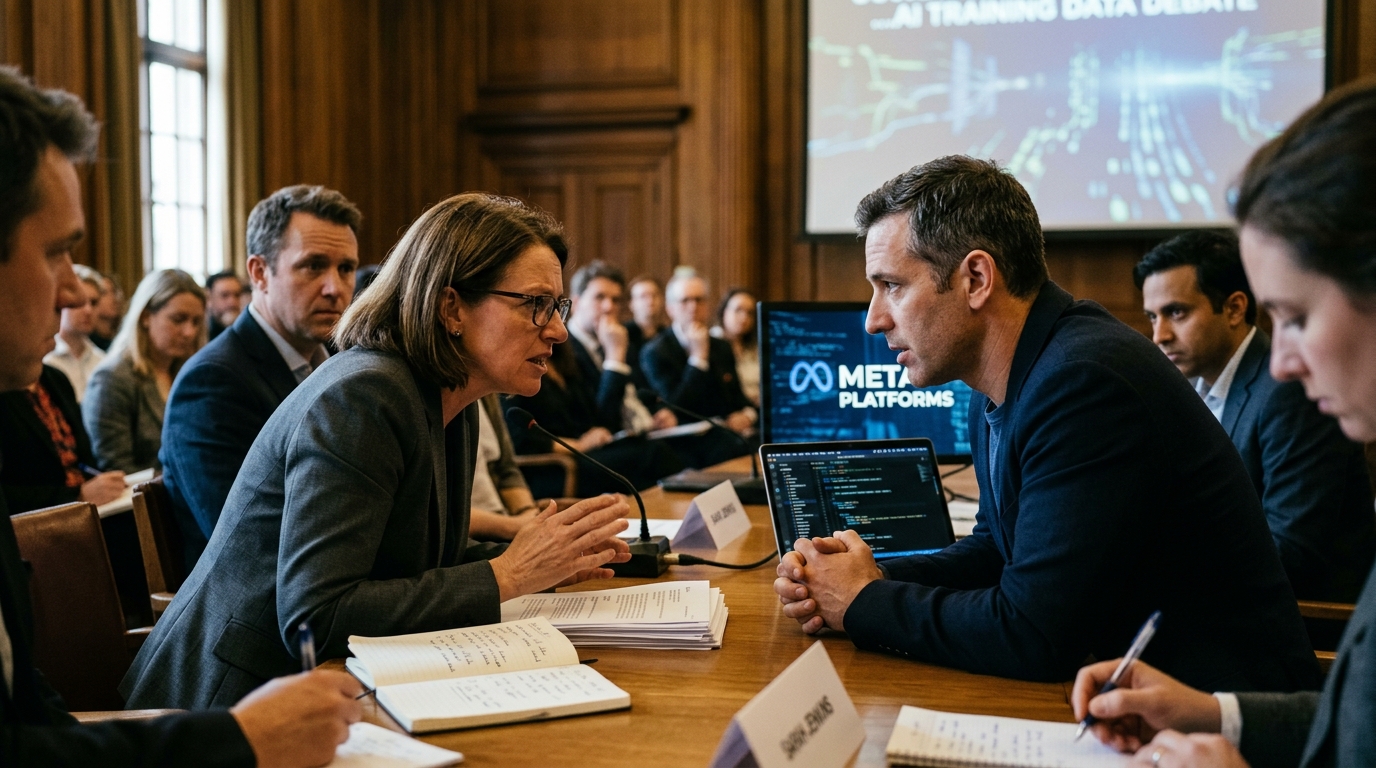
The digital economy stands at a critical crossroads as tensions between traditional media organizations and Silicon Valley tech giants reach a boiling point. At the heart of this confrontation is Meta Platforms, the parent company of Facebook and Instagram, which is accused by major publishers worldwide of using vast amounts of journalistic content to train its artificial intelligence models, such as Llama, without permission or financial compensation. This case is not just about lost profits; it is about the very survival of quality journalism in a world where algorithms can replicate information in seconds.
Digital Looting or Necessary Evolution?
For decades, the relationship between publishers and social media platforms was based on a tacit agreement: publishers provided content that kept users on the platforms, and in return, the platforms sent traffic back to the publishers' websites. However, the advent of Generative AI has upended this balance. Large Language Models (LLMs) no longer refer the user to the source; instead, they "swallow" the information and synthesize it, providing the answer directly to the user within the platform's environment.
Publishers argue that this practice constitutes a blatant violation of intellectual property. According to recent reports and legal actions, Meta has allegedly used millions of articles from leading news agencies to "teach" Llama how to write, analyze, and understand the world. The publishers' argument is simple: if your AI model is valuable because it was trained on our work, then our work has an economic value that must be paid for. Meta, on the other hand, often invokes the principle of "fair use," arguing that training models on publicly available data is not an infringement but a transformative use of information.
The Legal Arsenal and European Leadership
This conflict is unfolding on a global stage at different speeds. In the United States, court battles—such as the landmark lawsuit by The New York Times against OpenAI and Microsoft—are expected to set legal precedents that will also affect Meta. In Europe, however, the landscape is stricter. The European Union, through the Directive on Copyright in the Digital Single Market and the recent AI Act, has laid the groundwork for publisher protection.
- Neighboring Rights: Publishers in the EU now have the right to demand remuneration for the use of their snippets by digital platforms.
- Data Transparency: The new AI Act requires companies to make public summaries of the data used to train their models.
- Opt-out Rights: Publishers can now "lock" their content from AI crawlers, although this often leads to reduced visibility in search engines.
Meta has already reacted in some jurisdictions, such as Canada and Australia, by threatening or even blocking news from its platforms to avoid payments. This tactic of "digital blackmail," as many analysts call it, shows the magnitude of the gap between the tech industry and the Fourth Estate.
The End of the "Free" Internet?
This confrontation highlights a deeper crisis in the model of the internet as we knew it. If publishers start closing their content behind paywalls and banning access to AI bots, the internet risks becoming fragmented. On the other hand, if Meta and its peers continue to use the work of thousands of journalists for free, the economic foundation of news will collapse, leaving the field open for misinformation and machine-generated content without ethical barriers.
"We are not asking for charity; we are asking for our fair share of the value we create," representatives of publishing associations state.
In Greece, this debate takes on particular importance, as the local market is small and publishers depend directly on digital advertising. The move by In.gr and other major groups to highlight the issue is part of a global effort to set rules in the "Wild West" of artificial intelligence. The outcome of this battle will determine whether artificial intelligence will be a partner to human creativity or its executioner.