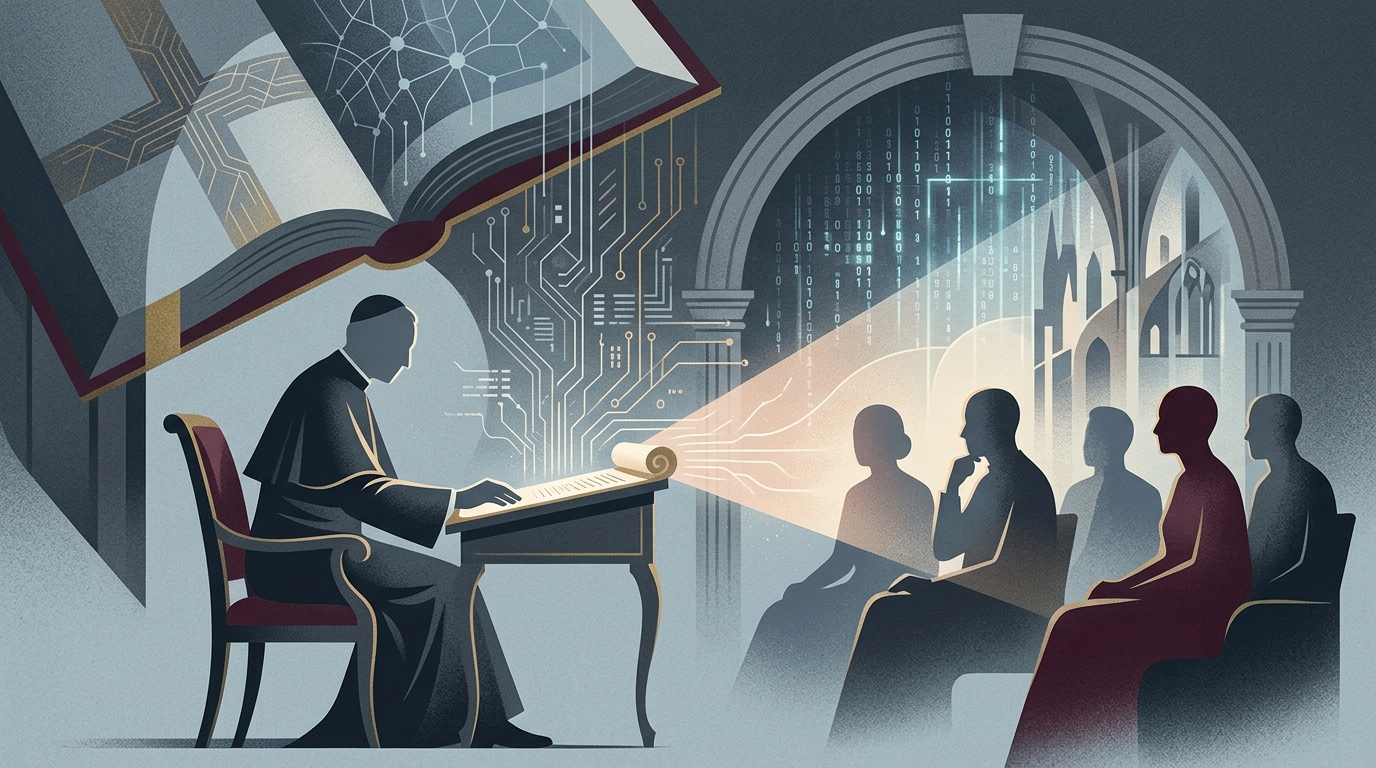
In the wake of an era where Artificial Intelligence (AI) is no longer a mere tool but a transformative force of the human experience, Pope Leo XIV is preparing to release his first encyclical dedicated exclusively to technology. The document, expected to be a landmark for the 21st century, is addressed not only to the world's 1.3 billion Catholics but to all of humanity, posing the critical question: What is the place of the spirit in a world governed by data?
'Algorethics' as a New Doctrine
The central concept of the encyclical, according to Vatican sources, is "Algorethics." Pope Leo XIV argues that technology is never neutral. Every line of code contains the values, biases, and intentions of its creators. The Church, staying true to its tradition of social teaching, emphasizes that AI must be designed with the human person at its center (anthropocentrism), rather than profit or efficiency.
The encyclical places particular emphasis on the concept of "Imago Dei" (Image of God). If humans are made in the likeness of God, then the attempt to create an "artificial consciousness" carries the risk of a new form of idolatry. The Pope does not reject progress—on the contrary, he welcomes the potential of AI in medicine and solving the climate crisis—but warns that technology can never substitute for the divine spark of human judgment and empathy.
Digital Inequality and the 'New Poor'
One of the most dynamic sections of the encyclical concerns social justice. Leo XIV introduces the term "digital proletariat," referring to those left behind by the rapid evolution of technology. The Church expresses deep concern over the concentration of power in the hands of a few tech giants, which could lead to a new form of "digital colonialism."
- Access to Knowledge: AI must be a public good, not a privilege of wealthy nations.
- Dignity of Work: Automation should not lead to the impoverishment of workers but to their liberation from repetitive tasks.
- Algorithmic Transparency: Decisions affecting people's lives (loans, hiring, justice) must not be made by "black boxes" without human oversight.
The encyclical calls on governments to establish strict regulatory frameworks, similar to those for nuclear weapons, ensuring that AI remains under the control of ethical conscience.
Spirituality in the Silicon Age
Finally, the Pope touches on the sensitive issue of religious practice. Can a chatbot hear a confession? Can an algorithm pray? The encyclical's answer is a resounding no. Faith requires presence, flesh, and blood. "Digital presence" can be a tool for catechesis, but it cannot replace the Sacrament.
"Technology can simulate thought, but it cannot experience love. Love requires sacrifice, something no processor can understand," the text notes poignantly.
With this encyclical, the Vatican attempts to bridge the gap between ancient wisdom and future technology, reminding a world fascinated by artificial intelligence that the greatest challenge remains the preservation of our own human intelligence and heart.