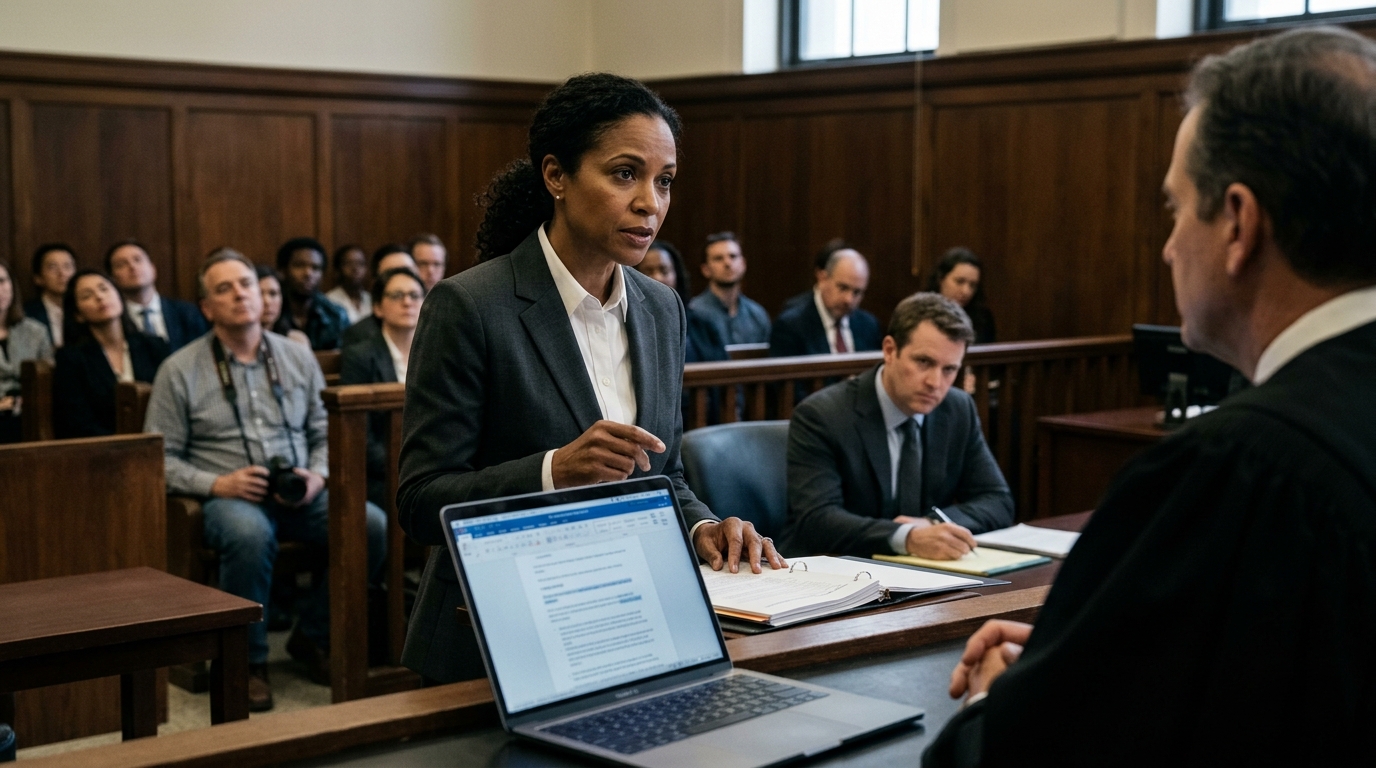
The legal profession, a field traditionally anchored in precision, precedent, and human judgment, is facing an existential challenge. A recent appellate court ruling in the United States has clarified the landscape, mandating that lawyers have an absolute responsibility to disclose when the use of Artificial Intelligence (AI) leads to errors or false citations. This ruling is not merely a procedural detail; it is a fundamental reaffirmation of the "duty of candor" toward the court.
The Illusion of Authority
The issue began with the widespread adoption of Large Language Models (LLMs) like ChatGPT by law firms seeking ways to accelerate the drafting of legal briefs. However, AI suffers from the phenomenon of "hallucinations," where the system generates text that appears perfectly convincing and legally sound but includes non-existent court decisions and fictional statutory quotes. The case of New York attorney Steven Schwartz, who submitted a brief containing six fake cases invented by ChatGPT, served as "ground zero" for this new legal crisis.
The appeals court, in its latest intervention, emphasizes that the use of AI does not absolve the professional of the obligation to verify. The difference today is that concealing the source of an error can be construed as fraudulent conduct. According to the court's reasoning, when a lawyer realizes that an argument or citation was based on incorrect data produced by AI, they must inform the court immediately, rather than attempting to fix the error "silently" or attributing it to human oversight.
Ethics and Digital Transformation
This ruling creates a new framework for legal ethics worldwide. In Europe, where the AI Act already sets strict rules for high-risk systems, justice is treated as a sector where transparency is non-negotiable. Bar associations are now being called upon to integrate these guidelines into their codes of conduct. The question is not whether AI will be used—which is now considered inevitable for competitiveness—but how the integrity of the process will be ensured.
- Supervision: The lawyer remains the ultimate guarantor of truth (Human-in-the-loop).
- Transparency: The use of algorithmic tools in drafting documents must be disclosed when it affects the substance of the case.
- Liability: Sanctions for "algorithmic negligence" can range from fines to disbarment.
Impact on the Lawyer-Client Relationship
Beyond the courtroom, the ruling affects the relationship of trust with the client. If a lawyer charges for research hours that were actually performed in seconds by an AI, and that tool produces errors that damage the case, legal malpractice liability multiplies. The court made it clear that "technological ignorance" is no longer a viable defense. Legal professionals must be technologically competent, a requirement added to the traditional skills of the trade.
"Artificial Intelligence is a tool, not a colleague. The responsibility for the truth cannot be delegated to a programming code," the ruling states pointedly.
In conclusion, justice in the age of AI requires more, not less, human intervention. The need to disclose machine-induced errors is the first step in protecting legal culture from a flood of automated misinformation. The lawyers who will thrive in this new environment will be those who manage to combine the speed of algorithms with the rigorous scrutiny of classical legal thought.