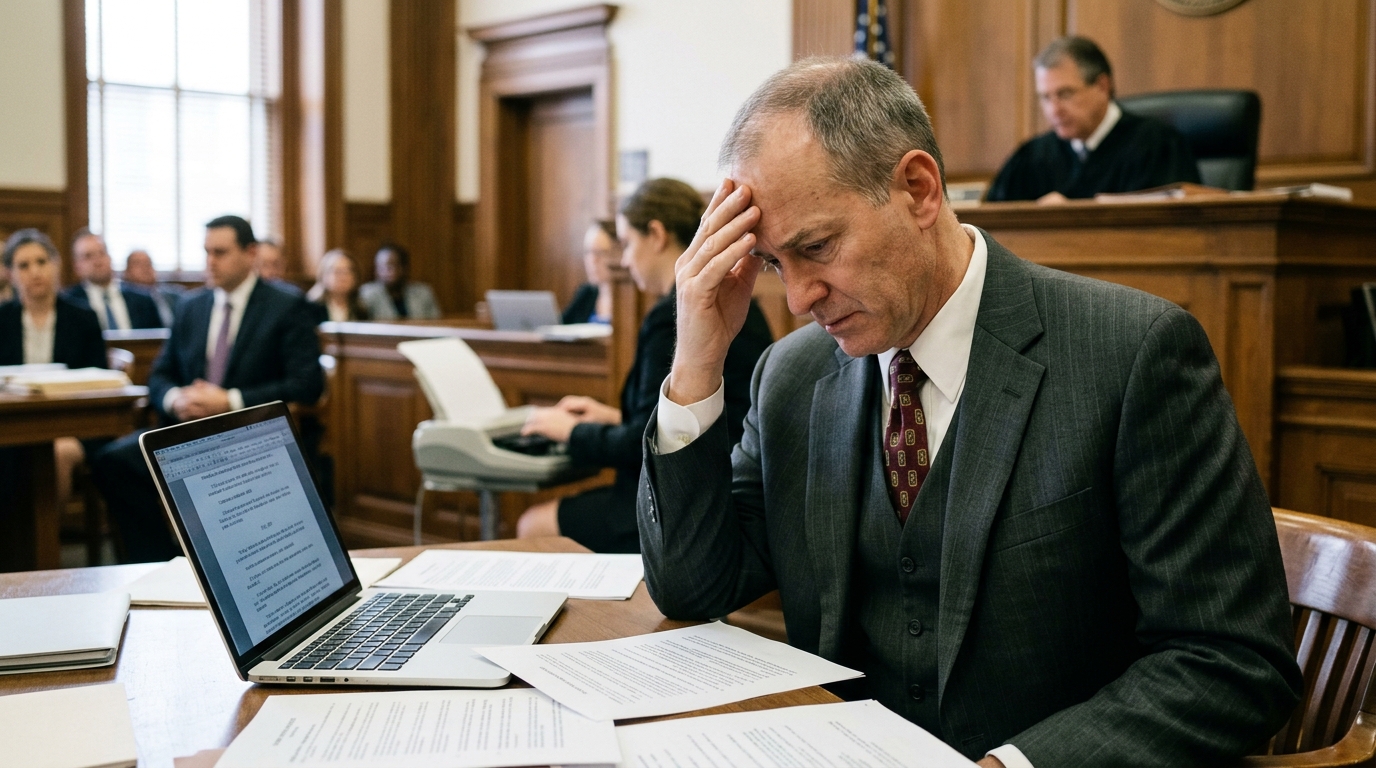
The courtroom has always been a space where the precision of language and rigorous documentation form the very bedrock of justice. However, in the era of Generative Artificial Intelligence (AI), this foundation is being shaken by the intrusion of so-called "hallucinations." The recent news that a lawyer was forced to apologize for using "phantom" legal citations in a case involving layoffs related to Donald Trump’s campaign or businesses serves as a resounding wake-up call for the entire legal profession.
The incident, reported by Reuters, describes a situation that is becoming disturbingly common. A legal representative, in an attempt to expedite the drafting of legal documents, placed blind trust in an AI tool. The result was the inclusion of quotes and court decisions that never existed in reality. These "ghosts" of the code are not mere typos; they are fabricated illusions presented with absolute conviction, misleading even seasoned professionals.
The Anatomy of a 'Legal Hallucination'
To understand how an experienced lawyer could fall into such a trap, we must examine the nature of Large Language Models (LLMs). These systems are not databases of legal information; they are statistical engines designed to predict the next word in a sequence. When an LLM is asked to find legal support for an argument, it often "synthesizes" an answer that sounds legally sound, using terminology and structures that mimic real decisions without actually corresponding to existing records.
In the Trump-related case, the false references were flagged by the court, prompting an immediate reaction from the presiding judge. The lawyer's apology, while sincere, highlights a deeper issue: the erosion of critical thinking and the abdication of professional due diligence in the face of automated convenience. Justice cannot be based on probabilities; it must be grounded in proven facts and established law.
Ethical Implications and Professional Responsibility
The use of AI in the legal field raises serious ethical questions. Bar associations worldwide, including those in the U.S. and Europe, have begun issuing guidelines emphasizing that the responsibility for the accuracy of filings rests solely with the human attorney. "Technological ignorance" is no longer an acceptable defense.
- The Ethics of Verification: Every source generated by AI must be cross-referenced with official legal archives.
- Transparency: Some courts now require lawyers to disclose whether AI was used in the preparation of their briefs.
- Sanctions: Submitting false information, even if done unintentionally via AI, can lead to disciplinary action or even disbarment.
At stake is the very credibility of the legal system. If judges cannot trust the citations provided by counsel, the process of adjudication slows down and becomes vulnerable to manipulation.
The Paradox of Speed vs. Quality
We live in an era where the pressure to reduce costs and increase speed is immense. Law firms view AI as a tool that can perform hours of work in seconds. However, as the "phantom" citations case proves, time savings can lead to immeasurable costs in terms of reputation and legal fallout. Technology must function as a copilot, not an unsupervised autopilot.
"Artificial intelligence can write a poem or code an application, but the interpretation of the law requires an ethical compass that only a human possesses," industry analysts note.
In conclusion, the case of the lawyer in the Trump layoffs litigation is not an isolated accident but a symptom of a transitional period. Legal science must integrate technology with skepticism and strict control protocols, ensuring that the quest for efficiency never sacrifices the truth.