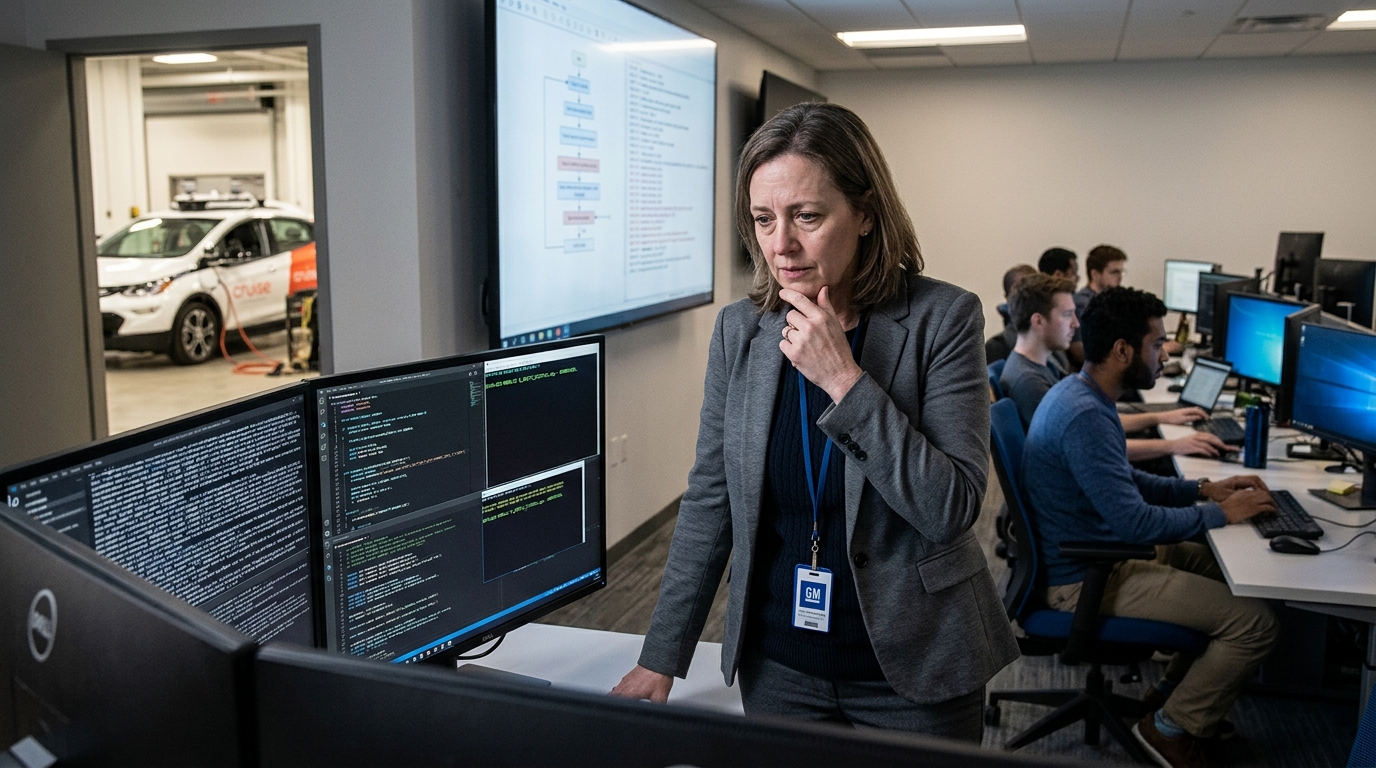
The automotive industry in Detroit is facing a historic turning point as General Motors (GM) revealed that 90% of the code governing its autonomous driving systems is no longer written by human hands, but by advanced Artificial Intelligence models. This news, surfacing through international reports, has sent shockwaves through car owners and road safety experts, posing a fundamental question: Can we trust our lives to an algorithm that no human can fully comprehend?
The Shift from Determinism to Probabilities
For decades, automotive software relied on a deterministic "if-then-else" logic. Developers anticipated every possible scenario—a child darting into the street, a sudden downpour, an illegal U-turn—and wrote explicit instructions for how the vehicle should respond. This system was predictable and auditable. However, the sheer complexity of the real world proved too vast for this manual approach.
GM, following the lead of Tesla and Waymo, is now adopting an "End-to-End" neural network paradigm. In this model, the AI is trained on billions of hours of real-world driving data and "learns" to drive much like a human does—by recognizing patterns rather than following rigid rules. The result is code that is automatically generated and highly efficient, yet functions as a "black box." Even GM's top engineers now struggle to explain exactly why the system makes a specific split-second decision.
Consumer Anxiety and the Transparency Gap
GM car owners are not just concerned about technical performance; they are worried about moral and legal accountability. "If my car makes a mistake caused by code that no human wrote, who is responsible?" is a recurring question in user forums. The transition to 90% AI-generated code means that auditability—the ability to trace a failure back to a specific line of human-authored instruction—is drastically reduced.
- Lack of Explainability: When an AI generates code, it doesn't leave behind comments or documentation explaining its reasoning.
- Emergent Behaviors: There is always the risk of "edge cases"—rare events the AI hasn't encountered during training—where it might react in an irrational or dangerous manner.
- Cybersecurity Risks: AI-generated code might contain vulnerabilities that traditional security audits are not equipped to detect.
"It’s no longer about programming; it’s about teaching. And like any student, an AI can learn the wrong lessons from the data it's fed," notes an industry analyst.
Economic Stakes and Competitive Pressure
For GM, this move is as much about economics as it is about technology. Maintaining millions of lines of code with thousands of engineers is expensive and slow. AI can generate software updates almost instantaneously, allowing the legacy automaker to compete with the agility of Silicon Valley startups. However, the reputational risk is immense. A series of accidents attributed to "algorithmic failure" could lead to massive recalls and irreparable damage to consumer trust.
The Regulatory Challenge
Regulators in the US and the EU are closely monitoring these developments. Until now, safety standards were based on code inspection. In this new reality, authorities must develop tools to audit not the code itself, but the performance and behavior of AI models in massive simulations. GM maintains that its system is safer than a human driver, but proving this claim requires a level of transparency that current AI technology struggles to provide.
In conclusion, GM’s move signals the end of the era of "handcrafted" software in automobiles. As we enter the age of AI-driven mobility, society must decide if it is ready to trade full technological transparency for the promise of a superior, yet mysterious, artificial intelligence.